Live data from Hacker News

The Lost Art of Lacing Cable (2018)

thebroadcastbridge.com

111–120 of 156 posts

Re: The Lost Art of Lacing Cable (2018)

#111
post #64

Speaking as an automotive engine mechanic, sometimes we use lacing in long-haul tractor trailers. Wiring for sensor modules along the air-slide fifth wheel, near the attic, or especially around the air brake dryer are always laced. The reason for this is zip ties will quickly fail after freeze-thaw cycles. professional drivers in wisconsin or Minnesota cannot get stuck due to an electrical failure on the side of a re…

>Then theres manufacturer recommendations. Zip tie plastic can contain additives that bugs or rodents find quite delicious

Lol, what a load of BS on the part of the OEM. The soy plastics are more expensive. Your $1.99 pack of Harbor Freight nylon zip ties won't use it. OEMs (at least for smaller vehicles) have been phasing in soy based wiring insulation since the late 1990s (done at the recommendation of the EPA IIRC). This is why rodents now are more likely to chew on wires (whereas in the past they'd just make nests in dumb places). I guess they'd rather stretch the truth than say "because reasons".

Edit: looks like someone else posted a link to a story about soy wiring.
Re: The Lost Art of Lacing Cable (2018)

#112
post #56

Earlier quoted context omitted.

Why is it a negative consequence that the replacement requires no skill? Turning on a light switch requires far less skill than trimming wicks for oil lamps, but I'd consider that a feature not a bug.

It's a bit double. On one side: yes it's obviously better, faster, if anyone can do it. On the other hand learning a skill is valueable as well.

A person can learn another (likely more valuable) skill in the time that they would have had to take to learn to lace cables.

Re: The Lost Art of Lacing Cable (2018)

#113

Earlier quoted context omitted.

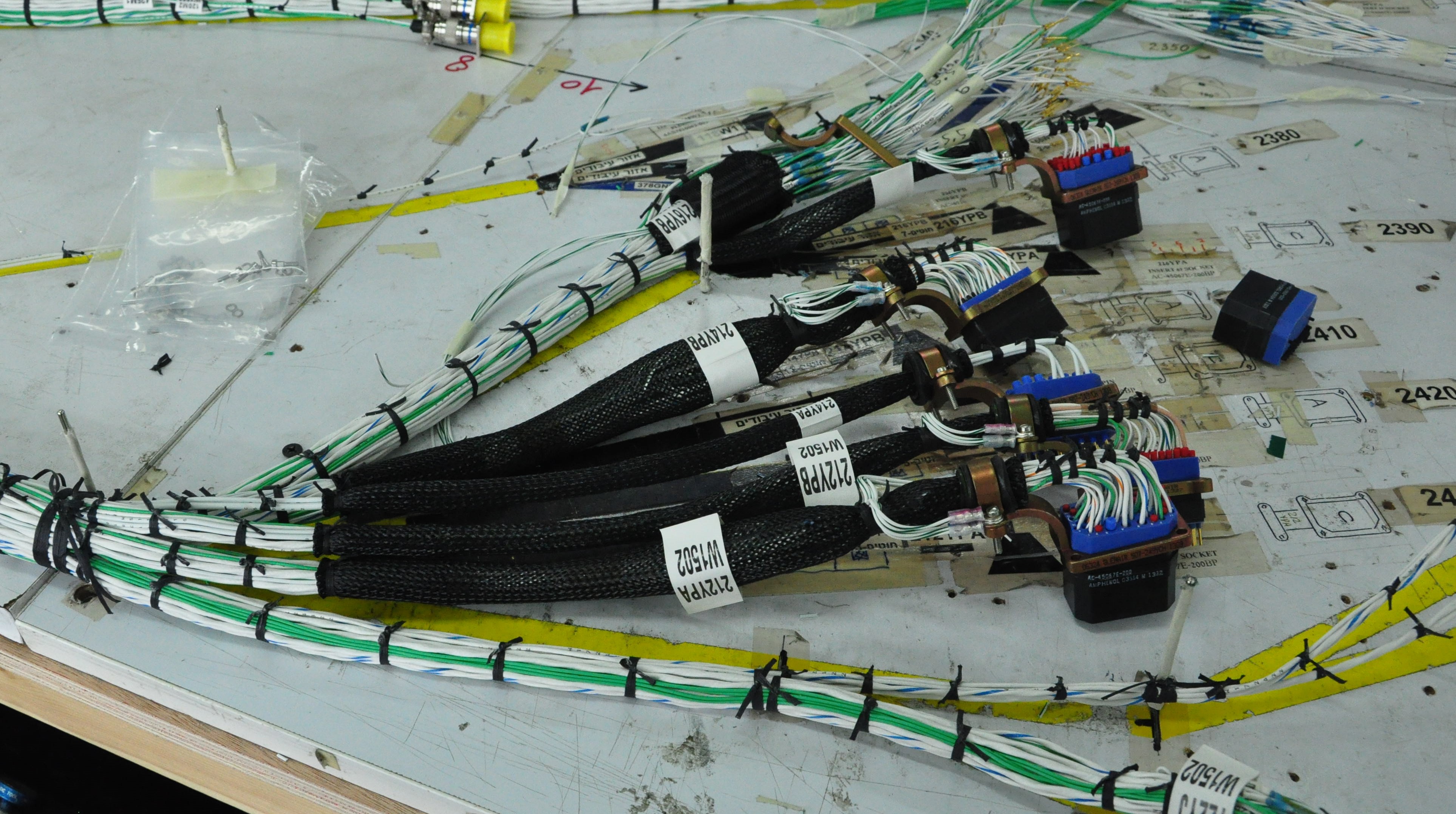
We still use lacing cord for most of our aircraft harnesses. Nobody but the engineers and technicians ever get to see it, which is a shame because it really does look beautiful.

pictures, please!

Here is an example: https://starkaerospace.com/wp-content/uploads/2016/11/Wire-H...

The black ties is the lacing cord. Sometimes its just small pieces that bundle the wire every few inches, sometimes its a long continuous piece that is looped at those intervals. The black nylon overbraid is for any wiring harness that is exposed or handled routinely. They typically don't use it on anything that gets tucked away. Also notice the heavy harness supports on those connectors. This is thick gauge cable and a lot of it. Large aerospace companies have shops and techs dedicated to making these all day long.

Re: The Lost Art of Lacing Cable (2018)

#115
post #29

A significant part of my life is cable management. Velcro brand cable ties are the way to go. Zip ties are banned from my networks. They don’t cut into the cables, you can add cables later, they’re very strong. You can chain them together as your bundle size increases. I keep a spare roll in my briefcase.

I really like the rolls of hook and loop where you cut the tie to length. You can make massive bundles or just small ones and never waste it. Bonus is that they are reusable. I've used reusable zip-ties before, they are a massive pain to remove when breaking down equipment.

Re: The Lost Art of Lacing Cable (2018)

#116
post #92

Wow never thought I'd see this on HN! I paid $20k to go to tech school for aviation maintenance. After doing that for 3 years I figured it just wasn't for me and I decided to go to university for computer science. But before my last day of being an aircraft mechanic, I "accidentally" brought home a roll of high temp (non-waxed) lacing tape because I was already in the habit of using string to tie cables together (com…

Neat! I don't tend to lace cables regularly, but it is my preferred method of wire management for old motorcycles. I use leather lacing, and it's mainly an aesthetic thing, since zip ties look so out of place, and the leather looks great w/ cloth wiring. My only gripe is how long it takes, especially if changes need to be made in a run. Are you aware of any good techniques or instructional materials to help with laci…

Sure. I don't do the method were you use one continuous piece of string all the way down the bundle as you can see (which wastes string imo).

I think the instructions for doing the individual bindings was something like a "double half hitch with a lock knot" with a really long picture series of how to do that. I memorized it and could do it, but it was slow. An electrician spotted me once tying cables (slowly, and somewhat of a no-no for regular mechanics; but I didn't care) and showed me the "quick" way which is also apparently the same knot: https://imgur.com/a/TZFeBvb

Basically make a loop and feed it under the bundle. Then pull one free leg of the string through that loop partway (to make another loop in the loop). Then feed the other leg through that loop. That's the "half hitch" part of the knot which allows you to cinch down on the bundle without it loosening back. Then for the "lock knot" part, its a regular square knot which is two overhand knots that are tied right over left and then another one opposite (left over right). Once tightened it should form a small square (can't really see on my version). I only showed one overhand knot in my pictures (forgot the other one).

edit: I think the knot in question is a "clove hitch": https://imgur.com/a/9rgk9n2

Re: The Lost Art of Lacing Cable (2018)

#117
post #38

Earlier quoted context omitted.

For telephone exchanges "Plastic flow" was the reason we were given - if you lace plastic cables and the lace is too tight then the plastic will flow and may expose the wires / cause internal shorts etc. Also lacing can increase cross talk (because the wires run beside each other for long distances). Cable lacing was used in old "step by step" telephone exchanges which used cotton wrapped wires. When the new fangled…

Thanks for the insight! I wonder if ability to resist creep[0] has ever been much of a goal when formulating wire insulation. Or is this "plastic flow" a different phenomenon than creep? For installations that are intended to be long-term (inside walls, buried under ground or concrete, etc.), it seems like the failure mode you describe would be really annoying to fix. [0] https://en.wikipedia.org/wiki/Creep_(deformat…

Most cables had "spare pairs" in case problems occurred. In a hundred pair cable, there'd be 10 unused for example, and if a short / open developed somewhere then you'd use a spare pair. I remember there was a procedure for replacing a cable in a form (the tied set of cables), but not something I ever did, they were in the process of phasing out lacing when I started and I only did it for a few years, there were these new things called "microprocessors" which seemed interesting.

Re: The Lost Art of Lacing Cable (2018)

#118

Earlier quoted context omitted.

For telephone exchanges "Plastic flow" was the reason we were given - if you lace plastic cables and the lace is too tight then the plastic will flow and may expose the wires / cause internal shorts etc. Also lacing can increase cross talk (because the wires run beside each other for long distances). Cable lacing was used in old "step by step" telephone exchanges which used cotton wrapped wires. When the new fangled…

> ... (the steel shelves running above the equipment, which were also good for the occasional nap). You've just given me a fun idea for the office. :)

It was not unknown after a long lunch to find a tech having a little nap. I can't imagine that happening these days, there'd be forms to fill out, meetings with HR....
Post reply on HN