Live data from Hacker News

LightSail 2 Spacecraft Successfully Demonstrates Flight by Light

planetary.org

101–110 of 150 posts

Re: LightSail 2 Spacecraft Successfully Demonstrates Flight by Light

#101

Can someone more familiar with orbital mechanics help me understand why it looks like the perigree is coming down in opposite to the apogee? I'm but a mere KSP player, but I've always thought the perigee comes down in a fairly linear fashion based on drag, which is mostly a function of altitude - I would assume they'd be using the sail to just "burn prograde" whenever the solar angle is possible, raising both the apo…

(another ksp'er here...) I think the problem is atmospheric drag, which increases when the sail is open. If you're looking to increase apogee, the most efficient place to do so is at the perigee, which also happens to be where the atmospheric drag is the worst. So setting the mission, you get to choose the orientation of the sun relative to your orbital ellipse. If the sun direction to the sun is perpendicular to the…

I don't think it's atmospheric drag unless deployment took several days. On the graph the change in perigee doesn't start until several about 2-3 days after the sail was deployed.

[0] https://planetary.s3.amazonaws.com/assets/images/charts-diag...
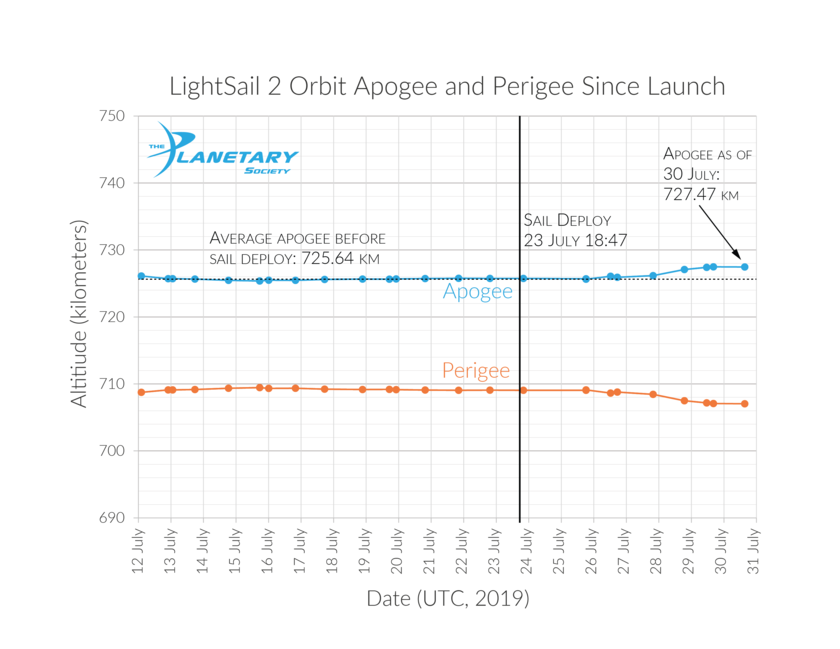
Re: LightSail 2 Spacecraft Successfully Demonstrates Flight by Light

#102
I'm glad they raised the orbit, it's just that it's not enough for me (in the northeast US) to be in the radio footprint of the satellite. It was launched into equatorial orbit with a fair amount of inclination, but elevation angles from my location never exceed 11 degrees making reception difficult.

I was hoping to receive the satellite's Morse code beacon and/or telemetry stream [1]. BTW: Does anyone know the downlink frequency for the photos?

[1] http://www.planetary.org/blogs/jason-davis/2016/20160609-lig...

Re: LightSail 2 Spacecraft Successfully Demonstrates Flight by Light

#103

I'm glad they raised the orbit, it's just that it's not enough for me (in the northeast US) to be in the radio footprint of the satellite. It was launched into equatorial orbit with a fair amount of inclination, but elevation angles from my location never exceed 11 degrees making reception difficult. I was hoping to receive the satellite's Morse code beacon and/or telemetry stream [1]. BTW: Does anyone know the downl…

Downlink frequency is 437.025 MHz. You'll be able to download telemetry, but you won't be able to decode photos because NOAA says no.

Re: LightSail 2 Spacecraft Successfully Demonstrates Flight by Light

#104

Earlier quoted context omitted.

(another ksp'er here...) I think the problem is atmospheric drag, which increases when the sail is open. If you're looking to increase apogee, the most efficient place to do so is at the perigee, which also happens to be where the atmospheric drag is the worst. So setting the mission, you get to choose the orientation of the sun relative to your orbital ellipse. If the sun direction to the sun is perpendicular to the…

Unlike Lightsail 1, Lightsail 2 operates at an altitude where the atmosphere is negligible.

It's not quite negligible at 700km. The effects of the atmosphere are also proportional to the craft's B* value (atmospheric drag coefficient), which is partially based on the surface area/mass ratio.

Id imagine that a sail's effectiveness probably increases as its area increases and mass decreases so it should have have a relatively high B* compared to similar objects. Looking at the published TLE's seems to back this up— Lightsail 2's B* is larger than any current cubesat's value (https://celestrak.com/NORAD/elements/cubesat.txt)

Re: LightSail 2 Spacecraft Successfully Demonstrates Flight by Light

#105
post #41

Earlier quoted context omitted.

Not a sailor (solar or otherwise) but my instinct is you could turn by "furling" parts of the sail (say, if there were vanes that could be turned perpendicularly to the flow of photons). But lots of designs seem to call for propulsion from a laser, so maybe that could just be angled away slightly. At astronomic distances that might be tough, though.

Supposedly, if you are orbiting the sun, you can turn a solar sail in such a way that you can brake against the solar wind, thereby moving in-system rather than out. But the sailing analogy breaks down for turning. A boat is pushing against the water and the wind. That gives it the ability to do things that you can’t in a vacuum, like move faster than the wind. For ‘turning’ you have only thrust vectoring, right?

There are several control methods available to solar sails that can work. They were studied quite extensively by NASA during the 60s.

The thrust generated by a solar sail is proportional to the angle between it and the sun, as is the direction of that thrust. If any part of your sail can twist, then you have steering vanes that are quite useful. You can twist the vanes to angles where the vane on one side of the craft is reflecting sunlight while the one on the other side is not in order to get a rotational acceleration.

If your sail is carrying a payload, then that payload will likely be in the center of the craft, with the sail spread out around it symmetrically. If you can shift the payload side to side relative to the sail, then that will shift the center of mass of the whole craft. With more of the sail to one side of the center of mass you will again get a rotation.

If you want more information, find a copy of the book Space Sailing by Jerome Wright; it's quite good.

Re: LightSail 2 Spacecraft Successfully Demonstrates Flight by Light

#106
post #84
post #68

Earlier quoted context omitted.

Why would it explode? More likely, the small rock would put a hole into the spaceship. This isn't a disaster. The spaceship residents would notice a gradually decreasing amount of pressure, assess where the leak is, and put a piece of duct tape over the hole. Remember kids, real life isn't like the movies.

The kinetic energies involved can be huge . In the same way that an object won't explode when hit by a subsonic 9mm round with ~0.5kJ of muzzle energy ('just' causing a leak and decreasing amount of blood pressure) it will when hit by a 0.50 calibre round with 14-20kJ of muzzle energy. For two objects in low earth orbit, travelling in opposite directions, the speed of impact can be over 14km/s - or 98000kJ per kg. At…

Whipple shields are cheap and effective. The impact does indeed impart a lot of kinetic energy, but on a thin sacrificial layer. This breaks the projectile into thousands or millions of tinier projectiles in an expanding cone of debris. As each of those smaller projectiles carries much less kinetic energy, and they impact your craft over a much larger area, the damage to the hull is minimized or even eliminated.

Since a solar sail is just a huge sheet of plastic coated in aluminum, any impact with the sail will tend to leave just a pinhole, or possibly a tear. You do need to design your sail with ripstops, but the total area lost to the pinholes will tend to be quite small.

Re: LightSail 2 Spacecraft Successfully Demonstrates Flight by Light

#107
post #30

Earlier quoted context omitted.

I'm saying the electric fan is pointed so that it is blowing air in the forward direction. A sail at the front of the car will catch said air and propel the car forward. I'm sure it would work in a vacuum too if you had a CO2 canister mounted to the car blowing forward into the sail.

No it will not. If you attach a fan to a derby car and point it backwards, the car will move forwards. If you redirect the fan so it's pointing forward, the car will move backwards. If you put a sail in the way, the car will move backwards less efficiently. If you make a perfect sail that blocks all the air from the fan, it will not move at all.

> If you make a perfect sail that blocks all the air from the fan, it will not move at all.

It should push the fan and the sail apart, which could result in a structural failure.

Re: LightSail 2 Spacecraft Successfully Demonstrates Flight by Light

#108
post #69

My understanding of what's going on here is that the light sail isn't aiming or changing at all. It's just a big sail, in orbit. When it's moving away from the sun, the sail is being pushed "forward", which adds to it's velocity- this increases the apogee on the opposite side of the orbit. When it's moving towards the sun, the sail is being pushed "backwards", lowering it's current velocity and reducing the perigee.…

I didn’t work on Lightsail, but the article implies that it does aim the sail. It isn’t expanding/contracting, but it does change orientation using the reaction wheels. Basically, they turn the sail broadside to catch the sunlight to raise the orbit, and turn it on edge when they don’t want the extra drag. This particular satellite won’t ever leave orbit because the sail can’t overcome even the tiny amount of atmosph…

Hypermiling in space is an awesome concept. Would be so cool to have the solar race competition evolve from cars to spacecraft.

Re: LightSail 2 Spacecraft Successfully Demonstrates Flight by Light

#109
post #69

My understanding of what's going on here is that the light sail isn't aiming or changing at all. It's just a big sail, in orbit. When it's moving away from the sun, the sail is being pushed "forward", which adds to it's velocity- this increases the apogee on the opposite side of the orbit. When it's moving towards the sun, the sail is being pushed "backwards", lowering it's current velocity and reducing the perigee.…

I didn’t work on Lightsail, but the article implies that it does aim the sail. It isn’t expanding/contracting, but it does change orientation using the reaction wheels. Basically, they turn the sail broadside to catch the sunlight to raise the orbit, and turn it on edge when they don’t want the extra drag. This particular satellite won’t ever leave orbit because the sail can’t overcome even the tiny amount of atmosph…

> a bigger sail and a higher orbit

But a bigger sail would increase the atmospheric drag!

Re: LightSail 2 Spacecraft Successfully Demonstrates Flight by Light

#110
post #20

Why deorbit it though? Why not try for an EM-Lagrange point?

They are in a low earth orbit and there is still considerable atmospheric drag in the region. This causes the satellite to deorbit. This was a technology demonstrator and it has completed its mission successfully. It simply wasn't launched to an orbit where it can do more (Cubesats hitch rides on rockets launching larger, expensive payloads) NASA does have a mission intended to navigate quite a bit more using a solar…

As long as the trust produced by the solar sail is more than atmospheric drag it technically has enough Δv to go anywhere.
Post reply on HN