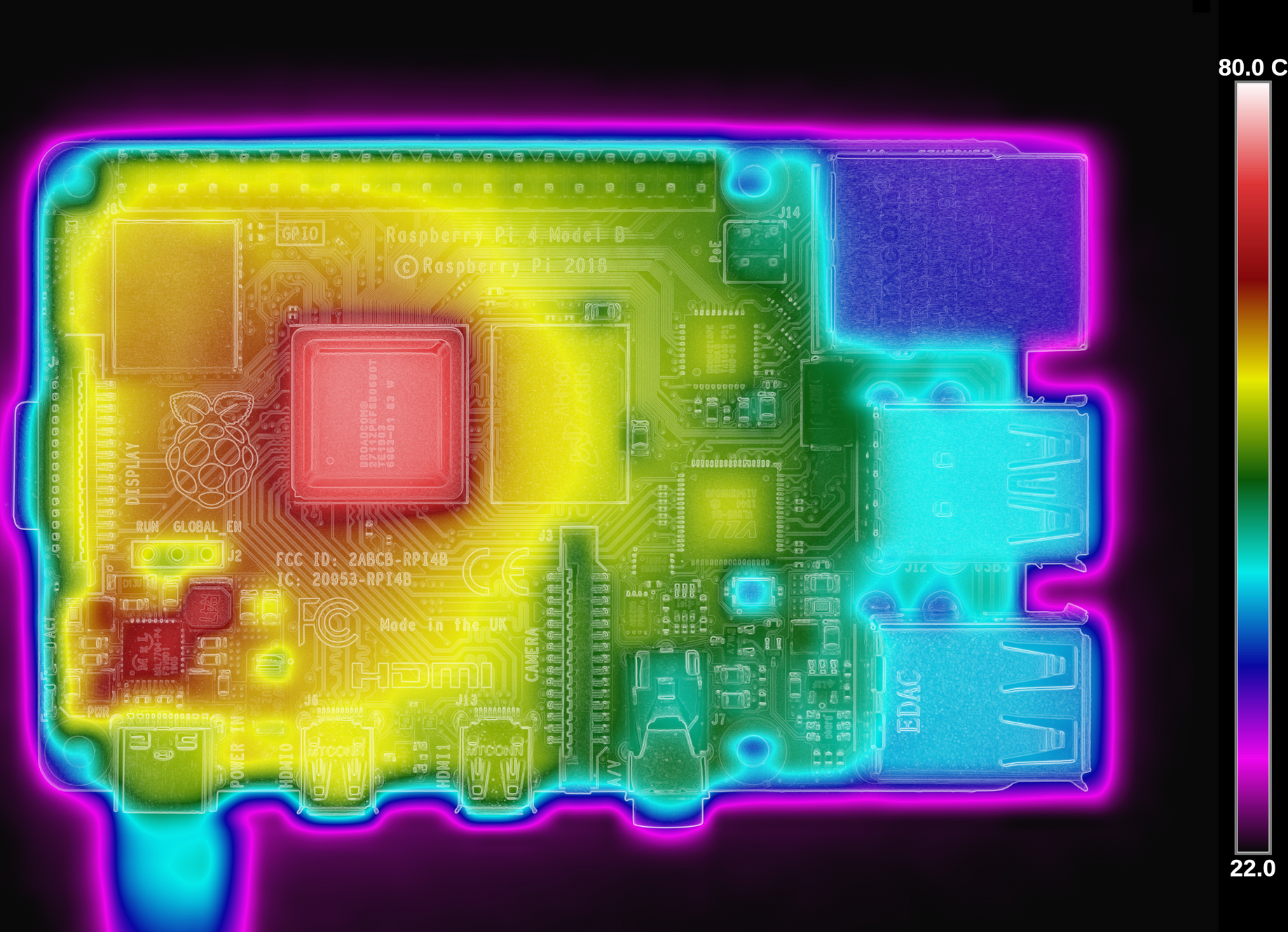
You needed to make that heatmap translucent and overlay it on top of the rpi with a diagram pointing to each chip and what it does. That would have been a super cool graphic.
The Raspberry Pi 4 needs a fan
111–120 of 293 posts
Re: The Raspberry Pi 4 needs a fan
#112Earlier quoted context omitted.
Indeed - there is enough aluminum/copper in the SoC's metal lid and PCB's inner (ground/power) layers, that the whole thing is effectively a 2-3 square-inch heat-sink. Eben himself has been talking about this technique around the time RPi3+ was released. And your point here is completely understandable too - there is a kinda-heatsink there already. Just add a fan, and we're good. My point is - seeing a large black ho…
How does it radiate enough heat with so little surface area (in comparison to an extruded aluminum heat sink with fins?)
There is more area than meets the eye - a large chunk of PCB itself is a "heatsink" thanks to sheer amount of metal in there.
Re: The Raspberry Pi 4 needs a fan
#113Reading all those IR images popping about the raspberry made me wonder why we're still using a "rainbow" (HSV) colormap.
I think there are better alternatives, that have both a linear luminance variation, and are colorblind-friendly:
Re: The Raspberry Pi 4 needs a fan
#114Raspberry Pi is becoming like a NUC. Meanwhile, there are people using Intel NUCs as fanless Hackintoshes:
Re: The Raspberry Pi 4 needs a fan
#115So does the pi 3 if you stick it in a case, even with a heatsink. I was using a pi 3 with a heatsink in the official case to play a h265 movie (which will be software decoded on a pi3). After about 10 minutes I noticed it started dropping frames and it displayed the thermometer symbol in the top-right of the display. When I removed the top lid from the case, the temperature dropped enough for the thermometer icon to…
Flirc makes excellent passive cooling cases for RPis. Basically the entire shell is a heat sink. Works for me, all my little media boxes run happily with them, despite running 24/7.
I just found out you can pre-order pi 4 cases: http://blog.flirc.tv/index.php/2019/06/24/new-pi-4-cases/
(I don't have any monetary interest in flirc, I'm just another happy pi3 flirc case owner)
Re: The Raspberry Pi 4 needs a fan
#116Quote: the metal casing helps spread that heat around It does, to a degree. But that is absolutely not what we are seeing in that IR picture. Shiny bare metal is a mirror at the wavelengths that thermal camera uses. So what you see on thermal image where wifi-module shield and CPU are is reflection of ambient (room) where this picture was taken. Try waving your hand around, you'll see it reflecting there too. To meas…
Yep, a lot of people nowadays is using IR cameras without any calibration or understanding of the physics behind the measurement. The truth is, the camera requires an emissivity coefficient to associate the received radiation with the emitter body temperature. There are tables for different types of materials, but the best is to calibrate against a surface thermocouple or similar.
A corollary of this is, when you see an IR picture of a product with very different surfaces like rubber, shiny metal, matte paint, plastic, glass, etc. you know that almost for sure the measurement is unreliable because at most they calibrated the camera for the emissivity coefficient of one of the surfaces. And they vary quite a lot...
Re: The Raspberry Pi 4 needs a fan
#117They sell cases with heatsinks and fans for $10-$20. I would just recommend buying one of those versus modding one like the guy in the article did.
Re: The Raspberry Pi 4 needs a fan
#118Earlier quoted context omitted.
By default it's always on. If you (optionally) install the daemon then it can use the Pi SoC's internal temperature sensor to control dynamically based on need.
@mindcrime - I can't reply to you due to max depth. The current version doesn't, we're having a new, custom, fan made with an RPM feedback line for a future model but it'll be a couple of months yet.
Nice.
Re: The Raspberry Pi 4 needs a fan
#119So, I just stumbled upon an amazing heatsink while replying to a comment below. I use a painkiller carbon tablet pipe [0] that fits (barely) in my poe hat fan hole.
It brings the idle temperatures down to 42 degrees C, and sysbench never goes above 61 degrees.
Image here: https://imgur.com/a/Cr38Abz
[0]: https://www.apotea.se/treo-brustablett-500-mg-50-mg-20-st
Re: The Raspberry Pi 4 needs a fan
#120Even the previous-gen Pis would easily throttle under load without a heat sink (although usually installing a decent heat sink was enough to resolve the problem, assuming decent airflow). As the article notes, the heat was mainly from the SoC in the past. The Pi 4 is on a whole different level indeed. I imagine the logic here is the same as with many other Pi accessories: if you need it, you'll buy it or get it as pa…
Yeah, I'm kinda wondering just what the Pi is supposed to be at this point. Is it still an inexpensive low power device for teaching basic computer science? Because it seems like it's more for making Kodi boxes or the worlds most powerful LED blinkers.
The Pi4 is overpowered for a Kodi box.
That said, there is a huge number of applications for overpowered LED blinkers, and no lack of people to use them. And there is a great deal of educational value on having those boards available and easy to get.
Besides, it's becoming hard to find people without access to a machine where they can learn basic computer science. So this one niche is closing down, while the Pi is still unbeatable on hardware hacking.