Live data from Hacker News

Project Vesta – Mitigating climate change with green sand beaches

projectvesta.org

81–90 of 341 posts

Re: Project Vesta – Mitigating climate change with green sand beaches

#81
Let's assume the Pilot is a smashing success, let's also say math works out in some country to do it for 0.2% of their GDP.

How do the logistics of policy adoption work for the first "pilot" country?

1. You would need environmental clearance and the government's own stud(ies) on it. How do you get a government to do this assessment?

2. If you have to get Costa rica(or any listed potentials on the page) to show interest do you go to the Environment Ministry and do a power point and ask "So?".

2.1. Do you get them to do this as part of implementing some climate pledge. And in this case what are you mostly competing with for the fixed size pot of $$?

Re: Project Vesta – Mitigating climate change with green sand beaches

#82

Earlier quoted context omitted.

I think I get the worry and skepticism about geo-engineering but to be completely frank we've been (inadvertently) geo-engineering the planet at least since the industrial revolution, so I don't really think we have much of a choice, especially since we need to go carbon negative, not just neutral. This olivine solution doesn't really look any less viable than CO2 scrubbers, if I'm being honest.

I would rather we strengthen our forests than add more pollution. I guess if forestry is considered geo-engineering then I support it. But I don't think "we're already adding pollution, so we might as well add more pollution to try to net out carbon" is a sound argument.

I'd agree with you if we could do what we need with just forests. But unfortunately we can't. Some other form of reducing carbon is a core part of any long term plan.

It's just bad enough now that forestry is no longer a valid option on its own.

Re: Project Vesta – Mitigating climate change with green sand beaches

#83
The wording of "less than half the volume of construction materials" mined each year seems hand wavy as a justification that this is possible. If I'm reading the chart right that would suggest we'd need a roughly 25% increase in the amount of global mineral extraction.

Re: Project Vesta – Mitigating climate change with green sand beaches

#85
post #81

Let's assume the Pilot is a smashing success, let's also say math works out in some country to do it for 0.2% of their GDP. How do the logistics of policy adoption work for the first "pilot" country? 1. You would need environmental clearance and the government's own stud(ies) on it. How do you get a government to do this assessment? 2. If you have to get Costa rica(or any listed potentials on the page) to show intere…

At least in Costa Rica beaches are already used for private resort beaches (illegal in law, but meh), extracting salt and dumping construction debris or stealing sand. With those antecedents I don't think the government would oppose to do something actually useful.

Re: Project Vesta – Mitigating climate change with green sand beaches

#86
post #76

Earlier quoted context omitted.

4,000 ppm was a period far before humans or advanced primates, and very different flora. 200ppm is around the level humanity, and much of the flora we share the planet with, evolved. It's the level we started to develop from, to farm. Nature and the planet has no ideal, it copes with whatever there is. Humanity on the other hand would appear best served by the level we evolved with - 200ppm or thereabouts. 400ppm cau…

Greenhouse owners generally spike their air to 1200-1500ppm CO2. That's the compromise between best cost and best for the plants and is lower than these species evolved in. As to humans, 400ppm causes zero problems, matter of fact, OSHA says 1000ppm for continuous exposure. NIOSH says 10,000 ppm for a 10 hour work shift. For instance: https://inspectapedia.com/hazmat/Carbon%20_Dioxide_Exposure_...

The GP obviously doesn't mean that 1000+ ppm CO2 is toxic, they mean that the changes to the environment it would cause are less than ideal for humans to thrive.

Re: Project Vesta – Mitigating climate change with green sand beaches

#87
post #7

Earlier quoted context omitted.

It seems like you didn't read the paper, or really anything on this. But, to make it easy for you: * 1 ton of Olivine will absorb 1.25 tons of CO2[1] * Transportation cost is 161.8 grams of CO2 per ton mile[2] * They are looking at mines within a 300km[1] (or ~190 miles) radius. That's a maximum transportation cost of ~31kg CO2. That's a rounding error. * Mining cost for a ton of Olivine is ~$30/ton right now. Let's…

You're right, I didn't read enough or do enough back-of-the-napkin math. I read more; this seems plausible in life cycle terms, but now I have doubts about the economics. At $30/ton, 30Gtons becomes $900 billion a year. For comparison US discretionary spending is $1.4 trillion. It's not clear to me where this level of spending is going to come from (jewelry sales?), for an activity that has no useful economic output…

Olivine is mined at $25/ton right now, which presumably takes capital requirements into account, so that's less of a concern from my POV.

The need for $900 billion to make this work (or even $300bln if the olivine price really drops as they predict) is the hard part. But then, the alternative is pretty much climate collapse, so it's still a bargain. Question is if people will realize that soon enough. But yeah, definitely not paid through jewelry. I'd imagine an actual emissions tax with teeth might help.

As for ecosystem impact, let's for now just look at a per-country amount. CR is 5M people, ~1.6tons of CO2/yr, so 8 megatons. With 800 miles of coastline, that's a lot of rocks - if they were only deposited on the beach. But it can be dumped in the water as well, if the currents are right. See e.g. https://projectvesta.org/science/#dflip-df_90/26/ (Not CR, but Europe, and basically says "pour it in the Channel")

I don't have the weathering rate, and the claim in their booklet (p. 32) actually doesn't make sense to me, so that's the big question for me as well. AIUI, this is the big unknown - they claim the old numbers don't apply, but they need to run a large-scale test to actually tell what the numbers would be.

I'm not, to be clear, saying "don't be skeptical". I'm merely saying as far as CO2 absorption ideas at scale go, this is one of the saner ones. It's not immediately unfeasible, and we should probably test it.

(As you can tell, I'm a fan of arguing on the Internet ;)
Re: Project Vesta – Mitigating climate change with green sand beaches

#88
post #76

Earlier quoted context omitted.

4,000 ppm was a period far before humans or advanced primates, and very different flora. 200ppm is around the level humanity, and much of the flora we share the planet with, evolved. It's the level we started to develop from, to farm. Nature and the planet has no ideal, it copes with whatever there is. Humanity on the other hand would appear best served by the level we evolved with - 200ppm or thereabouts. 400ppm cau…

Greenhouse owners generally spike their air to 1200-1500ppm CO2. That's the compromise between best cost and best for the plants and is lower than these species evolved in. As to humans, 400ppm causes zero problems, matter of fact, OSHA says 1000ppm for continuous exposure. NIOSH says 10,000 ppm for a 10 hour work shift. For instance: https://inspectapedia.com/hazmat/Carbon%20_Dioxide_Exposure_...

>As to humans, 400ppm causes zero problems

You mean it causes zero known problems.

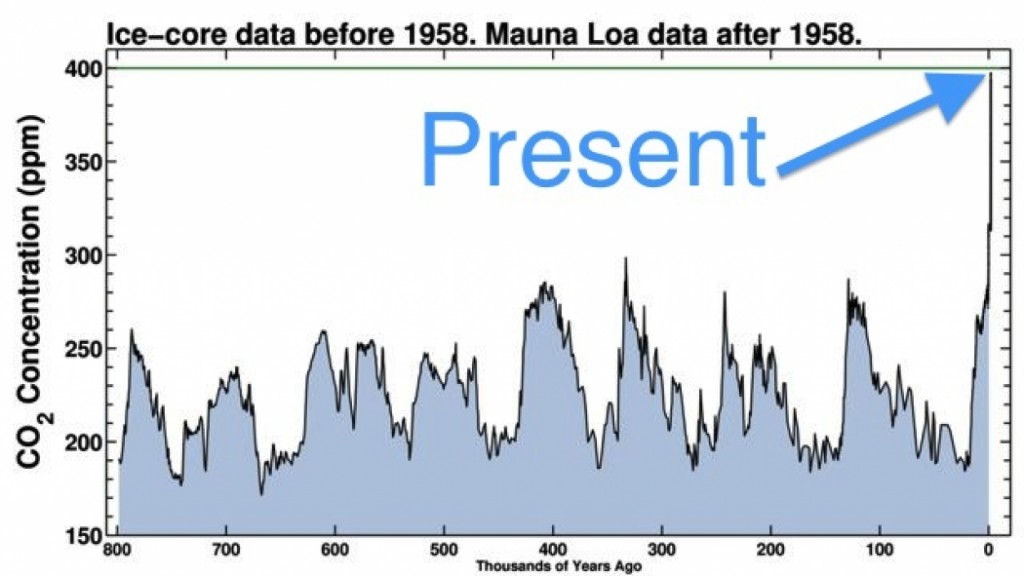
Medicine and biology are not yet advanced enough to say in most case whether putting the human body in a condition humans haven't experienced in 800,000 years is harmful. It took decades to learn that asbestos is harmful. If the harm caused by asbestos were cognitive decline rather than shortened lifespan, it probably would've taken longer, and cognitive decline is the effect that appears at the lowest concentration of all of the known adverse effects of co2. (One study found cognitive decline after 2.5 hours of exposure to 1000 ppm.)

Plants use co2 to make their bodies just as we use proteins, fats and carbohydrates to make our bodies, so I am not particularly reassured by knowing the plants thrive at very high co2 levels.

Graph of co2 levels over the last 800,000 years: http://kaltesonne.de/wp-content/uploads/2017/03/co2-1024x576...

Re: Project Vesta – Mitigating climate change with green sand beaches

#90

Earlier quoted context omitted.

Several California cities are already spending millions annually to dump sand and rocks and to build/expand seawalls, to try to stave off the ocean taking prime beachfront real estate (and it's not working, in the long run). Those cities (though not in the ideal location for this project, I guess) would likely be ecstatic to have subsidized assistance (though who subsidizes it?). They're losing the beaches no matter…

My main point was about developing countries. Eric himself noted that "the idea is to utilize mines within 300 km (186 mi) of the destination beach" and "or many of the first beaches, we will be looking to use tailings piles (waste rock) from previously dug and developed mines, as well as the infrastructure from those mines, such as rail for transport". The idea is summarized in this image [1], which shows mines and…

Shouldn't the thing pay for itself in climate impact costs avoided?
Post reply on HN