Live data from Hacker News

The Zero-Sum Bias: When people think that everything is a competition

effectiviology.com

121–130 of 152 posts

Re: The Zero-Sum Bias: When people think that everything is a competition

#121
This article just kicked me off into a one hour tangent thinking about voting reform activism and my frustration with staunch ordinal voting advocates.

I've found that a lot of ordinal voting system advocates seem to feel that in order for a voting system to work well, it must impose a total order on peoples' preferences. Although they might say that people's preferences are naturally totally ordered, and that it wouldn't be an imposition at all. For me, ordinal systems are destroying information about equal openness to multiple choices. They are filtering the nuances of my preferences through a strict and destructive hierarchy. All just to distill these hypothetical "favorites" that I don't actually have, but which ordinal voting system advocates seem to feel are real anyway.

But I just don't believe that. It's like a whole different worldview. I believe that this sort of bias is at play in that broken, age old gap between ordinal and cardinal voting system advocates.

I wish some funny people would get together and do skits exposing the quirks of different voting systems by playing them out in an everyday, relatable situations e.g. a group of people choosing what restaurant to go to.

I can just imagine a Rob Richie character enforcing that everyone must have a strictly ranked preference between pizza and Thai food. No you are not allowed to be open to both. You must declare which is your ultimate favorite of the two. Even if it means alienating our lactose intolerant friend. They'll be fine since there's salad at the pizza place.
Re: The Zero-Sum Bias: When people think that everything is a competition

#122
post #102

Earlier quoted context omitted.

Funny corollaries because Monopoly is a zero-sum game (at the end there will be a ordering of players by relative wealth, and their absolute wealth ceases to matter): players should be trying to 1) trade as much as possible, even if some trades are slightly slanted against them, 2) spread their trades evenly amongst the other players, and 3) to actively discourage trades between other players. You might as well give…

Yes, Monopoly more or less is (there are ways to gain and lose money without taking the other players' money, but they almost do not depend on players' choices). I think the parent's point is that trade in monopoly, however, is not. By making an exchange that allows both traders to complete a color set, they end up both much richer than before the trade.

I understand the parent's point because I am the parent.

Re: The Zero-Sum Bias: When people think that everything is a competition

#123
post #110

I see this most clearly in people who will not trade in a board game like Monopoly unless the deal is extremely slanted in their favor. They simply can't understand that people who trade will always beat people who don't, and the easiest way to trade is to trade fairly. If four people are playing a game of Monopoly, and two trade with each other but the other two refuse, now two people are playing Monopoly and the ot…

Monopoly is a zero sum game. So perceiving it as such shouldn't be the bias that leads to poor strategy. (edit: it seems that it may be possible to play monopoly in a way that generates infinite money and with no win condition)

Trading in Monopoly is not zero-sum, the outcome is.

Re: The Zero-Sum Bias: When people think that everything is a competition

#124

I see this most clearly in people who will not trade in a board game like Monopoly unless the deal is extremely slanted in their favor. They simply can't understand that people who trade will always beat people who don't, and the easiest way to trade is to trade fairly. If four people are playing a game of Monopoly, and two trade with each other but the other two refuse, now two people are playing Monopoly and the ot…

There's such an advantage to having a full color set, it's hard to imagine folks that don't want to trade to get one.

I've come to discover that a lot of people just wait to randomly get one, one person eventually does, and the others just wait to land on that person's property and lose. After 6 hours of play and maybe one elimination they call the game off and vow never to play again.

Re: The Zero-Sum Bias: When people think that everything is a competition

#125

I see this most clearly in people who will not trade in a board game like Monopoly unless the deal is extremely slanted in their favor. They simply can't understand that people who trade will always beat people who don't, and the easiest way to trade is to trade fairly. If four people are playing a game of Monopoly, and two trade with each other but the other two refuse, now two people are playing Monopoly and the ot…

This is my life-long frustration on monopoly and Catan. There isn't a better case for free trade than playing those games in my opinion, but people really are reluctant to understand that trades make their possition better at the expense of everyone else. Allow me to boast about my single most fantastic monopoly play where nobody wanted to trade at all, so I initiated a series of trades where I gave each opponent a m…

Sounds masterful. I've always explained Monopoly as a trading game unlike any other out there in that you spend the entire first 3/4 of the game building up to one big trade. It may be a complex multi-part trade, involving other trades in preparation, but it's all you were working towards. After that trade, you're just a passenger seeing how your valuations played out.

Sometimes, like what you did here, you can just structure everything so well that every trade is a better deal for the other player than it is for you, but the sum total of the trades makes you unstoppable. As I mentioned before, this is almost inevitable when you spread your trades between all of the players, and they don't trade with each other. So if you specifically target their needs (like you did), they might not even be able to come up with productive trades with each other...

Re: The Zero-Sum Bias: When people think that everything is a competition

#126

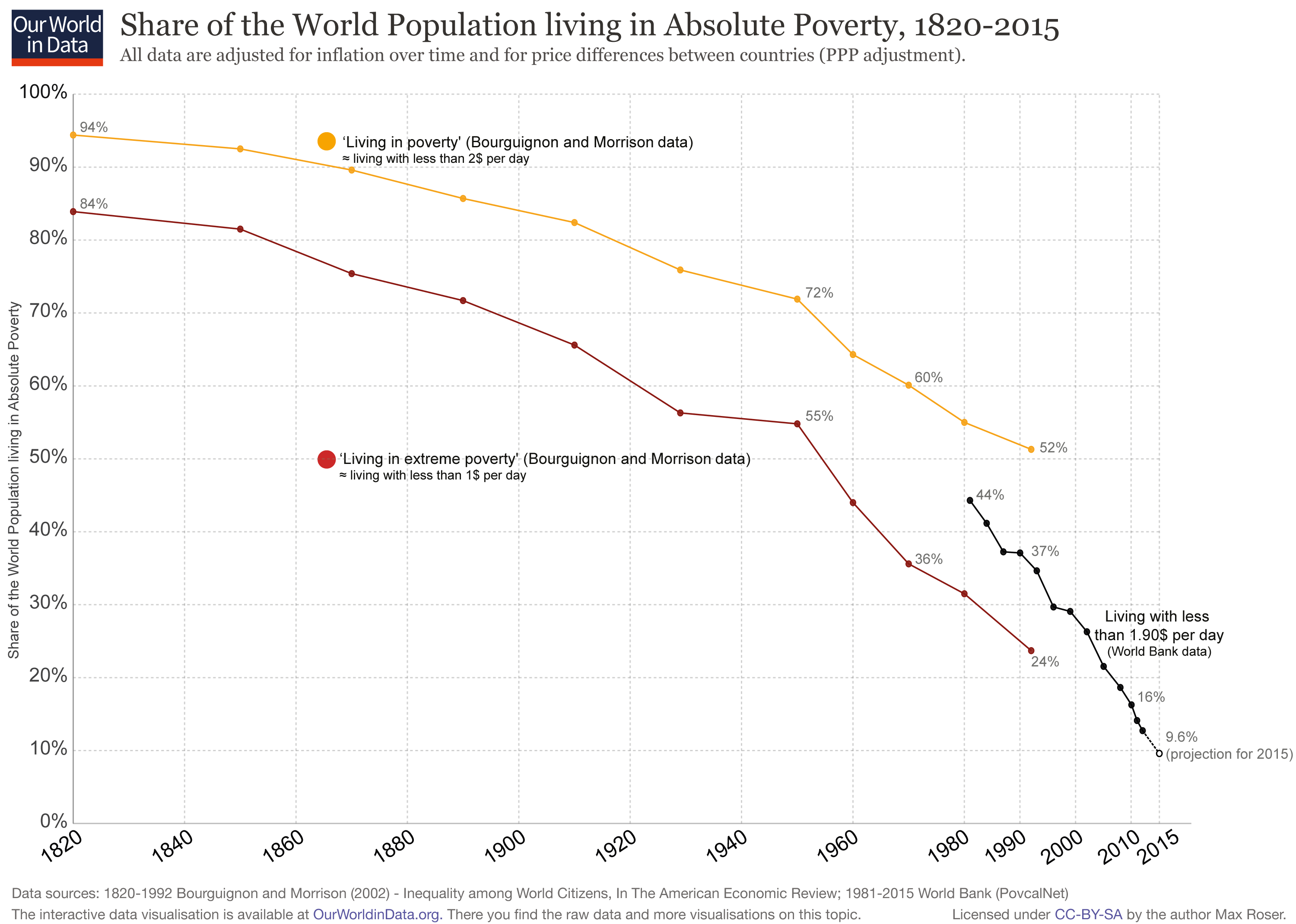
One of my favorites is the economy. People constantly talk about there only being a finite number of resources or money. While this is true, there is not a finite amount of wealth. The whole point of an economy is to generate new wealth and goods. Inventions and innovations. It is easy to see when you take the historical perspective, that the vast majority of us are living much better off than those a hundred years a…

> vast majority of us Like 1% or 10%?

No I mean this [0]. Percent of people that live in extreme poverty is plummeting. Or select most other metrics and you will find similar trends (as in >20 year time spans)

[0] https://ourworldindata.org/uploads/2013/05/World-Poverty-Sin...

Re: The Zero-Sum Bias: When people think that everything is a competition

#127
Every single example of zero sum thinking the author used was of whites and men trying to protect their own interests though zero-sum thinking which I found interesting. The author also seems to ignore that altruistic policies which could garner majority groups indirect benefits are themselves based on zero-sum thinking.

When I hear people justify affirmative action policies and racial and gender quotas some of the most frequent stats I heard bring up is relative income levels, relative employment levels, relative everything. Essentially the argument is based around the idea that "majorities' succeeding must have come at the expense of other groups. Even in say... a field like computing in America which is an economic juggernaut that popped up from nowhere which funnels money into the country... the very fact that more White/Asian/Indian men have gotten more jobs than other groups is framed as a crime against those other groups when this is not obvious. Specific needless discrimination and bias is brought up to bring home an argument that majority groups have been playing a nepotistic zero-sum game to their benefit and others and the greater good of societies detriment by keeping talented people with diverse perspectives down. Which isn't an obviously wrong argument yet the solutions on how to fight against this issue like affirmative action are fundamentally couched in zero-sum thinking. People who oppose it do not have zero-sum bias although they are arguably bias towards selfishness. Those are not the same thing.

I don't believe the author made his argument very well. He's confusing zero-sum bias with other types of bias. Singling out white men in all his examples also makes him come off as acting as if it's one group which has the problem which is unlikely to persuade anybody that it's personally wrong for them to engage in zero-sum bias.

P.S. Is zero-sum thinking truly irrational with the future repercussions of population growth and global warming? Time will tell.

Re: The Zero-Sum Bias: When people think that everything is a competition

#128
post #110

Earlier quoted context omitted.

Monopoly is a zero sum game. So perceiving it as such shouldn't be the bias that leads to poor strategy. (edit: it seems that it may be possible to play monopoly in a way that generates infinite money and with no win condition)

It technically isn't, because if everyone forgives each other's expenses they can be infinitely rich as the bank never run out of money.

Money in monopoly doesn't matter except as a means to increase your probability of winning. The probability of winning is zero sum.

Re: The Zero-Sum Bias: When people think that everything is a competition

#129

Men making games for men doesn't prevent women from making games for women, but somehow people always assume that the incumbents must adapt to serve the entire market. Why don't people see this as a great opportunity for women to carve out their own place in the industry? Literature already works like this, we have erotic romance novels with explicit descriptions of men's bodies catering to women and we have action n…

Gamers go apeshit over games for other men that they don't like. Or doritos. Gaming is absolutely worst example for this, because the community tend to be volatile over stupidest nonsense.

Re: The Zero-Sum Bias: When people think that everything is a competition

#130
post #129

Men making games for men doesn't prevent women from making games for women, but somehow people always assume that the incumbents must adapt to serve the entire market. Why don't people see this as a great opportunity for women to carve out their own place in the industry? Literature already works like this, we have erotic romance novels with explicit descriptions of men's bodies catering to women and we have action n…

Gamers go apeshit over games for other men that they don't like. Or doritos. Gaming is absolutely worst example for this, because the community tend to be volatile over stupidest nonsense.

The game industry is not zero sum, but a game series is.

If a company made a new IP based around nerf guns and cell shaded graphics then nobody would complain. However if the next call of duty changed all weapons to nerf guns and used cell shaded graphics people would go ape-shit on it because it killed their beloved series. If the switch to nerf guns came as a result from gun-ban activists then people would send death threats to said gun-ban activists for killing their beloved series. This behavior is stupid and insane, yes, but it isn't as random or unreasonable as many think it is.

Post reply on HN