12 nines? Yawn. Let me know when they get to 15. j/k
That's some serious precision. I wonder if this would have been possible to calculate on a Pentium?[0] After last week, cloud service providers would be happy for 3 nines.
61–70 of 219 posts
That's some serious precision. I wonder if this would have been possible to calculate on a Pentium?[0] After last week, cloud service providers would be happy for 3 nines.
> After months of working on solving the problem, Rafael González recalls, “I remember one morning I was making myself a slice of bread with Nutella, when suddenly, I said out loud: Mothers! It is there!” > He then ran to his computer and started programming the idea. When he executed the solution and saw that it worked, he says he jumped all over the place. It is unclear whether he finished eating the Nutella bread.…
This raises the perennial question of whether product placement is a legitimate source of funding for fundamental scientific research. After placing an ice-cube in my delicious glass of refreshing coca-cola brand carbonated beverage, I yelled Eureka! and jumped out of the bath. Is that really how it happened? Is it not inconsistent with the pursuit of truth?
Earlier quoted context omitted.
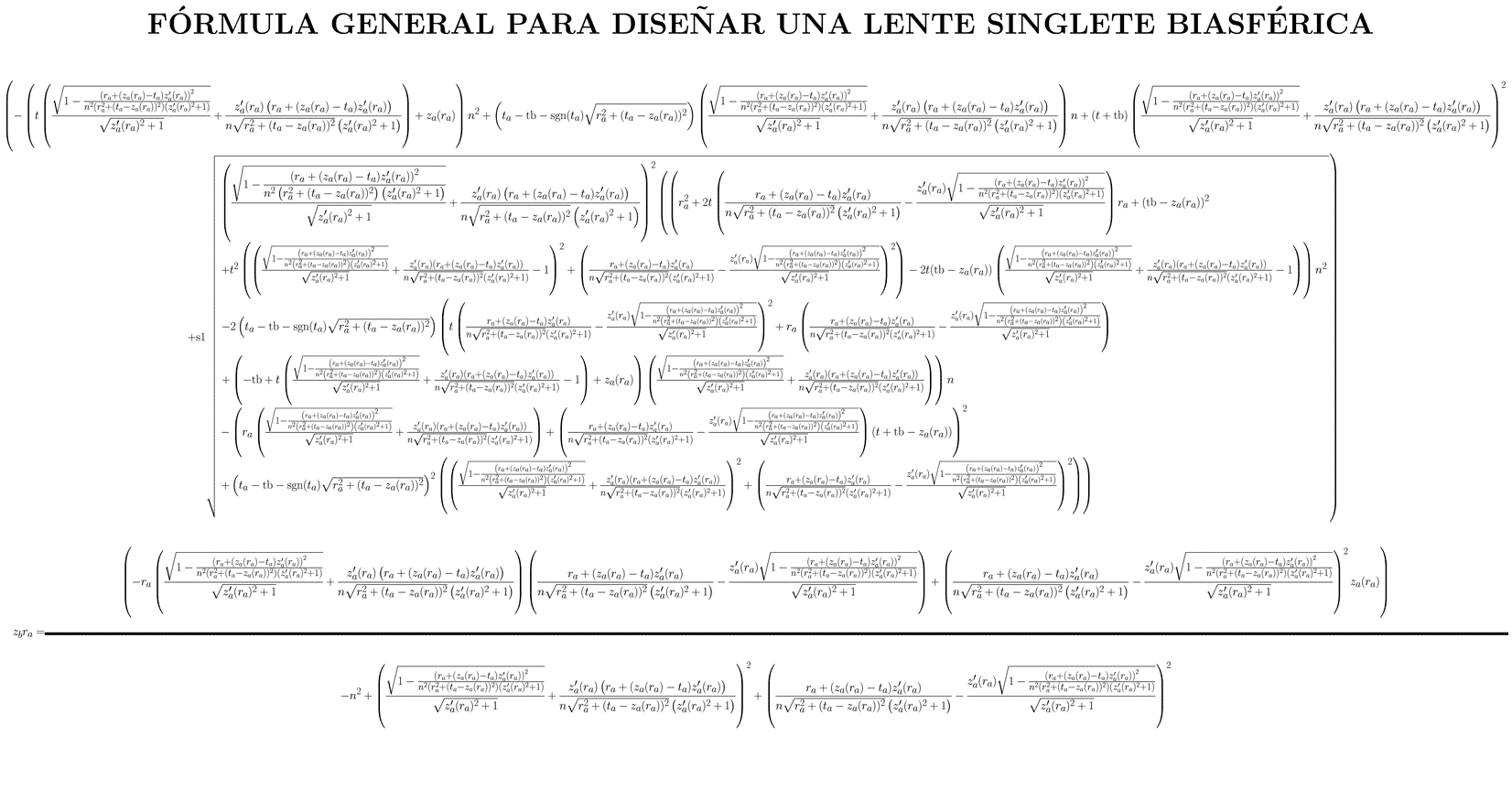
Gave me shivers reading it. Beautiful example of the incredible mystery of the human mind. Poof! And the solution materialized. Of course, all the groundwork had been laid. All the neurons primed. Just incredible. And that formula. Damn.
That was my thought. Why is it so damn complex? You’d think the solution would be simpler.
Is the resulting lens rotationally symmetric?
definitely generated by mathematica
Earlier quoted context omitted.
Gave me shivers reading it. Beautiful example of the incredible mystery of the human mind. Poof! And the solution materialized. Of course, all the groundwork had been laid. All the neurons primed. Just incredible. And that formula. Damn.
Isn’t that how most of us are solving complex problems? Building context and then walking away from the desk for a walk, or perhaps while we’re in the shower in the morning or at night, not focused on the problem but our brain working on it in the background until it is brought forward to our consciousness?
Work hard on it for a while, then leave it for one-two days. More often then not this give a way better end result.
I wouldn’t be terribly surprised if this result helps indirectly with off-axis aberration, though — a closed-form solution to the spherical aberration problem may make it easier to optimize for lens shapes that minimize other aberrations.
I have not checked the actual paper, but according to the article itself: > Moreover, the solution involved aspherical elements , which are harder to manufacture in a precise way and are thus more costly. > Their findings were published in the article General Formula for Bi-Aspheric Singlet Lens Design Free of Spherical Aberration, in the journal Applied Optics. I’m no expert in optics, but that does not sound like t…
I laughed when they tried to translate "Madres!" , but a pissed off Latina mother running at you waving her sandal in the air like a medieval warrior swinging a truncheon is definitely an "Oh shit" moment.
My understanding is that centuries ago in Latin America "madre" became an euphemism for "madame of a brothel", while actual moms are called "mamá". In Spain it carries no such connotation.
Madre is used more often in phrases, such as "Madre de dios!", Or "La madre putria," or "Pinche tu madre", or it's used as a formal to refer to one's mother. It's similar in English, such as "On my mother's side", "Mother fucker", "Mother of God!", etc.
In Mexico, "tu madre" can be a general insult, probably shortened from "pinche tu madre", though in English we have a similar vulgar retort of "your mother". As a weird turn on the phrase, "de puta madre" is slang for a good thing.
I'm not aware of an association with brothels in Mexico, but certainly in some Latin American country it could have.