Live data from Hacker News

A Look at the AMD Zen 2 Core

fuse.wikichip.org

41–50 of 94 posts

Re: A Look at the AMD Zen 2 Core

#41
post #4

"Zen employs a dynamic predictor known as a hashed perceptron." When will Hollywood tap into this wealth of cool vocabulary? Is this a gimmicky marketing term, or is it logical\descriptive\rational?

Hashed probably means that some features are mapped to a desired perceptron weight via a hash function. This serves as an implicit regularization and can be much more efficient (no need for a predetermined feature vector, sparse representation etc.). It's called hash trick in ML. Perceptron is a single layer NN. Dynamic predictor, a branch predictor that adapts to program input, not just some predetermined state (lik…

In this case, I'm pretty sure it means that multiple instruction addreses are hashed to the same perceptron (or is what you said effectively the same thing in ML-speak).

Since you don't have branch predictors for each address, you share the same prediction data for multiple addresses (this is one often underlooked cost to heavily branchy code).
Re: A Look at the AMD Zen 2 Core

#42
post #18

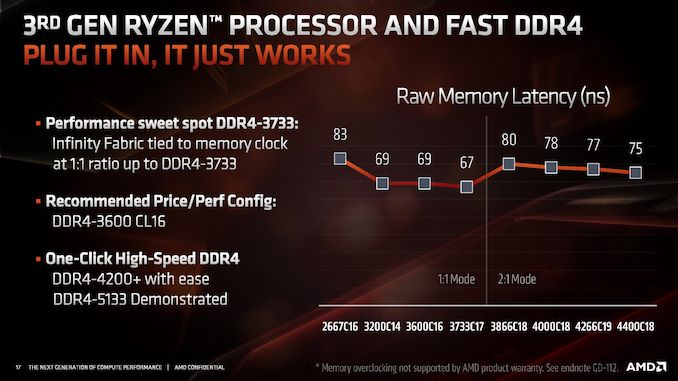
Zen 2 is very good in number crunching and synthetics. But it has a problem - terrible memory latency. 70ns with 3600cl16. ( https://www.userbenchmark.com/UserRun/18168279 ) It distills to a not-so-good gaming frame times. It's 64mb L3 cache ( https://en.wikichip.org/wiki/amd/ryzen_9/3900x ) helps only partially. Few games will suffer greatly from it, but there are several titles with RAM bottlenecks, like PUBG and F…

As far as I know, these processors are not yet released. What's the confidence level that this user benchmark will be indicative of real life expected performance? It seems implausible that this user benchmark is a good indicator. The Zen 1 architecture exhibited nothing of the sort[0] -- it would be an order of magnitude performance regression. I expect we'll start to see more accurate tests once the processors are…

https://images.anandtech.com/doci/14525/TravisK_DonW-Next_Ho...

>69 ns at 3600C16

Re: A Look at the AMD Zen 2 Core

#43
post #37
post #31

Earlier quoted context omitted.

I will distill your post to: most user builds are bad balanced to begin with and they wont see a difference and would had a better price / more cores. Valid point, i agree with it. Still could be argued about a need for a better memory for Ryzen. This equalizes total build cost and you need to be informed about this platform trait beforehand, which will results in even worse average build balance. Imagine prebuilt PC…

You seem pretty certain this will manifest as a noticeable performance hit. Can this kind of thing be easily measured in practice? I don't know if my workloads would be memory latency sensitive and worse, I don't even have a clue how I would find out. I'm not too concerned though, since I already use Zen 1 and it looks to be around the same. If I had to take a shot in the dark, I'm guessing it's just a consequence of…

2400 vs 3000 vs 3200 MHz RAM | Ryzen 2nd gen: https://youtu.be/TjMq-Nv6Mq8

It affects general tasks too, but with much less magnitude than gaming, because games are concerned with frame times and overall latency the most.

Re: A Look at the AMD Zen 2 Core

#44
This is a really good article. I am finally at the point in my college education where I can understand what they are talking about!

Are there any articles like this about Apple or Intel chips? I like hearing about actual implementations, not just educational processors. (I am looking through the other articles on this site.)

Re: A Look at the AMD Zen 2 Core

#45
post #43
post #37

Earlier quoted context omitted.

You seem pretty certain this will manifest as a noticeable performance hit. Can this kind of thing be easily measured in practice? I don't know if my workloads would be memory latency sensitive and worse, I don't even have a clue how I would find out. I'm not too concerned though, since I already use Zen 1 and it looks to be around the same. If I had to take a shot in the dark, I'm guessing it's just a consequence of…

2400 vs 3000 vs 3200 MHz RAM | Ryzen 2nd gen: https://youtu.be/TjMq-Nv6Mq8 It affects general tasks too, but with much less magnitude than gaming, because games are concerned with frame times and overall latency the most.

Well, sure... but doesn't increasing the RAM clock increase the throughput as well?

What I'm asking is, is there a good way to test the effects of just memory latency?

Re: A Look at the AMD Zen 2 Core

#46
post #18

Zen 2 is very good in number crunching and synthetics. But it has a problem - terrible memory latency. 70ns with 3600cl16. ( https://www.userbenchmark.com/UserRun/18168279 ) It distills to a not-so-good gaming frame times. It's 64mb L3 cache ( https://en.wikichip.org/wiki/amd/ryzen_9/3900x ) helps only partially. Few games will suffer greatly from it, but there are several titles with RAM bottlenecks, like PUBG and F…

This has been a problem with AMD for as long as I can remember. I remember about 10 years ago when AMD made a strong push against Intel and they traded memory latency for larger LL cache sizes and a directory based cache architecture where the better utilization was supposed to make up for the smaller L1/2 sizes.

Didn't work. Intel smoked them, especially on server workloads that were cache optimized. I wonder if the same things is going to repeat itself?

I haven't build a desktop in almost a decade, so I was thinking of it when the top shelf ryzen chips hit the market. I don't play any games, but would use it for server dev and basic ML work.

Re: A Look at the AMD Zen 2 Core

#48
post #18

Zen 2 is very good in number crunching and synthetics. But it has a problem - terrible memory latency. 70ns with 3600cl16. ( https://www.userbenchmark.com/UserRun/18168279 ) It distills to a not-so-good gaming frame times. It's 64mb L3 cache ( https://en.wikichip.org/wiki/amd/ryzen_9/3900x ) helps only partially. Few games will suffer greatly from it, but there are several titles with RAM bottlenecks, like PUBG and F…

if a old and outdated FX8370 can handle modern games, I think that a Zen 2 would not have any problem.

I had no issues with an FX-8320e and gaming. I was concerned at first about the memory latency of Zen when I upgrade to a Ryzen R7 1700 but it's been a non issue.

Re: A Look at the AMD Zen 2 Core

#49
post #44

This is a really good article. I am finally at the point in my college education where I can understand what they are talking about! Are there any articles like this about Apple or Intel chips? I like hearing about actual implementations, not just educational processors. (I am looking through the other articles on this site.)

The site has a search function, did ya find anything?

I remember Stokes had a recommended book and quite a few articles on Ars Technica back in the day. Covering older hardware, but typically a prereq in understanding newer compatible designs.

Re: A Look at the AMD Zen 2 Core

#50
post #18

Zen 2 is very good in number crunching and synthetics. But it has a problem - terrible memory latency. 70ns with 3600cl16. ( https://www.userbenchmark.com/UserRun/18168279 ) It distills to a not-so-good gaming frame times. It's 64mb L3 cache ( https://en.wikichip.org/wiki/amd/ryzen_9/3900x ) helps only partially. Few games will suffer greatly from it, but there are several titles with RAM bottlenecks, like PUBG and F…

> Few games will suffer greatly from it, but there are several titles with RAM bottlenecks, like PUBG and FarCry.

The memory bottlenecks you encounter with the games you mentioned revolve around bandwidth and timing, not latency.

Post reply on HN