Earlier quoted context omitted.
I gotta say your Medium post about Missive being a hybrid app and beating native UIs in many aspects was pretty inspiring.
This is the only reason we can as a tiny team of 3 keep pushing features/improvements[1] on all platforms. Not to say it's perfect. [1] https://missiveapp.com/changelog
We tried to hustle our way into YC after we got rejected
121–130 of 169 posts
Re: We tried to hustle our way into YC after we got rejected
#122Earlier quoted context omitted.
conferencebadge.com is very interesting to me, as are all niche businesses that can generate 7 digits. Would you care to share how you identified the opportunity and estimated potential revenue?
Went into the why and how in this podcast https://www.indiehackers.com/podcast/033-philippe-lehoux-of-...
Re: We tried to hustle our way into YC after we got rejected
#123Re: We tried to hustle our way into YC after we got rejected
#124Earlier quoted context omitted.
Having $500 in MRR proves two things: 1. The product is something that people will pay for 2. The team can sell it, at least a little bit Both are huge validations of a startup
That's the thing. In my mind $500 proves nothing. Well, it proves that you can get $500 a month. I think it says zero about the actual ability of this business to become a success. Put differently, if I believe in the idea behind a startup, I'm willing to overlook the fact that they have no rapid growth yet. If the idea is not enough to convince me, a miserable $500 is sure as hell not going to make a difference. It'…
Re: We tried to hustle our way into YC after we got rejected
#125missiveapp.com and conferenceBadge.com, my two startups, have both been rejected at the interview phase. Our yearly revenue for both now stands in the 7 digits. We are still just a team of 3 + 1 employee, 100% bootstrapped. Life is good. My advice, keep pushing! https://missiveapp.com/ https://www.conferencebadge.com
Re: We tried to hustle our way into YC after we got rejected
#126Re: We tried to hustle our way into YC after we got rejected
#127A big part of the onus of the original product, at least, as it was launched, was that it was "watermark free" and the way it was "sold" to end-users was that it was a free service. Now, I can understand the initial rationale here -- you want to get users, you start with free, and assume you'll pivot to paid options/add-ons at some point or get sponsorship or other revenue streams, or pretend it's still 2009 and that startups with no revenue can obtain ridiculous valuations and then be acquired by Yahoo or whatever.
The problem is, it's no longer 2009 and investing strategies have changed. Revenue has replaced users as the important growth metric for lots of investors. (There are exceptions, I'm aware, but this is a general trend we've seen over the last few years. Don't worry founders, the pendulum is bound to go back in the other direction in another few years.)
Now, I don't know what the team's original business plan was for this service, but based on the YC letter, it appears that they said "we'll start charging eventually" and that led to the question about why you aren't already trying that now, when you have 35,000 MAU. A fair question -- and one that really represents more of a question about business plan rather than lack of MRR.
But the team read this as "if we can show MRR, we can prove we're ready" -- except that wasn't and isn't the problem here. Yes, it's impressive that the team was able to hack together a payment gateway and offer a pro product in a weekend and obtain $500 in revenue (should be noted that this isn't recurring and it won't be clear what the actual recurring revenue is for several months), but the fact that it was done so haphazardly, and honestly, for what looks like the wrong reasons (it wasn't about "this is best for the business" it was about "this will get us into YC"), is the biggest red flag.
If you want to change a fundamental part of your product (no watermarks) and make it a pro feature to entice users to pay, you're welcome to do that. It may or may not work for existing users, and it's possible there are better ways to extract revenue/add value. The truth is though, this was an idea done at the last minute to try to secure placement in an accelerator, it doesn't appear to be born out of actual business rationale for the product.
Re: We tried to hustle our way into YC after we got rejected
#128Earlier quoted context omitted.
Maybe I just don't get the Silicon Valley culture, or perhaps I'm missing something fundamental, but let me just get this straight: 1. Startup has no revenue whatsoever, but ostensibly have good product. They go pitch to investors and get rejected, likely because they have no revenue. 2. They hack around for 1 (!) weekend and get their MRR to $500. Five hundred bucks. They now go back to investors and say: hey look,…
I sort of agree, but $500 monthly is quite a bit - it's way more than I'd expect most people who don't already have a significant public following to be able to reach on e.g. Patreon in one weekend. I could probably expect to find $500 from friends and family, but I doubt I could get a monthly commitment of $500 from them.
Re: We tried to hustle our way into YC after we got rejected
#129It's great that YC provides feedback on why they don't accept (some) companies. However, it's a bit disappointing to see that not having MRR is a reason to reject a company. It seems like a lot of the successful YC companies were accepted way before they were anywhere to close to revenue -- and some were even working on a completely different product when accepted. My hope is that MRR is sufficient, but not necessary…
Maybe I just don't get the Silicon Valley culture, or perhaps I'm missing something fundamental, but let me just get this straight: 1. Startup has no revenue whatsoever, but ostensibly have good product. They go pitch to investors and get rejected, likely because they have no revenue. 2. They hack around for 1 (!) weekend and get their MRR to $500. Five hundred bucks. They now go back to investors and say: hey look,…
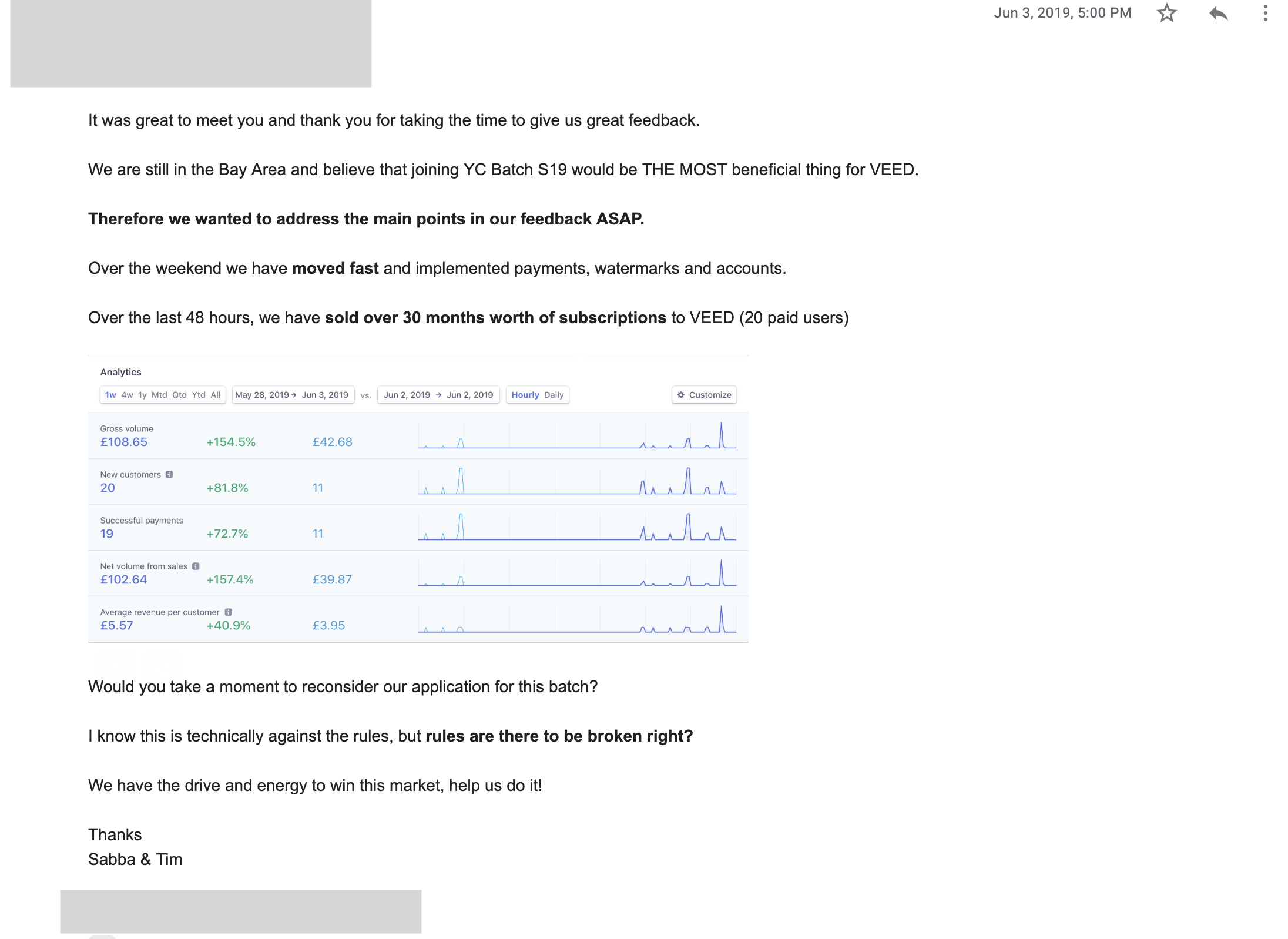
"Therefore, we thought that if we can get first paying users and MRR over the weekend and get back to YC next Monday morning, they would see that we had achieved MRR in only a few days. Additionally, we would look like a team who could move fast, listen to feedback and get stuff done."
The reason they were rejected is because they had no MRR. They were also told they need to move fast.
They proved over 1 weekend that they can get $500 in revenue and move fast.
It's the notion that they got feedback, moved fast to implement feedback, and showed that users were willing to pay on day 1 with a half-baked MRR plan.
Also their reply email hits all the points they were rejected: https://ghost-veed-blog.s3.eu-west-2.amazonaws.com/2019/06/S...
They did all this in 48 hours as 2 developers.
Re: We tried to hustle our way into YC after we got rejected
#130Earlier quoted context omitted.
Having $500 in MRR proves two things: 1. The product is something that people will pay for 2. The team can sell it, at least a little bit Both are huge validations of a startup
That's the thing. In my mind $500 proves nothing. Well, it proves that you can get $500 a month. I think it says zero about the actual ability of this business to become a success. Put differently, if I believe in the idea behind a startup, I'm willing to overlook the fact that they have no rapid growth yet. If the idea is not enough to convince me, a miserable $500 is sure as hell not going to make a difference. It'…
And honestly, seeing something like this would make me less confident in a startup, because as I said in another comment, the impetus for charging seems to be completely tied to getting accepted by YC, rather than trying to build revenue for the business. "Let's just hack our way to $500 then we can show we have revenue and the objection they listed will be moot and we'll get accepted."
The better move would be to have a solid plan for a pro product, start charging, be able to show growth in paying users, and then reapply for the winter YC class showing those data points.