Nearly 400 medical devices, procedures and practices found ineffective in study
1–10 of 153 posts
Re: Nearly 400 medical devices, procedures and practices found ineffective in study
#2Actual study: https://elifesciences.org/articles/45183
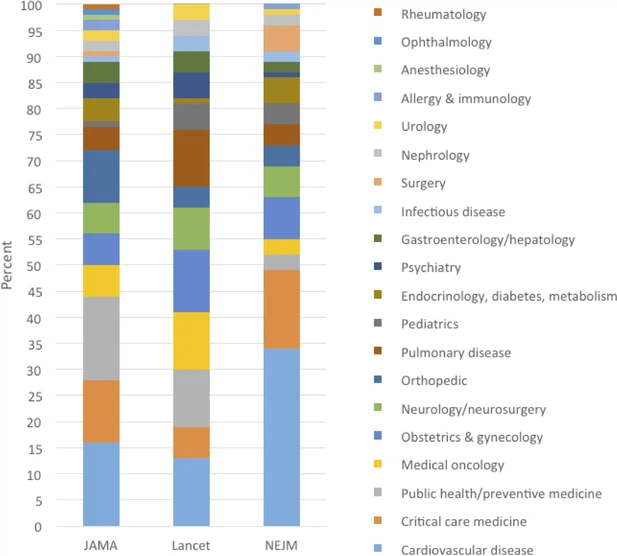
Seems to impact nearly all medical disciplines.. https://iiif.elifesciences.org/lax:45183%2Felife-45183-fig2-...
Re: Nearly 400 medical devices, procedures and practices found ineffective in study
#3Abstract:
> The ability to identify medical reversals [practices that have been found, through randomized controlled trials, to be no better than a prior or lesser standard of care] and other low-value medical practices is an essential prerequisite for efforts to reduce spending on such practices. Through an analysis of more than 3000 randomized controlled trials (RCTs) published in three leading medical journals (the Journal of the American Medical Association, the Lancet, and the New England Journal of Medicine), we have identified 396 medical reversals. Most of the studies (92%) were conducted on populations in high-income countries, cardiovascular disease was the most common medical category (20%), and medication was the most common type of intervention (33%).
The original study can be found here: https://doi.org/10.7554/eLife.45183.001
Re: Nearly 400 medical devices, procedures and practices found ineffective in study
#4I think it's bad policy for the FDA to screen medicines not just for safety but also efficacy. From this study it appears to be frequently unjustified but it gives the drug a seal of approval that has a tendency to replace the judgement of doctors and patients. It's not that the FDA decision makers are corrupt or incompetent. These are wildly complex issues that nobody can get right consistently. Better not to conceal that with centralized decision making.
Modern medicine can't even agree in broad strokes on the proper ratio of macronutrients for humans. We give them too much power when we uncritically accept their judgement on any given treatment. For me, prayer would have no effect. For others it could be a life saving intervention. The efficacy of a particular molecule for a particular patient isn't much easier than that to determine. Therefore decision making should be as decentral and computationally parallel as we can make it.
Re: Nearly 400 medical devices, procedures and practices found ineffective in study
#5I think it's bad policy for the FDA to screen medicines not just for safety but also efficacy. From this study it appears to be frequently unjustified but it gives the drug a seal of approval that has a tendency to replace the judgement of doctors and patients. It's not that the FDA decision makers are corrupt or incompetent. These are wildly complex issues that nobody can get right consistently. Better not to concea…
It seems wrong to judge based on the number of false positives without weighing agianst all the snake oil they keep out.
Re: Nearly 400 medical devices, procedures and practices found ineffective in study
#6I think it's bad policy for the FDA to screen medicines not just for safety but also efficacy. From this study it appears to be frequently unjustified but it gives the drug a seal of approval that has a tendency to replace the judgement of doctors and patients. It's not that the FDA decision makers are corrupt or incompetent. These are wildly complex issues that nobody can get right consistently. Better not to concea…
Not screening for efficacy will result in both legitimate cancer medication and homeopathic medicine having an FDA stamp of approval.
Nothing is stopping decentralized decision making, you just need to market whatever non-effective but safe remedy you're selling as a food supplement, a tea or whatever. You just can't advertise that it's a drug.
Re: Nearly 400 medical devices, procedures and practices found ineffective in study
#7I think it's bad policy for the FDA to screen medicines not just for safety but also efficacy. From this study it appears to be frequently unjustified but it gives the drug a seal of approval that has a tendency to replace the judgement of doctors and patients. It's not that the FDA decision makers are corrupt or incompetent. These are wildly complex issues that nobody can get right consistently. Better not to concea…
Even computationally parallel algorithms hopefully have a centralization point where the compulation completes. What's the equivalent for whether or not a drug is more effective than a sugar pill, given countless edge cases? I could imagine a case where a drug that was never effective is widely distributed before being calculated to be no more effective than placebo. In the meantime, such a widely distributed drug could cause significant harm as it is selected over medication with actual efficiacy or effective drugs avoided due to the side effects of the ineffective one.
Re: Nearly 400 medical devices, procedures and practices found ineffective in study
#8I think it's bad policy for the FDA to screen medicines not just for safety but also efficacy. From this study it appears to be frequently unjustified but it gives the drug a seal of approval that has a tendency to replace the judgement of doctors and patients. It's not that the FDA decision makers are corrupt or incompetent. These are wildly complex issues that nobody can get right consistently. Better not to concea…
Efficacy is important as many drugs have significant side effects. If a drug is not going to actually reduce your chance of heart attack or help treat aggressive cancer it's likely not worth the trade-off with side effects.
Re: Nearly 400 medical devices, procedures and practices found ineffective in study
#9I think it's bad policy for the FDA to screen medicines not just for safety but also efficacy. From this study it appears to be frequently unjustified but it gives the drug a seal of approval that has a tendency to replace the judgement of doctors and patients. It's not that the FDA decision makers are corrupt or incompetent. These are wildly complex issues that nobody can get right consistently. Better not to concea…
> The efficacy of a particular molecule for a particular patient isn't much easier than that to determine.
How do you handle situations where the provider doesn’t know/care which is best either and just chooses the intervention that was the most heavily marketed to them?
Why do we see new patent drugs replace the “old and boring” generics without any proven efficacy benefit?
Re: Nearly 400 medical devices, procedures and practices found ineffective in study
#10I think it's bad policy for the FDA to screen medicines not just for safety but also efficacy. From this study it appears to be frequently unjustified but it gives the drug a seal of approval that has a tendency to replace the judgement of doctors and patients. It's not that the FDA decision makers are corrupt or incompetent. These are wildly complex issues that nobody can get right consistently. Better not to concea…
You lost me when you made the assertion that the FDA isn’t corrupt.