Of historical interest, it's the sort of thing you might do if you were a Victorian industrial magnate, for some value of "home": https://en.wikipedia.org/wiki/Cragside
A home microhydro plant (2009)
51–60 of 94 posts
Re: A home microhydro plant (2009)
#52I remember when this was originally posted, and I am still super impressed with him making his own transformers.
Re: A home microhydro plant (2009)
#53Earlier quoted context omitted.
line-line potential is 2kV so the wear is worse between conductors. The only saving grace is the current is so low that the wire will see almost no heating which almost eliminates thermal stress.
You are misunderstanding. He runs each wire in a separate, sealed insulating cable pipe. These would most likely be 1-1.5 mm wall thickness PVC.
Re: A home microhydro plant (2009)
#54Earlier quoted context omitted.
In what way? The digging? Or the water? It seemed he only uses a very little bit of the available water.
At some point he was using 2/3 of the creek.
Re: A home microhydro plant (2009)
#55I remember when this was originally posted, and I am still super impressed with him making his own transformers.
Re: A home microhydro plant (2009)
#56How much would all this cost in 2019? I'm wondering because I see many more people turn towards solar panels, or alternatively windmills. First time I see a hydro plant of this size.
The author mentions solar in a later post: > Another restriction is that there is no power at this place. Bringing power here would require a 350 meter long transmission line through dense forest, or else installing a solar panel, battery and regulator. Due to the low head available between the intake dam and the forebay, a picohydro system to provide some power is hardly feasible. Solar power is quite restricted too…
Re: A home microhydro plant (2009)
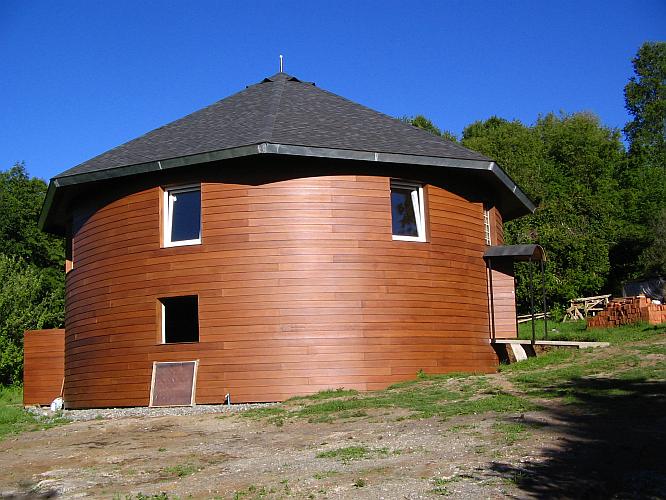
#57The only disappointing thing about his projects was the house he built. You go out to live in paradise... and decide to make your home in a cave SMH.
Need way more windows: https://ludens.cl/paradise/house/814.jpg
Re: A home microhydro plant (2009)
#58Earlier quoted context omitted.
It looks like a good way to ruin an entire ecosystem.
Running water through pipes is going to destroy the surrounding forests how exactly? It might modify where the wetter parts of the area are, but I don't think that equates to destroying it.
Additionally, there are some definite issues with sedimentation during construction. They excavated the channel to the intake and put all the dirt from the excavation into the stream for it to "carry away"[1]. This would not be allowed in most areas I know of - essentially, fish can't breathe if there's too much dirt in the water. Then several times it overflowed and eroded the channel - more sedimentation. The author even admitted using concrete liner would be the better choice, but opted not to because it was expensive - essentially, this externalized the cost of sedimentation to the ecosystem.
Re: A home microhydro plant (2009)
#59There’s a very cool hydro system built over a few years by a YouTuber called ‘Mr HydroHead’ over a bunch of videos spanning several years - the first here: https://m.youtube.com/watch?v=edEhvmNlYqk Pretty impressive how much power these things can produce!
If you don't want to watch 19 episodes spanning a few years, he put up three summary videos of the project starting at episode 20: https://www.youtube.com/watch?v=61lZn1sUkzE
Re: A home microhydro plant (2009)
#60Earlier quoted context omitted.
Running water through pipes is going to destroy the surrounding forests how exactly? It might modify where the wetter parts of the area are, but I don't think that equates to destroying it.
There's more to water than forests. For example invertebrates, which play a key role in an ecosystem. Next time thing before you talk.
It's not primarily a moral or ethical thing. We're just trying to prevent this place from burning itself to the ground. That requires everyone to have a certain discipline with their angrier impulses here.
https://news.ycombinator.com/newsguidelines.html
(Your comment would be just fine without the last sentence.)