Live data from Hacker News

Unexpected Surge in Global Methane Levels

climatenexus.org

161–170 of 230 posts

Re: Unexpected Surge in Global Methane Levels

#161
post #158

Earlier quoted context omitted.

How does CO2 level above 400 cause release of methane from Siberia? There is no established direct link between CO2 atmospheric levels and release of methane.

More CO2 = more warming. The polar regions are so far seeing the most extreme temperature increases: see e.g. https://static.skepticalscience.com/pics/ArcticTC1880-2010NC... Higher arctic temperatures = permafrost melts, releasing trapped methane. e.g. https://www.nature.com/articles/d41586-019-01313-4

So CO2 --> methane is an indirect link at best, and methane levels have been increasing linearly for the last thirty years.

https://climatenexus.org/wp-content/uploads/2019/05/ch4_tren...
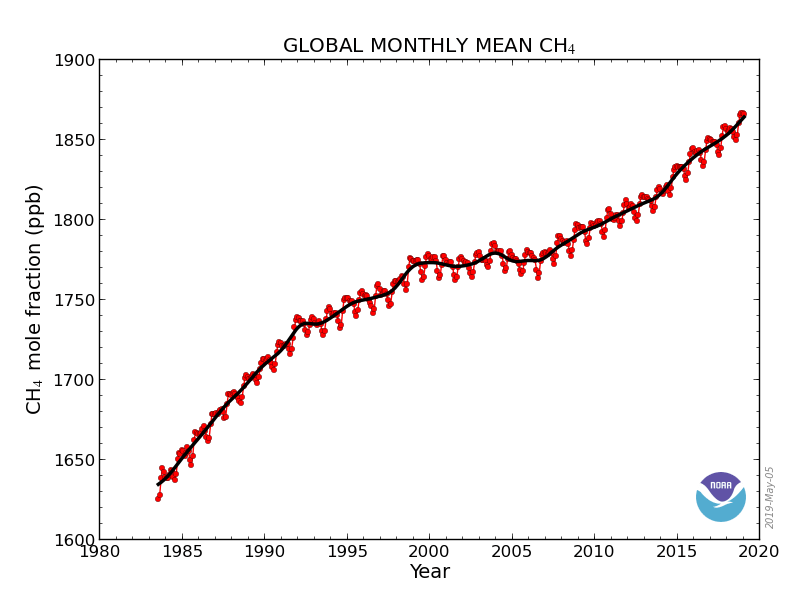
There is no magical CO2 level of 400 that suddenly causes methane to be released from permafrost.

Re: Unexpected Surge in Global Methane Levels

#162
post #158

Earlier quoted context omitted.

More CO2 = more warming. The polar regions are so far seeing the most extreme temperature increases: see e.g. https://static.skepticalscience.com/pics/ArcticTC1880-2010NC... Higher arctic temperatures = permafrost melts, releasing trapped methane. e.g. https://www.nature.com/articles/d41586-019-01313-4

So CO2 --> methane is an indirect link at best, and methane levels have been increasing linearly for the last thirty years. https://climatenexus.org/wp-content/uploads/2019/05/ch4_tren... There is no magical CO2 level of 400 that suddenly causes methane to be released from permafrost.

You might be reading the post too literally.

The 400 PPM is a target that is easy for humans to discuss. The general idea that increased atmospheric CO2 leads to accelerated methane releases due to thawing of arctic permafrost still holds true, and humans need to set CO2 targets to mitigate this issue.

Re: Unexpected Surge in Global Methane Levels

#163
post #22

Often I see comments asking what we can do to combat this, or expressing feeling hopeless. While it is not the complete solution, one direct way is by eliminating your personal consumption of animal products. Animal agriculture is a huge contributor to methane production, especially from cows. > Overall, we conclude that methane emissions associated with both the animal husbandry and fossil fuel industries have large…

Let's also look at greenhouse gases in general:

"According to the U.S. Environmental Protection Agency, the largest sources of U.S. GHG emissions in 2016 were electricity production (28 percent of total emissions), transportation (28 percent) and industry (22 percent). All of agriculture accounted for a total of 9 percent. All of animal agriculture contributes less than half of this amount, representing 3.9 percent of total U.S. greenhouse gas emissions. That’s very different from claiming livestock represents as much or more than transportation." [0]

Global direct greenhouse gas emissions from transportation versus livestock represent 14 versus 5 percent respectively. [1]

Also consider: "According to the FAO, as much as 70 percent of all agricultural land globally is range land that can only be utilized as grazing land for ruminant livestock." [1]

[0] https://theconversation.com/yes-eating-meat-affects-the-envi...

[1] http://news.trust.org/item/20180918083629-d2wf0

Re: Unexpected Surge in Global Methane Levels

#164
post #144

Earlier quoted context omitted.

The efficiency of converting plant based protein into animal protein to feed that to humans is very low [1]. A huge portion of the crops are actually used to feed cattle. If humans stopped eating meat tomorrow, we would have plenty of food (we'd better start eating a lot more soy, though) https://iopscience.iop.org/article/10.1088/1748-9326/11/10/1...

I’ll pass on the phytoestrogens, though. This doesn’t really address the fact that there are ways to still eat meat but minimize the greenhouse effects. For example, chicken and pork is dramatically less directly impactful than beef. There is still the feed efficiency problem, but America’s love of red meat is a better place to start than no meat at all. https://timeforchange.org/are-cows-cause-of-global-warming-m...

The soy/phytoestrogen scare is not scientific/fact-based.

https://www.hsph.harvard.edu/nutritionsource/soy/

> Results of recent population studies suggest that soy has either a beneficial or neutral effect on various health conditions. Soy is a nutrient-dense source of protein that can safely be consumed several times a week, and is likely to provide health benefits—especially when eaten as an alternative to red and processed meat.

By the way, the reason @jaxr is talking about eating lots of soy is not because we'd need to be heavily reliant on soy for protein if we gave up meat - there are lots of other protein sources, of course. They mentioned eating lots of soy because we currently feed something like 70+% of soy to livestock, so there'd be a lot of it "laying around" if livestock suddenly didn't exist. Of course, it wouldn't actually play out like that.

Re: Unexpected Surge in Global Methane Levels

#165

Earlier quoted context omitted.

This is terrible advice, because it makes people think they did "enough" themselves to combat climate change when dropping animal product methane to 0 would not even be close to enough. Remember, 100 companies are responsible for 71% of climate emissions. These need to be dealt with, swiftly. https://www.theguardian.com/sustainable-business/2017/jul/10...

>Remember, 100 companies are responsible for 71% of climate emissions Most of these 100 companies are oil companies, and the emissions from oil they sold on to consumers is unfairly attributed to them. Exxon don't burn oil for fun, they sell it to people to power their cars. This statistic is incredibly misleading.

Are they seriously counting Joe's car's CO2 as Exxon's responsibility? Can I ask for a reference/quote on that?

Re: Unexpected Surge in Global Methane Levels

#166

Earlier quoted context omitted.

This is terrible advice, because it makes people think they did "enough" themselves to combat climate change when dropping animal product methane to 0 would not even be close to enough. Remember, 100 companies are responsible for 71% of climate emissions. These need to be dealt with, swiftly. https://www.theguardian.com/sustainable-business/2017/jul/10...

>Remember, 100 companies are responsible for 71% of climate emissions Most of these 100 companies are oil companies, and the emissions from oil they sold on to consumers is unfairly attributed to them. Exxon don't burn oil for fun, they sell it to people to power their cars. This statistic is incredibly misleading.

Pollution is an externality of the oil industry. Might be better if today's consumer paid for that at the pump rather than future generations dealing with it in the environment.

The artificially low price of oil due to postponing / offloading these external costs significantly slows free market innovation of alternatives and efficiencies.

So... what's the best way to pay for these negative externals so we don't simply pass the buck to our kids?

We don't have to throw executives in jail for addressing the market, we just need a more comprehensive (and truer) price (via taxes) applied to oil.

Re: Unexpected Surge in Global Methane Levels

#167
post #144

Earlier quoted context omitted.

The efficiency of converting plant based protein into animal protein to feed that to humans is very low [1]. A huge portion of the crops are actually used to feed cattle. If humans stopped eating meat tomorrow, we would have plenty of food (we'd better start eating a lot more soy, though) https://iopscience.iop.org/article/10.1088/1748-9326/11/10/1...

Cattle doesn’t convert plant based protein into animal protein. Also cattle eats crop that humans can’t eat and which grows in significantly more tough conditions than those required for crops used as feed. Eating lots of soy is not healthy. It’s a very weird and unconvincing argument on your part, to suggest humans should just start eating crops fed to cattle and that would somehow work in terms of sufficiently heal…

Eating lots of soy is not a requirement of a diet without red meat.

Cattle can eat grass, but most of them in North America eat very little grass. They eat a lot of grain that is intensively farmed. That feed farming has a significant impact on the environment through regular agriculture practices. By growing food for humans instead, the impact would be reduced simply because not as much crop is needed.

Red meat does have a good nutrition profile, but a balanced vegetable focused diet does too. People underestimate how much protein and fat can be had from plants. I'm not sure why you think people won't do this if they stop eating red meat. Why isn't that realistic?

I speak as someone who absolutely loves meat and thought much like you do recently. Life without, or with much less meat is fine. I've come to realize I largely eat it out of convenience and comfort.

Re: Unexpected Surge in Global Methane Levels

#168
post #159

Earlier quoted context omitted.

Cattle doesn’t convert plant based protein into animal protein. Also cattle eats crop that humans can’t eat and which grows in significantly more tough conditions than those required for crops used as feed. Eating lots of soy is not healthy. It’s a very weird and unconvincing argument on your part, to suggest humans should just start eating crops fed to cattle and that would somehow work in terms of sufficiently heal…

Baffled to read this, as I thought it was widely established as grossly inaccurate. Suggest you read Steinfeld, Henning; Gerber, Pierre; Wassenaar, Tom; Castel, Vincent; Rosales, Mauricio; de Haan, Cees (2006), Livestock's Long Shadow: Environmental Issues and Options Or alternatively anything about food culture and supply in India. I don't believe your current position is substantiated by any evidence; but I'm happy…

I suggest you also read Steinfeld's own correction regarding the 2006 claim that livestock accounts for 18% of GHG emissions:

"The comparison measures direct emissions from transport against both direct and indirect emissions from livestock."

http://news.trust.org/item/20180918083629-d2wf0

Re: Unexpected Surge in Global Methane Levels

#169
post #101

Earlier quoted context omitted.

I also grew up eating crazy amounts of meat here in Canada. I'm steadily moving towards a vegetarian (though with some fish and other sea life I harvest) diet despite still absolutely loving meat. I just can't justify it anymore. To me (and I know others don't need to feel the same way) it's practically immoral to eat in a way that wouldn't be sustainable if everyone else did. It's incredible to be born in a place an…

How do you justify having kids (also unsustainable if everyone did it.)?

Honestly, I can't. It makes me feel bad for doing that to others and also for what the world might become for my kids. I wish I was kidding. This sort of thing has kept me up at night.

Re: Unexpected Surge in Global Methane Levels

#170

Earlier quoted context omitted.

I think they were more driven by biological evolution than by climate change, though. At least some of them (Cambrian, maybe also Dinosaurs). Humans are actually very adaptable to all sorts of climates. They've lived in the arctic and in the Saharah. Also, mass extinction events OK, but we are talking about a runaway effect of heating up the atmosphere, turning it into a Venus like planet. That doesn't seem to have h…

A Saharah like climate won't feed 7.5 billion people. If the population crashes to a few million stragglers living mostly at the poles then we'll regress back to the stone age.

There may be no way yet to support 7,5 billion people on renewable energy. Then what?

Also not saying everything will become like the Saharah. Just that humans may adapt better than those animals who died in mass extinction events in the past.

Post reply on HN