Live data from Hacker News

China unveils 600 kph maglev train prototype

globaltimes.cn

161–170 of 192 posts

Re: China unveils 600 kph maglev train prototype

#161
post #51

The article mentions "designed top speed of 600 km per hour". But then a bit further it mentions "Now the prototype has achieved static levitation and is in good condition" (emphasis mine). That leaves me wondering what was the actual speed reached during testing and what will be the actual operational speed. Don't get me wrong, I still find this project impressive. But there's a fair amount of boasting going on as w…

The French record was with a modified test unit but on a regular track (LGV Est), albeit with upgraded voltage.

They also adjust the tension of the catenary wires for the test runs so that the train does not catch up with the wave it induces. https://en.wikipedia.org/wiki/TGV_world_speed_record#Catenar...

Re: China unveils 600 kph maglev train prototype

#162

Earlier quoted context omitted.

China's population is concentrated in one part of the country. That makes it easier to serve them more efficiently with mass transit. This isn't true for the United States. The population resides on the coasts, which you can serve with high-speed rail, but connecting the two coasts with the inland population centers via rail is a much, much bigger project.

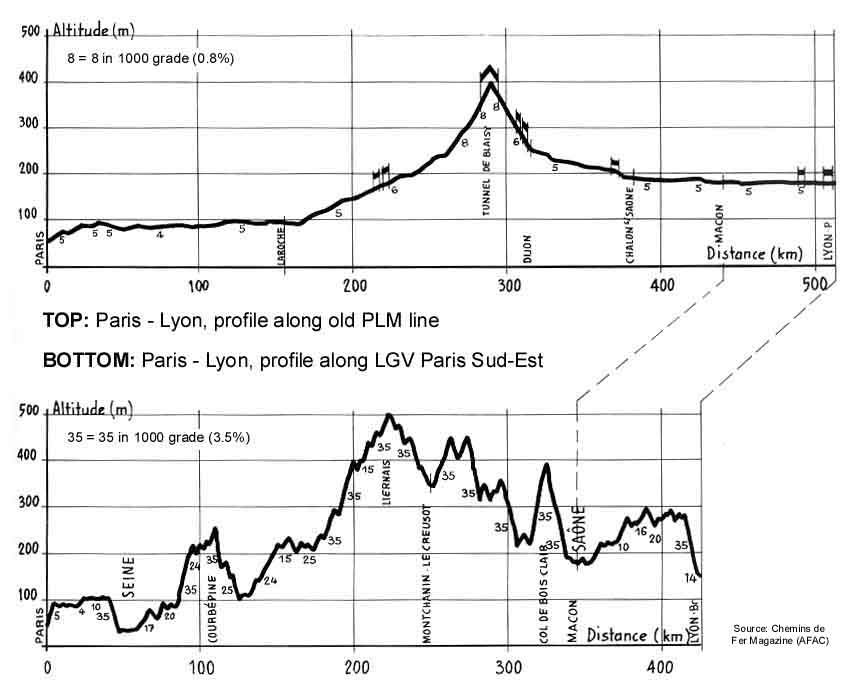
Building a railway from coast to coast has already been done in the 19th century. An HSR line is just a railway line built to higher standards: - larger curve radiuses (spelling?). Not much of a factor when a line mostly crosses sparsely populated, flat areas. - less steep inclines (but if a steam engine can climb an incline, so should every modern train) - Switches that allow high speeds on the diverging branch. But…

High speed lines can have steeper profiles than normal lines because the greater kinetic energy and loco power makes them less troubled by slopes. Eg this compares the profiles of the old Paris-Lyon route with LGV Sud-Est:

http://www.railfaneurope.net/tgv/images/misc/profilln1.jpg

Re: China unveils 600 kph maglev train prototype

#163
post #119

Earlier quoted context omitted.

Reacting to things is still important and time critical. You just can't react to anything in sight. Instead the things you can react to are data and camera feeds from far up ahead. What are the other trains doing? Did the next junction switch successfully? I think that raises a question of: what is the point of having a driver on the train? Why not have people in a control room drive the trains, coordinating the syst…

> What are the other trains doing? Did the next junction switch successfully? These are not things the train driver would react to. There will be a signal protecting the switch, which won't be "green" until the change is successful. If the driver tries to pass a red signal (or exceed the speed limit), the emergency brake is applied automatically. The driver needs to react to unexpected events -- which might mean appl…

I don't think any of these things are reasons to have the driver on the train. The train drivers could be located at a remote location and still be aware of these things. Loss of connectivity already means it's unsafe for the train to continue and must stop, as it cannot be aware of signals or hazards ahead.

As far as foreign objects or track failures go, these are not promptly apparent from the cabin anyway. CCTV on the track and crossings ahead is better placed for early warning.

Additionally, remote control of trains could potentially be more safe, as it would be easier for a new driver to take over in the event of e.g. the driver having a heart attack or stroke.

I think the only remaining reason is the physical accountability of being on the train.

Re: China unveils 600 kph maglev train prototype

#164
post #160

Earlier quoted context omitted.

Remote control systems can and will fail.

I don't see why this is an issue. If it fails, the train should stop. The train should be designed such that it only continues on its way if a continuous "okay to proceed" signal is received, gated on automatic safety systems and deliberate human action. Even if you have a driver, the train should still stop if it cannot communicate, because the driver can't determine whether the track ahead is safe.

Railroads were developed in a time when “continuous communication” wasn’t even a fiction, much less reality.

I don’t know what continuous monitoring/communication brings other than numerous new failure modes.

Re: China unveils 600 kph maglev train prototype

#166
Let’s put this kind of speed into perspective using distances between North American cities and existing highways, from Google Maps. This is not a proposal, this is merely perspective.

Note: this is also not a proposed route map, but it is probably bleedin’ obvious that some major cities lend themselves to being high speed rail hubs more than others, because they were and/or are historical rail hubs.

I tried to cover the entire lower 48 and the a good portion of Canada and a small part of Mexico so that hopefully most everyone in the US sees a possible line in the data that would 1. Interest them and 2. Give them a sense of scale as to how far two points of interest really are and 3. Imagine how long it would take to get from one point of interest to another along a 600 kph railway.

- Seattle to Portland: 280 kilometers

- Seattle to Spokane: 449 kilometers

- Seattle to Fargo: 2296 kilometers

- Seattle to Minneapolis: 2666 kilometers

- Seattle to Chicago: 3322 kilometers

- San Francisco to Los Angeles: 617 kilometers

- San Francisco to San Diego: 807 kilometers

- San Francisco to Ensenada, Baja California: 937 kilometers

- San Francisco to Cabo San Lucas, Baja California Sur: 2456 Baja California Sur (from San Diego: 1654 kilometers)

- San Francisco to Reno: 352 kilometers

- San Francisco to Sacramento: 141 kilometers

- San Francisco to Salt Lake City: 1184 kilometers

- San Francisco to Chicago: 3426 kilometers

- San Francisco to Portland: 1022 kilometers

- San Francisco to Seattle: 1300 kilometers

- San Francisco to Vancouver, British Columbia: 1529 kilometers

- Los Angeles to Las Vegas: 435 kilometers

- Los Angeles to Phoenix: 600 Kilometers

- Los Angeles to Salt Lake City: 1108 kilometers

- Los Angeles to Denver: 1635 kilometers

- Los Angeles to Chicago: 3244 kilometers

- San Diego to Mexicali: 198 kilometers

- San Diego to Tucson: 655 kilometers

- San Diego to El Paso: 1165 kilometers

- San Diego to Houston: 2366 kilometers

- San Diego to New Orleans: 2922 kilometers

- Dallas to Corpus Christi: 662 kilometers

- Houston to Austin: 266 kilometers

- Houston to San Antonio: 317 kilometers

- Houston to El Paso: 1199 kilometers

- Houston to Dallas: 385 kilometers

- Houston to Corpus Christi: 334 kilometers

- Houston to New Orleans: 560 kilometers

- Houston to Tallahassee: 1141 kilometers

- Houston to Miami: 1911 kilometers

- Houston to Denver: 1656 kilometers

- Houston to Oklahoma City: 716 kilometers

- Houston to Kansas City: 1198 kilometers

- Houston to St. Louis: 1253 kilometers

- (Trans-Missouri Express! Kansas City to St. Louis: 399 kilometers)

- Houston to Chicago: 1741 kilometers

- Houston to Nashville: 1253 kilometers

- Houston to Atlanta: 1276 kilometers

- Houston to Charleston: 1756 kilometers

- Houston to Charlotte: 1668 kilometers

- Houston to Washington: 2270 kilometers

- Chicago to Winnipeg: 1392 kilometers

- Chicago to Saskatoon: 2109 kilometers

- Chicago to Edmonton: 2633 kilometers

- Chicago to Calgary: 2570 kilometers

- Chicago to Milwaukee: 148 kilometers

- Chicago to Minneapolis: 657 kilometers

- Chicago to Des Moines: 537 kilometers

- Chicago to Lincoln: 841 kilometers

- Chicago to Denver: 1617 kilometers

- Chicago to Kansas City: 820 kilometers

- Chicago to St. Louis: 503 kilometers

- Chicago to Memphis: 850 kilometers

- Chicago to Indianapolis: 292 kilometers

- Chicago to Nashville: 757 kilometers

- Chicago to Louisville: 476 kilometers

- Chicago to Washington: 1124 Kilometers

- Chicago to Philadelphia: 1221 kilometers

- Chicago to New York: 1270 kilometers

- Chicago to Detroit: 453 kilometers

- Chicago to London, Ontario: 648 kilometers

- Chicago to Toronto: 835 kilometers

- Chicago to Ottawa: 1271 kilometers

- Chicago to Montreal: 1363 kilometers

- Chicago to Boston: 1581 kilometers

- Chicago to Portland, Maine: 1740 kilometers

- Boston to Portland, Maine: 180 kilometers

- Boston to New York: 353 kilometers

- New York to Albany: 249 kilometers

- New York to Syracuse: 397 kilometers

- New York to Montreal: 596 kilometers

- New York to Montauk: 190 kilometers

- New York to New Haven: 130 kilometers

- New York to Buffalo: 600 kilometers

- New York to Philadelphia: 151 kilometers

- New York to Washington: 364 kilometers

- New York to Raleigh: 811 kilometers

- New York to Charleston: 1219 kilometers

- New York to Atlanta: 1390 kilometers

- New York to Miami: 2059 kilometers

- Miami to Orlando: 380 kilometers

- Miami to Jacksonville: 558 kilometers

- Miami to Savannah: 783 kilometers

- Miami to Tampa: 454 kilometers

- Miami to Tallahassee: 777 kilometers
Re: China unveils 600 kph maglev train prototype

#167

Earlier quoted context omitted.

Yes, this excuse has been given for the past 50 years. Usually, in reference to Europe. That might explain why they’re building 25,000 miles of high-speed rail in China, but it doesn’t address why the US has zero. You’re being sort of vague with the numbers of course. If you actually look at population densities in Spain, for example, and compare them to California or New York, what do you think we’d find? For some r…

People also want the federal government to fund the construction of this infrastructure, which is a very hard sell (and possibly unconstitutional) if you don't average all of those states in some way. Most of the opposition to Amtrak and existing infrastructure projects like the Gateway Project is coming from those states, who don't see improving rail service in the Mid-Atlantic and New England as something they want…

The federal government funded the highway system.

There are 350 million Americans. Do you know who pays most of the taxes to the federal government? It’s not the people in the mid-West.

https://en.m.wikipedia.org/wiki/Federal_tax_revenue_by_state

Re: China unveils 600 kph maglev train prototype

#168
post #156

Earlier quoted context omitted.

Fact: that was made up

You may not know the economic history of Britain, if you disagree. Peak of British economy was after it invaded/sabotaged/drugged/then robbed two of the richest civilizations at that point (accounting for 50% of world GDP) China & India. The beginning of British decline started in the early 1900s with the end of the opium trade (which at its peak, in ~1895, accounted for 35% of Britain's GDP) Do you think UK, China,…

Not the issue. The made-up part was, that's the only way for Britain to move back up in the world. So many ways for that to happen - tech, information, space, diplomacy to name a few.

Re: China unveils 600 kph maglev train prototype

#169
post #2

I really wish we had high speed rail in Australia. I'd pick a 600km/h train over a plane any day.

High-speed trains are starting to impact airline routes: https://www.travelstatsman.com/08082016/high-speed-rail-trai...

Surely this is good for everyone save airline operators. Less planes on busy routes, more options for those don't want to fly, etc.
Post reply on HN