Live data from Hacker News

Amazon rolls out machines that pack orders and replace jobs

reuters.com

341–350 of 511 posts

Re: Amazon rolls out machines that pack orders and replace jobs

#341
post #333
post #320

Earlier quoted context omitted.

Sure there is. If they don't do it, someone else will be able to outcompete on price, eventually at least. And yes, most of our history is full of examples of newer technologies lowering cost, that's kind of the whole reason that or civilization is more advanced (materially) than it was in the past.

Yeah, one of Bezos’ oldest mantras is “Your margin is my opportunity”.

Bezos also said his top 3 priorities are lower prices, faster delivery, and wider selection.

Re: Amazon rolls out machines that pack orders and replace jobs

#342

Earlier quoted context omitted.

I think HN's tune would be quite different if someone came up with a technology that eliminated half of all programming jobs. Not quite so many people would be saying, "This is great! I for one look forward to technological advancement." I do think the future should involve more automation, I just think we should be -- I dunno, a little less gleeful about it and think about the people it's impacting.

UBI. Then we can be gleeful about more automation.

I agree with UBI is principle, but implementation is where the dragons are.

For one, doing UBI in a single country will cause whole number of problems. Do you keep borders relatively open and recall Europe's migrant crisis as a cute little inconvenience, or do you close them shut deal with political consequences of that -- generally people who are for closing borders are also against taking personal hits to prop up others. (and dealing with that involves doubling down on nationalism and other ugly notions).

With a planetary government and mostly automated industrial base (that likely needs more power over individual countries than US federal government has over individual US states), it will probably work. Good luck getting there.

Or with most of the countries (by population) implementing comparable UBI regimes mostly at the same time. So we'll have to wait for at least China and India to catch up.

Re: Amazon rolls out machines that pack orders and replace jobs

#343

Earlier quoted context omitted.

If we take all the money the Netherlands spends on social security, welfare, pensions, etc, and add extra money from increased taxes (make it flat 50-60%), every single household can have a UBI of about 42 000 euros/year. The numbers are similar for other western economies.

>add extra money from increased taxes (make it flat 50-60%) Good luck passing a bill that raises my effective tax rate from 17% to 55%. Obviously if you take a whole lot more money from everyone else there will be more to hand out to others.

There's no way your effective rate goes from 17% to 55%. Did you include the extra 3000/month you'll be getting?

Re: Amazon rolls out machines that pack orders and replace jobs

#344
post #312

Earlier quoted context omitted.

>machines bring lower prices Do you have any source about this? If the costumer is already willing to pay a price there would be no point in lowering the price just because you automated the process. Or better said, theres no point in investing in machines if your profit margin is not going to get wider.

It's worth expanding on this. Because I think it gets lost in the rhetoric, whether deliberately or by accident. A profit-maximizing firm sets prices that maximize its expected profit. This seems tautological, but it's important and I think it's implications aren't appreciated. If your prices are already beating the competition, and you already have a solid reputation for low prices, there is no incentive to continue…

I agree with the general idea. In your experience, when has Amazon acted negatively towards the welfare of the consumer?

The point I was talking about has to do with the internal labor publicity at Amazon which rarely affects the consumer.

Re: Amazon rolls out machines that pack orders and replace jobs

#345

Earlier quoted context omitted.

A UBI in the salary range of an Amazon warehouse worker would be on the order of 1/3rd GDP.

Having one third of the value created by everyone pooled together to distribute to everyone sounds completely fine to me. I'd say the society as a whole plays a role that is on average greater than 1/3 on your success.

First of all, GDP is a bad measure for "value created". It's more of a measure for "money spent" and that generally includes a lot of long-term and debt, especially in the US.

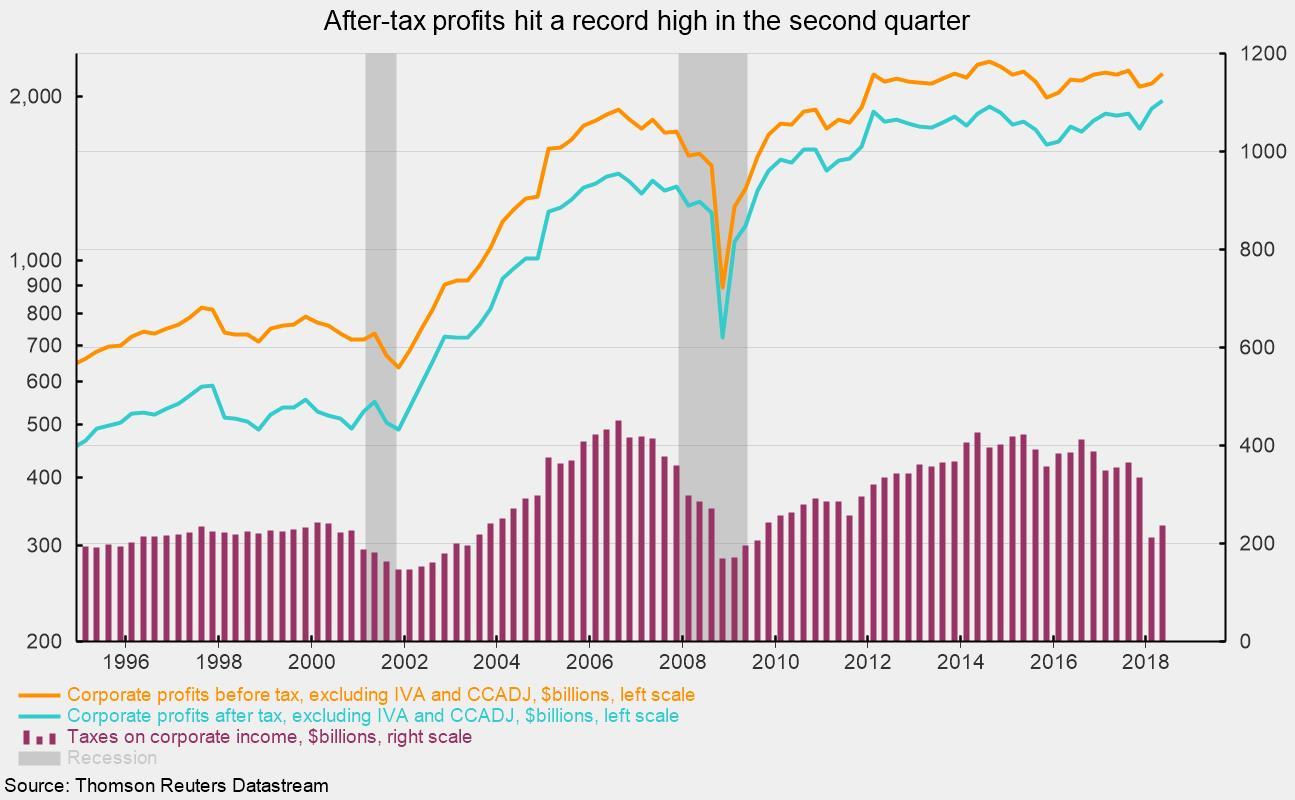
Secondly, you can't actually redistribute GDP. You could (in theory) take 100% of the profits of all businesses, that would add up to about 12% of GDP:

https://static.seekingalpha.com/uploads/2018/8/30/saupload_B...

Notice the drop around 2008? That's what happens when a lot of debt can't be serviced anymore.

Lastly, "society as a whole" doesn't contribute to anyone's success. Just because you are a member of society doesn't automatically imply you have done anything for anyone. If I was offered a UBI on an Amazon's worker's salary, I would just retire, or at least drastically reduce my workload. A lot of my money goes towards my retirement anyway, so why bother?

This is entirely different from a "subsistence UBI", which I do support in principle.

Re: Amazon rolls out machines that pack orders and replace jobs

#346
The industrial revolution helped spur the Progressive Era and the modern welfare state, the current technological evolution will likely bring about the next wave of Progressive actions. The US is more conservative than Europe, but sooner rather than later we are going to have to reckon with the fact that employment based health care doesn't cut it when the blue-collar jobs of yesteryear are eliminated by automation.

It's not Amazon's role to provide jobs for Americans, it's their job to increase profits -- it's the government role it tax Amazon appropriately and use those funds to support Americans disrupted by the changing landscape. It's time for all of us to accept what the future brings and act appropriately.

Re: Amazon rolls out machines that pack orders and replace jobs

#347

I'm surprised that Amazon still uses boxes. They have the market power to insist manufacturers comply with amazon-specific packaging requirements. Why not just insist that all products be packaged in postal-compatible packaging? Then the amazon warehouse robot need only slap a label on the product and throw it in the shipping bin. Another answer would be to have products packaged in standard, or at lease square, boxe…

The vast majority (95%, including lots of oddball pcbs, fasteners, etc) of my recent Amazon deliveries have come from an Amazon van. I'm almost surprised they don't offer a reusable bin or something of that nature. It feels wasteful to throw away so many boxes.

[deleted]

Re: Amazon rolls out machines that pack orders and replace jobs

#348
post #312

Earlier quoted context omitted.

>machines bring lower prices Do you have any source about this? If the costumer is already willing to pay a price there would be no point in lowering the price just because you automated the process. Or better said, theres no point in investing in machines if your profit margin is not going to get wider.

It's worth expanding on this. Because I think it gets lost in the rhetoric, whether deliberately or by accident. A profit-maximizing firm sets prices that maximize its expected profit. This seems tautological, but it's important and I think it's implications aren't appreciated. If your prices are already beating the competition, and you already have a solid reputation for low prices, there is no incentive to continue…

The reason that this tends to lower prices for consumers is that these innovations rarely stay confined to the companies that invent them. If this lowers costs for amazon to fulfill orders, then these techniques tend to get adopted by their competitors.

And once adopted by competitors, when everyone's margins have increased, these companies do compete on price.

This process doesn't happen immediately but it does happen.

Re: Amazon rolls out machines that pack orders and replace jobs

#349
post #329

Earlier quoted context omitted.

The economy is not a zero-sum game, nor are corporate profits. Increases in productive efficiency create objectively more wealth overall, and those benefits diffuse out to every socioeconomic class (the classic conservative snark that even poor people have cars, refrigerators, and air conditioning, living better than medieval kings in many ways, is not inaccurate). We are living in an era where megacorporations and t…

If that is true then why is wealth inequality so high? I have a hard time believing the argument that that wealth manifests as tech toys and amenities when the amounts of money that are in question here outweigh technology a million-fold. UBI's an option -- one that I'm in favor of -- but as long as it is an idea and not reality there are still millions of people getting shafted without a lot of recourse, short of re…

Wealth inequality is because capitalism. We collectively permit a very large share of wealth to return to owners of capital. Frequently, this is concentrated because of a variety of financial realities (e.g. large amounts of liquid collateral make it easier to gain leverage, which can increase returns, etc.). OTOH, this return to capital has made the retirement funds and investments of many people's pensions possible. After all, Vanguard and others like them are probably the biggest beneficiaries of the great return on capital (who do you think "Shareholders" are?).

Balancing that return, is of course the relatively lackluster returns on cash. Companies sit on cash not because they enjoy counting it, but because they cannot find appropriately productive uses of it. They also hold it because it helps them cope with uncertainty (of economic reality, regulation, opportunity, etc). Taxing cash is fine, but companies will just change how they balance their uncertainty with other methods.

It sounds like what you are concerned with is that labor is not receiving an equal share of the output, compared with capital. this is likely because true labor productivity has not been great (https://www.bls.gov/opub/btn/volume-6/below-trend-the-us-pro...) and also because capitalists (including pension fund shareholders, often the workers themselves) are engaged in rent-seeking on behalf of their capital. I think in many cases this reflects a shift in the role of savings from the employee to the employer. In eras past, the employee received relatively more pay compared to shareholders, but was required to save for themselves. Corporates that offered pensions had to set aside money to managed those obligations directly. In modern times, corporations tend to create retirement benefits that come from an employee's salary and the company's money, but which have been underfunded due to the assumption of future returns. This "optimistic" assumption about rate of return on the 401k/retirement fund/pension funds of today drives a lot of capital into the role of rent seeking from corporations. Corporations respond by trying to meet their shareholder demands, and corporate officers tend to be the beneficiaries of generally capital friendly activity, since they themselves are shareholders.

There's a lot to unwind here, and a lot more that I haven't written, but I think it is best to not assume that there can be a single solution to a very complex problem which results from a system built of many interacting components.
Re: Amazon rolls out machines that pack orders and replace jobs

#350

Anyone parading around like this is bad news has never worked in an assembly line or warehouse job. This might reduce the workforce overall long-term, but honestly this is hard back-breaking long-workday labor. Anything that improves the livelihood of the warehouse workers is a win in my book.

I worked for Amazon in what was then a brand new warehouse for a few months in 2015. I worked 10 hour shifts, from 20:00 to 07:00 (the extra hour was for lunch and breaks). My job was picking orders. It seemed easy at first (and it was, but mentally, not so much). All I had to do was stand in one place while robots brought me pod after endless pod of products. There was nothing to it, and that was the problem. The pods were divided into indexed bins containing their random assortment of products and the computer told me to get product X from bin Y. Again and again and again. I was literally just a robot arm with a human brain attached to it, and for what? To torment it [me, the head]? I was in hell.

By the end of each shift I would be in a daze, wondering why the hell I thought this would be a good job, and by the end of my first month I started using heroin again (I had been clean for six months up until that point). Now I'm not saying I would have stayed clean if it wasn't for Amazon, but it definitely made relapse happen a lot sooner. And besides, the drug made me work like a machine. The 10 hour shifts that slogged by in sobriety began to blow by with blissful alacrity, and my numbers were excellent to boot. And eventually, well, I was fucking hooked on heroin again and I knew I had to stop. So I quit to focus on my recovery. It was the best decision I've ever made and I've been clean for over three years now.

That might be a stupid story, but the whole time I worked at Amazon, all I could think was "they are going to automate this job someday, and thank fucking god for that. What is taking them so long?" No human should be made to do such mindless work. It sucks. And for $13.75 an hour, it definitely isn't worth it.

Post reply on HN