Live data from Hacker News

Employees Start to Feel the Squeeze of High-Deductible Health Plans

npr.org

351–360 of 387 posts

Re: Employees Start to Feel the Squeeze of High-Deductible Health Plans

#351
post #303

Earlier quoted context omitted.

While this may make sense from the perspective of why people get insurance (to mitigate a catastrophic loss), it doesn't consider the insurer's incentives. No insurance company will want to underwrite a plan that doesn't bundle routine services, since those clearly reduce risk of complications down the road. A yearly checkup is cheap compared to missing a disease and letting it get worse.

Sorry, but annual physical exams for asymptomatic adults do not reduce mortality or morbidity and certainly do not "clearly reduce risk of complications down the road" https://sciencebasedmedicine.org/is-the-annual-physical-unne... https://sciencebasedmedicine.org/re-thinking-the-annual-phys... https://sciencebasedmedicine.org/questioning-the-annual-pelv... http://www.clinlabnavigator.com/questioning-the-value-of-the…

you need to go to both docs apparently, or find one who does both.

So you are saying that detecting early that you have high cholesterol and treats it, or a doctor noting gastrointestinal problems and tells you to get a colonoscopy, or that you have a blood sugar problem noting early onset diabetes - none of these thing will save money long term?
Re: Employees Start to Feel the Squeeze of High-Deductible Health Plans

#352

Earlier quoted context omitted.

The very first part of the article explains how the NHS denied coverage for certain breast cancer drugs because it was too expensive. My concern is that the Americans won’t be willing to do that. Here, you see all these articles talking about how terrible it is that families went bankrupt going out of pocket after they hit a $1 million cap. The UK wouldn’t have paid for that treatment in the first place.

You have an admirable faith the American insurance companies don't do exactly the same thing, with much less oversight. https://www.nytimes.com/2019/02/27/obituaries/carrie-ann-luc... > Her family said an antibiotic Lucas needed to treat her symptoms cost about $2,000 and her insurance company denied coverage of the medicine, leading her to take a less-effective drug. Lucas, who was allergic to multiple drugs and ant…

That’s not in the obituary?

Re: Employees Start to Feel the Squeeze of High-Deductible Health Plans

#353

Earlier quoted context omitted.

You have an admirable faith the American insurance companies don't do exactly the same thing, with much less oversight. https://www.nytimes.com/2019/02/27/obituaries/carrie-ann-luc... > Her family said an antibiotic Lucas needed to treat her symptoms cost about $2,000 and her insurance company denied coverage of the medicine, leading her to take a less-effective drug. Lucas, who was allergic to multiple drugs and ant…

That’s not in the obituary?

My bad, meant to link here:

https://www.denverpost.com/2019/02/28/carrie-ann-lucas-obitu...

Re: Employees Start to Feel the Squeeze of High-Deductible Health Plans

#354
post #230

Every discussion on healthcare payment structures in this country is completely asinine. Healthcare is best managed as a risk pool. The bigger the pool, the cheaper to be in it. The biggest risk pool is everyone. Therefore, we should put everyone in a single pool. How we manage this is a separate discussion. Private, public, maybe a federally chartered non-profit like the Fed. But as long as we keep ourselves fractur…

> Healthcare is best managed as a risk pool. No, health insurance is best managed as a risk pool, which, as you say, should obviously be everyone. But much of health care is not health insurance because it doesn't deal with insurable risks. Your need to get an annual physical isn't an insurable risk. Neither is a one-time appointment with a doctor to see if your headache and runny nose is just a cold or an infection…

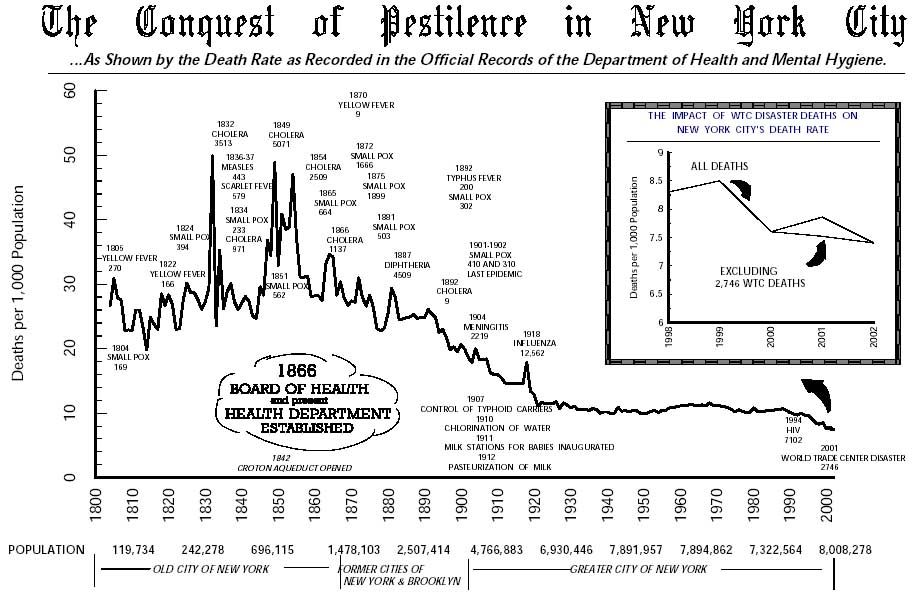
Insurance works through both poolong *and8 mitigating risks.

Standards of treatment, care, process, and product are all core risk-management practices. As are establishing preventive and public health regimes.

These in fact account for the overwhelming majority of health and longevity benefits since the 19th century.

http://1.bp.blogspot.com/-uTWEATUzgxk/TXQoTibILtI/AAAAAAAAAA...

Re: Employees Start to Feel the Squeeze of High-Deductible Health Plans

#355
post #248

Earlier quoted context omitted.

> No insurance company will want to underwrite a plan that doesn't bundle routine services, since those clearly reduce risk of complications down the road But current plans don't require you to get routine services like an annual physical; they just cover them if you get them. That doesn't make sense if the insurer's incentives that you describe are driving the plan. Also, these incentives don't seem to be operating…

I’m sure they would require you to get routine services if they could. Car insurance doesn’t cover routine maintenance because they also don’t cover problems that arise from not getting routine maintenance. I’d you neglect oil changes and blow up your engine, they don’t care, they don’t have to pay for it.

Governments may, however, demand standards of maintenance (e.g., Germany).

Re: Employees Start to Feel the Squeeze of High-Deductible Health Plans

#356

Earlier quoted context omitted.

I find it odd that some executive gets to pick which 401k and health insurance plans you get, and that you must pick from their few choices that allow you to have. I can see why the providers love it, they can target all their advertising, marketing, etc, at a few key people at large employers, but not sure how that benefits the average worker..

You can get an individual 401K or IRA and make all your own choices. If you're talking about an employer matched 401K, I don't think it's unreasonable at all for them to select it.

> If you're talking about an employer matched 401K, I don't think it's unreasonable at all for them to select it.

What's special about 401k matching that requires the employer to choose plans? My employer doesn't force me to have a checking account with a particular bank they chose if I want to receive my salary. They should be able to match contributions to any account anywhere.

Re: Employees Start to Feel the Squeeze of High-Deductible Health Plans

#357

Earlier quoted context omitted.

> Pay what you can Surely "what you can" should be relative to both your income and your need. We'd need to supervise the system to make sure people aren't taking advantage or else the whole system goes broke. > into a common pool We could also invest the money in the pool to make some extra cash and reduce what people need to pay in, we'd have to have an organization do that too. > (only as much as you need) How can…

They’re describing health insurance, except for the part where you pay what you can and get what you need and people are all in one pool.

We probably have different ideas of "paying what you can". How do you judge whether someone is only paying what they can, or they are taking advantage? Not a rhetorical question.

One way is like we do today -- highly-paid positions often come with high-quality insurance, which is (ime) fairly expensive and low-paid positions have less expensive insurance that is a bit worse (all this on average, I'm sure there are outliers).

We are in different pools today but I don't see how that's meaningfully different than everyone being in one pool if the individual pools are large enough and you can't discriminate the population of the pools.

Re: Employees Start to Feel the Squeeze of High-Deductible Health Plans

#358
post #2

You can argue that the ACA improved the healthcare system overall. But it's been tough for people who were already covered by employer insurance. I think people fail to appreciate that prior to the ACA, when the healthcare system worked, it actually worked really well. I got very sick at the age of 20 while I was still on my parents very modest insurance (pre-ACA). Within 48 hours I had an appointment at the best onc…

Pre ACA, pre-existing conditions could disqualify you from insurance. People with pre-existing conditions are the people that need health care coverage the most. We can't under-weigh the moral obligation we have to this previously marginalized group, when considering service may be slightly worse for people who have employer coverage. How I see it: if you were in the pre-ACA pre-existing condition pool, your perspect…

  pre-existing conditions could disqualify you from insurance
Only if you chose no insurance before diagnosis.

Under Obamacare, people can go with no coverage at all and, once diagnosed, then get care paid for without penalty. It's like letting people drive without insurance, then making insurance companies write retroactive policies for them after an at-fault collision.

Re: Employees Start to Feel the Squeeze of High-Deductible Health Plans

#359

Earlier quoted context omitted.

COBRA these days ends up being way too expensive for most people to afford. Perhaps at one time it was a useful regulation. Now it is pretty unaffordable.

If it was useful, it was a very long time ago. I remember my parents being in between jobs in the late 90’s and early aughts and complaining that COBRA was extremely expensive. The only reason the law seems to exist anymore is for people who somehow have some expensive debilitating condition yet can still work (or are a worker covering a family member with such condition). And that’s a pretty small subset of all heal…

I thought COBRA was exceedingly expensive in 2000. Now, the cheapest HMO Bronze plan is 300% more, adjusting for inflation.

Re: Employees Start to Feel the Squeeze of High-Deductible Health Plans

#360
post #67

Earlier quoted context omitted.

In my previous career, I was an accountant, and I worked for a health insurance company, you are straight up uniformed if you do not think that ACA raised the the cost of insurance. With that said, as a type 1 diabetic, without ACA it would be impossible for me to get insurance outside of employment, so i think there is some good in it, just needs to be actually thought through, unlike what the administration did tha…

>> just needs to be actually thought through, It's impossible because you both political parties want exclusively mutual results You can't have cheap insurance without making it mandatory since only the sick will get it You can't have easily accessible insurance without forcing healthcare companies to comply with new regulations forcing them to increase costs You can't have good insurance if you aren't willing to pay…

  It's impossible because you both political parties want exclusively mutual results
You can't blame ACA's flaws on party disputes -- Republicans were allowed no input to the process, and it passed on Democrat votes alone. Republicans and rank-and-file Democrats* weren't even given the final bill to read before the vote*.
Post reply on HN