Live data from Hacker News

Greed and corruption blew up South Korea’s nuclear industry

technologyreview.com

61–70 of 130 posts

Re: Greed and corruption blew up South Korea’s nuclear industry

#61

Earlier quoted context omitted.

> No. They can't as long as cheap energy storage on mass scales doesn't exist. It does, Tesla's grid-scale Powerwall made 25% of its cost in profits in 6 months (per https://insideevs.com/news/340702/tesla-powerpack-in-austral... ). Aside from using Powerwalls, us Europeans have extensive experience with using hydro pump storage.

The Tesla grid scale system made that money by stabilizing the grid, essentially providing storage for time periods below 15 minutes. It in no way provides the kind of storage that is needed to use solar or wind power as baseline production.

They also chose Australia on purpose, because the energy market there is pretty messed up and the result is high energy prices, i.e. higher profits than the same system would see somewhere else.

For battery storage to be cost effective in general it has to be quite a bit cheaper than it currently is. The cost has been declining, but people who expect exponential curves to continue forever are generally disappointed. It may or may not hit a stable floor before the cost is low enough to actually replace baseload power generation. What it is likely to be good for is to get over the load hump between dusk and bedtime for solar -- but that requires a lot less storage than being able to carry the whole night. Especially in winter (when the nights are longer), and especially if we expect people to switch from carbon-based to electric heat.

The issue is we need to be building things to replace carbon right now. Even if batteries become cost effective in a decade or more, that's too late. And there is no guarantee of even that.
Re: Greed and corruption blew up South Korea’s nuclear industry

#62
post #41

Nuclear power presents the perfect storm for negative public image: - Environmental movement went anti-nuclear in the '70s for no particular reason. - Fear Sells in the media. Nothing strikes fear like the invisible killer of radiation. Nuclear disasters get media attention like nothing else. - Nuclear weapons are scary, and rightfully so. And they share a word in common with "nuclear power," so there you go. Being t…

In fairness, nuclear is also just incredibly expensive. Witness Vogtie. Take away all taxes and regulations, then compare the price of, say, Iowa, building a nuclear plant instead of just slapping up windmills wherever they want. (Remember, we're assuming zero regulations. So while slapping up windmills would normally be incredibly illegal, we're able to do that under the conditions that our thought experiment postul…

Does anyone know if Saudi Arabia has explored solar power. Seems like they have a lot of unused land that gets a lot of sunlight...

Re: Greed and corruption blew up South Korea’s nuclear industry

#64

Earlier quoted context omitted.

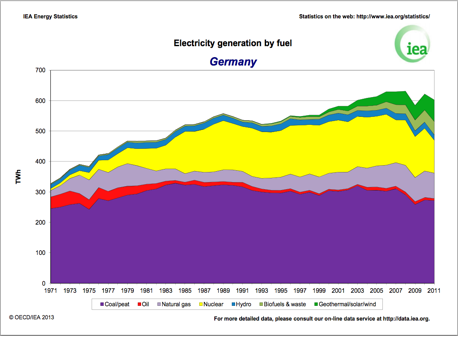
So why did Germany go with gas and coal?

Our coal infrastructure is on the way to be phased out, it won't be around for long-term any more - the Kohlekommission proposed 2035-2038 for the final shutdown, with 12.5 GW of 42.6 GW capacity going offline until 2022 (per https://www.zeit.de/wirtschaft/2019-01/kohlekommission-kohle... ). What's left will be gas and renewables.

It is planned to be phased out. Just like nuclear. That means that within 15 years Germany will have to replace roughly 70 % of its constant energy sources (nuclear and coals) by the only scalable constant energy source left: gas. Thereby becoming completely reliant on gas from Russia. Creating a massive geopolicital risk that didn't exist previously.

http://instituteforenergyresearch.org/wp-content/uploads/201...

I'll believe it when I see it. Also. What problem exactly is that supposed to solve?

I thought the whole energiewende stunt was about decreasing CO2 emissions. I'm not seeing this.

Re: Greed and corruption blew up South Korea’s nuclear industry

#65
post #51
post #48

Earlier quoted context omitted.

> because you still have all those coal, gas, and nuclear plants providing baseload power... That's right. So why would you not decommission all of that incredibly expensive nuclear, and draw down your use of the coal plants to fill in the gaps? That's how most dispatch stacks work. It's just common sense. Consumers want to save money. Utilities want to make enough money. There's just no way you use nuclear in any sc…

Coal can't dispatch fast enough, and most coal plants are at the end of their lifecycle and need to be replaced. So you have to build new baseload capacity, usually gas. (And really, you still need a bunch of batteries to handle short-term fluctuations in renewables output.) The problem, then, is that you have all new coal or gas plants, which are expensive capital assets, that you're basically using for standby powe…

Renewables and storage are already beating natural gas in that gap capacity. As both continue to decrease costs, that niche use will grow. Natural gas and coal tech are cost mature, while both renewables and storage are following natural tech development S-curves down and still have a long way to run.

Re: Greed and corruption blew up South Korea’s nuclear industry

#66
post #59
post #51

Earlier quoted context omitted.

Coal can't dispatch fast enough, and most coal plants are at the end of their lifecycle and need to be replaced. So you have to build new baseload capacity, usually gas. (And really, you still need a bunch of batteries to handle short-term fluctuations in renewables output.) The problem, then, is that you have all new coal or gas plants, which are expensive capital assets, that you're basically using for standby powe…

> So you have to build new baseload capacity... No, you don't. The coal plant in another Alliant Energy area has been around since roughly 1900? or so. It's been updated several times. Never was there a need to rebuild from scratch any coal plant. (This is Madison Wi btw.) Now we stopped using coal there in 2011, (all gas now). But the point is, all the renovations are much cheaper than building a nuclear plant. Util…

Just to back up your point a bit:

https://www.lazard.com/perspective/levelized-cost-of-energy-...

Running existing coal and nuclear generation appears to be cheap (2nd chart), but new generation appears to be much more expensive (1st chart). The cost of Solar + Storage is low and dropping, and already beats the cost of new nuclear plants (4th chart).

BTW, I grew up on the east side of Madison, Cheers.

Re: Greed and corruption blew up South Korea’s nuclear industry

#67
post #38

Earlier quoted context omitted.

I suspect the Chernobyl, Three Mile Island, and Fukushima Daiichi incidents also had a part to play in public perception.

And in particular, Three Mile Island happened in 1979 and crystallized a lot of US opposition to nuclear power. One of the problems it exposed is a too-friendly connection between the NRC and the nuclear power industry. According to a recent book [1], this problem still exists. [1] http://science.sciencemag.org/content/363/6424/237

I saw The China Syndrome as a kid and let’s just say I still think about it sometimes, living six miles from a Westinghouse PWR.

Re: Greed and corruption blew up South Korea’s nuclear industry

#68

Nuclear power presents the perfect storm for negative public image: - Environmental movement went anti-nuclear in the '70s for no particular reason. - Fear Sells in the media. Nothing strikes fear like the invisible killer of radiation. Nuclear disasters get media attention like nothing else. - Nuclear weapons are scary, and rightfully so. And they share a word in common with "nuclear power," so there you go. Being t…

> Environmental movement went anti-nuclear in the '70s for no particular reason.

NO particular reason?

> Nothing strikes fear like the invisible killer of radiation. Nuclear disasters get media attention like nothing else.

Other than that, maybe.

Re: Greed and corruption blew up South Korea’s nuclear industry

#69
post #38

Earlier quoted context omitted.

I suspect the Chernobyl, Three Mile Island, and Fukushima Daiichi incidents also had a part to play in public perception.

And in particular, Three Mile Island happened in 1979 and crystallized a lot of US opposition to nuclear power. One of the problems it exposed is a too-friendly connection between the NRC and the nuclear power industry. According to a recent book [1], this problem still exists. [1] http://science.sciencemag.org/content/363/6424/237

At the same time the NRC is too cozy with the industry it has kept all nuclear projects in the US tied up in red tape for literally decades.

Re: Greed and corruption blew up South Korea’s nuclear industry

#70

Earlier quoted context omitted.

The Tesla grid scale system made that money by stabilizing the grid, essentially providing storage for time periods below 15 minutes. It in no way provides the kind of storage that is needed to use solar or wind power as baseline production.

They also chose Australia on purpose, because the energy market there is pretty messed up and the result is high energy prices, i.e. higher profits than the same system would see somewhere else. For battery storage to be cost effective in general it has to be quite a bit cheaper than it currently is. The cost has been declining, but people who expect exponential curves to continue forever are generally disappointed.…

To be fair, nuclear power plants can also take a decade or more to build.
Post reply on HN