The actual study is here: "Aβ and tau prion-like activities decline with longevity in the Alzheimer’s disease human brain" https://stm.sciencemag.org/content/11/490/eaat8462 >
Proteins central to the pathology of Alzheimer’s disease act as prions – study
21–30 of 108 posts
Re: Proteins central to the pathology of Alzheimer’s disease act as prions – study
#22Can someone with a better background tell me if this is a game changer? I thought the consensus was that Alzheimer's probably had a few potential causes.
There's nothing in principle that prevents other mechanisms from inducing the prion conditions that eventually leads to Alzheimer's symptoms.
This paper is just another piece of evidence that points to the plaques and tangles being self propagating, instead of being say for example a pure by-product of some other mechanism. In itself, that doesn't really tell us anything about the mechanisms at play.
Is it a game changer? Probably not. It's unlikely that Alzheimer's is purely spread through inter-human prion transmission, so other factors are likely still at play.
Re: Proteins central to the pathology of Alzheimer’s disease act as prions – study
#23Are there any curable prion diseases right now? As far as I can tell from googling, CJD does not have any known cure. If there aren't, does it mean we need to come up with a completely new class of treatments?
There are no current treatments for Alzheimers that do much of anything. If the problem/cause is more confidently known, at least there is a more narrow target to aim at.
There are no current treatments for Alzheimers that do much of anything.
Well, unless you count physical exercise.
Re: Proteins central to the pathology of Alzheimer’s disease act as prions – study
#24Does this mean that inflammation of the brain is to be ruled out as a cause?
cheesymuffin's comment is downvoted, but I think he's on to something. It would be very odd to consider inflammation of the brain to be a cause of any problem, because inflammation is a symptom of something else.
Yeah I agree, however I'd imagine if inflammation was the cause of issues (and I recall some studies showing brain inflammation to be linked to some brain disorders) then perhaps more research would go into what causes the inflammation.
Some evidence the inflammation might be diet related too. Although I can't recall the source at the moment.
Re: Proteins central to the pathology of Alzheimer’s disease act as prions – study
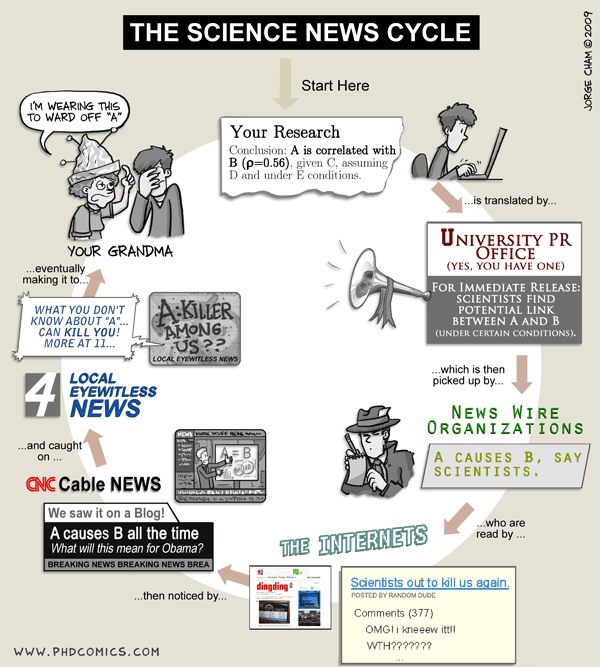
#25Y'all, please never post university press releases about single scientific studies . They are the worst thing. Every major human problem has been declared solved by one of them. They are even worse than posting single scientific study papers themselves at the time of publication, and that's still pretty bad, because of the overwhelming incentive to create exciting studies that are wrong, and our current inability to…
> lately it feels like _Science_ and _Nature_ are in fact especially likely to collect results that are very exciting and also wrong, because they feel like they're the best journals so their results should be surprising. I believe this is accurate on all counts. Slate Star Codex put the issue fairly pithily: there's only one way to get surprising-if-true results that isn't surprising.
Can you explain the joke?
Re: Proteins central to the pathology of Alzheimer’s disease act as prions – study
#26Does this mean that inflammation of the brain is to be ruled out as a cause?
cheesymuffin's comment is downvoted, but I think he's on to something. It would be very odd to consider inflammation of the brain to be a cause of any problem, because inflammation is a symptom of something else.
Being a symptom doesn't absolve it of being a cause too. If a thousand things can cause inflammation, but then there's a package of symptoms caused by inflammation itself, then it could be worth it to directly fight the inflammation in a lot of cases.
Re: Proteins central to the pathology of Alzheimer’s disease act as prions – study
#27How does a protein come to be misfolded? Is it a random mutation that happens to be self-propagating? Is it different between alzheimers and other ones like mad cow?
This is all preliminary, so nobody knows for sure about Alzheimers, but assuming it was, then it would likely be a different protein. (IOW a different linear chain of amino acids, that folded in a non-standard way.)
Re: Proteins central to the pathology of Alzheimer’s disease act as prions – study
#28Taken out of context, the press release makes this finding look a lot more ground-breaking than it is after I quickly read through the actual study. Still a good piece of work though.
It was already known, as pointed out in the actual paper, that Amyloid-beta (AB) and Tau, the proteins that have long been implicated in Alzheimer's disease (AD), have prion-like properties which means they exist in an abnormal 3D configuration that causes other AB/tau proteins they interact with to adopt this abnormal configuration.
But they can also polymerize into large neurofibrillary tangles (NFTs). Patients who died late, e.g. at age 80 with AD had a lot of these NFTs, so it seemed reasonable by many to assume that these NFTs are the major cause of brain deterioration. But there were a number of alternative hypotheses of what exactly AB and tau were doing in the disease.
This study suggests that AB and tau cause disease primarily through their prion-like activity and not due to their ability to accumulate into large trash-balls (NFTs). They noted that patients who died young of AD had very few NFTs but have a lot of the AB/tau prion-like forms, whereas patients who survived longer had a lot of NFTs but not a lot of prion activity. This lends evidence to the idea that the primary pathogenicity of AB/tau is through their prion activity and not the fact that they accumulate into large protein blobs.
Re: Proteins central to the pathology of Alzheimer’s disease act as prions – study
#29Y'all, please never post university press releases about single scientific studies . They are the worst thing. Every major human problem has been declared solved by one of them. They are even worse than posting single scientific study papers themselves at the time of publication, and that's still pretty bad, because of the overwhelming incentive to create exciting studies that are wrong, and our current inability to…
Re: Proteins central to the pathology of Alzheimer’s disease act as prions – study
#30Earlier quoted context omitted.
> lately it feels like _Science_ and _Nature_ are in fact especially likely to collect results that are very exciting and also wrong, because they feel like they're the best journals so their results should be surprising. I believe this is accurate on all counts. Slate Star Codex put the issue fairly pithily: there's only one way to get surprising-if-true results that isn't surprising.
Can you explain the joke?
The only way to get a surprising-if-true result that is not surprising is if the result is not true. Hence the joke is that most of these surprising findings are probably B.S.