Live data from Hacker News

Questions About Food and Climate Change, Answered

nytimes.com

71–80 of 143 posts

Re: Questions About Food and Climate Change, Answered

#71
The very first line in this article is just silly:

"Does what I eat have an effect on climate change? Yes. The world’s food system is responsible for about one-quarter of the planet-warming"

What you personally eat will make a tiny percentage of a fraction of 7 billionth difference.

Let's not just wash our hands of the issue and say "it's not my fault" - let's focus on encouraging action at the national and global level.

Re: Questions About Food and Climate Change, Answered

#72

There’s a bunch of good reasons you should reduce or eliminate meat from your diet, including environmental effects but also including your health and mistreating and killing intelligent creatures. If your diet requires people to do things to thinking, feeling animals that would be criminal to do to a dog, maybe having some bacon on your breakfast plate really isn’t that important after all.

I don't eat bacon.

I also don't share your view on the ethics of eating other intelligent beings (from different species). Many other animals eat other animals, and for this they have to kill them and cause them pain. The pain comes from the fact that animals do not easily die, and our death is almost always painful and horrifying.

But- why shoud humans be any different than other animals, when it comes to the ethics of killing other animals and causing them pain in order to feed on their meat? Other animals don't have any compunctions about doing the same to humans. Why are humans so special that it is immoral for us to eat meat?

Re: Questions About Food and Climate Change, Answered

#73
post #68

Earlier quoted context omitted.

Why are you dismissing Pinker simply because he is "a popular science writer", and "not a primary source"? If you're going to refute Pinker, show your work. Otherwise, it's just borderline ad hominem.

It's definitely not ad hominem, nor am I dismissing him. He is absolutely and indisputably a cognitive psychologist. And I would say that Enlightenment Now is clearly a popular science piece. Nothing is wrong with that. But he is just not a primary source on this data . So there is no refutation to be made in this context. Go to the bibliography, find the citation for the statistics that he used, and those can be dis…

This is social media, not a peer-reviewed journal. I don't think primary sources are necessary to justify basic numbers.

Pointing out that Pinker isn't a primary source isn't ad hominem. Bringing up that he's a psychologist and popular writer, repeatedly, is very much ad hominem. It's trying to discredit the messenger in order to dismiss the message. Don't do that, it's bad rhetoric.

Popular science writers serve an important role in disseminating ideas. As long as they're not misquoting sources, making up facts, or applying radical interpretations, there's nothing wrong with them. I don't see Pinker doing any of those things (if you disagree, be sure to source that!). And although Pinker may not be a climate scientist, he is a scientist of considerable credentials. He has taught at MIT, Stanford, and is a full professor at Harvard. In my mind, that brings a great deal of credibility to what he has to say on other scientific subjects, at least when quoting numbers.

So your arguments, as presented, provide approximately zero reason to doubt the numbers presented by the OP.
Re: Questions About Food and Climate Change, Answered

#74

Earlier quoted context omitted.

Isn't there a level of condescension and or proselytizing that always goes on around environmental conversations? Reduce, reuse, recycle - if you do it, good! If you don't, bad! Travel less, don't own anything. How can we frame these sorts of ideals so that people don't feel attacked? There _is_ a climate crisis. At least some level of that crisis is driven by consumer demands. We should be able to advocate a change…

I think it’s their problem and not ours. No one ever wants to change and no matter how nicely you put things they’ll always feel attacked. It’s just how it work, ultimately no one really wants to change so they need to be pushed.

> No one ever wants to change and no matter how nicely you put things they’ll always feel attacked.

Precisely. As another example, when people claim that progress pics are "fatshaming", it's pretty obvious that the problem isn't with the information or how it's presented, it's with the person feeling ashamed, which they rightfully are. These people should self-reflect upon why they feel ashamed instead of throwing a tantrum and playing the victim.

Re: Questions About Food and Climate Change, Answered

#75

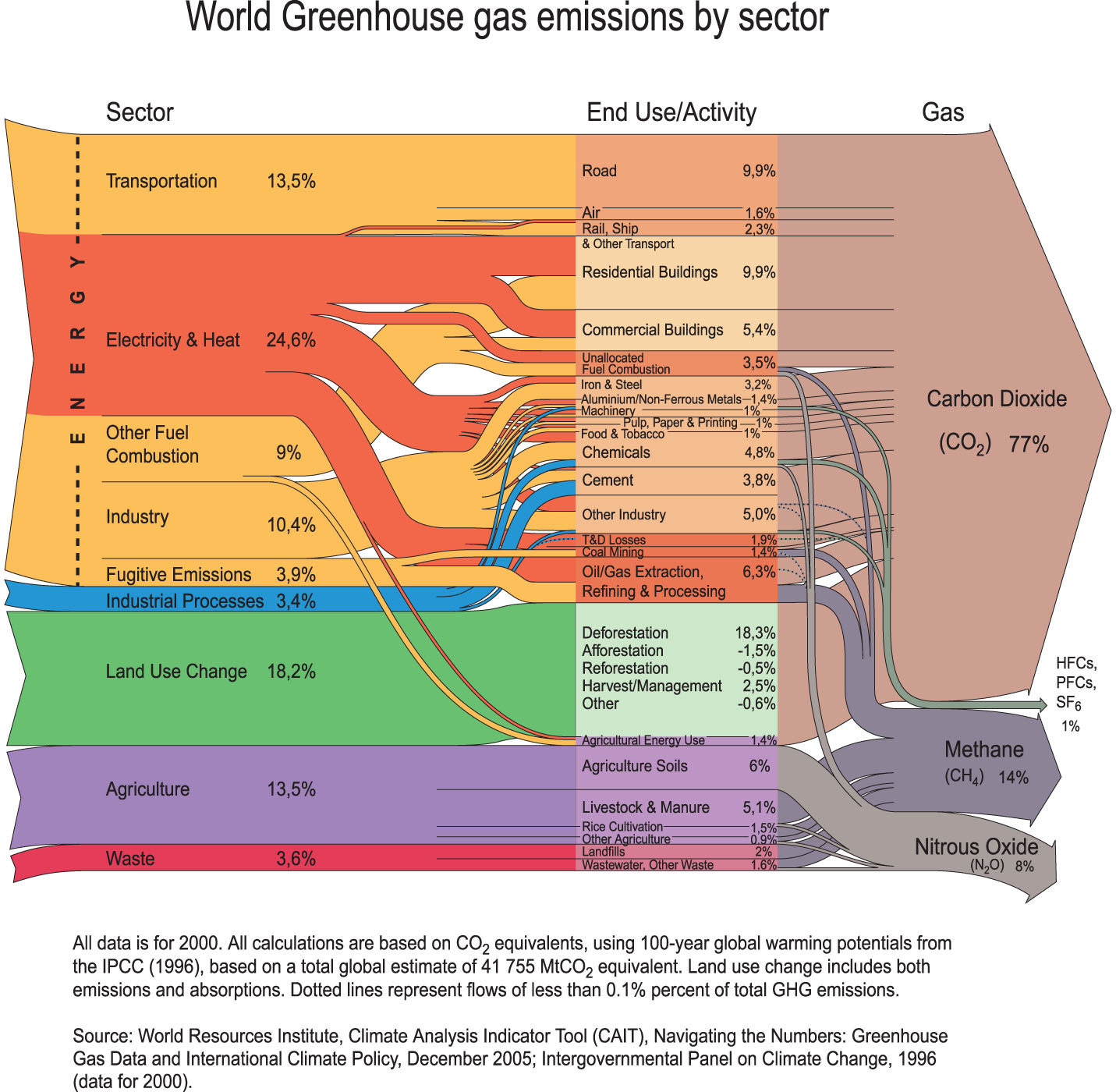
I know this isnt going to be a popular opinion here, but I'm going to say it anyways -- we are simply not going eat our away out of this climate change problem, and we shouldnt even try, we should focus the efforts in other places Here is the current breakdown of the world's emissions as of 2018: 1. heavy industry (29 percent) 2. buildings (18 percent) 3. transport (15 percent) 4. land-use change (15 percent) 5. the…

Personally I think the low hanging fruit is coal fires

https://en.m.wikipedia.org/wiki/Coal-seam_fire

Re: Questions About Food and Climate Change, Answered

#76

I know this isnt going to be a popular opinion here, but I'm going to say it anyways -- we are simply not going eat our away out of this climate change problem, and we shouldnt even try, we should focus the efforts in other places Here is the current breakdown of the world's emissions as of 2018: 1. heavy industry (29 percent) 2. buildings (18 percent) 3. transport (15 percent) 4. land-use change (15 percent) 5. the…

Most estimates put it at around 15%, not 5. Stopping climate change is going to require action on all these vectors, and diet is one of the easiest to change. It also has knock on effects like clear cutting rainforest to plant crops to feed to cows. On top of that it’s just cruel and unnecessary to go on eating so much meat.

Also clearing rainforests for palm oil trees.

Re: Questions About Food and Climate Change, Answered

#77

I know this isnt going to be a popular opinion here, but I'm going to say it anyways -- we are simply not going eat our away out of this climate change problem, and we shouldnt even try, we should focus the efforts in other places Here is the current breakdown of the world's emissions as of 2018: 1. heavy industry (29 percent) 2. buildings (18 percent) 3. transport (15 percent) 4. land-use change (15 percent) 5. the…

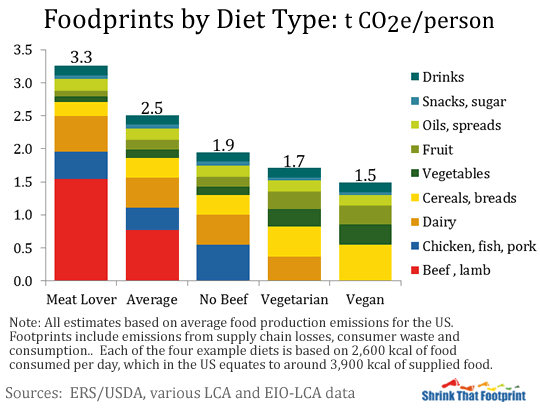
Going from the average diet to becoming a vegan would save about 1 ton per person annually: http://www.greeneatz.com/wp-content/uploads/2013/01/foods-ca.... The carbon footprint in the U.S. is about 20 tons per capita annually, so going from an average diet to full vegan would save just 5%. (Just cutting out beef would capture most of those gains, reducing CO2 footprint by 0.6 tons, or 3%.) Just eating less meat, or eating organic or whatever will have zero impact. And that's assuming that switching to veganism doesn't alter your other habits. If switching to veganism means you e.g. sign up for a meal delivery service to keep things interesting, or drive to the grocery store more often to get fresh fruits and vegetables (which, unlike meat, you can't freeze in bulk), your gains will be much less.

All of this stuff about "reducing your carbon footprint" is just such a mind-boggling waste of time. To keep the temperature increase to 2C we have to cut CO2 emissions worldwide by 19 gigatons in the next decade. Instead, China added 10 gigatons in the last decade. The U.S. and EU28 together emit just 9 gigatons. In the face of those numbers, all this "turn the lights off when you leave the room" and "try to eat less meat" stuff is pissing in the ocean.

Re: Questions About Food and Climate Change, Answered

#78

This is a great article. Do I have to go vegan? No. But it would have the biggest impact if you did. Is organic farming the answer? No. It tends to use more land for less output (although maybe the health-foodies could get off the No-GMO bandwagon). I also appreciate that the authors recognize that for some people living in certain cultures and climates _have_ to eat meat and there's no shame in that. The bulk of the…

This is an awful article because it doesn't put numbers on the various alternatives. Without hard numbers, the discussion of alternatives is meaningless. Even going from an average diet to fully vegan will only reduce your food-related emissions by 40%, which only accounts for about 12.5% of your carbon emissions to begin with (in the US): http://www.greeneatz.com/wp-content/uploads/2013/01/foods-ca.... Cutting your CO2 footprint 5% is not going to do anything. Cutting it even less than that is utterly pointless.

"Doing your part" and "doing small things" will not have any impact on climate change. It ignores the enormous gap between where our emissions need to be and where they are now. If you could convince everyone in America to become a vegan tomorrow, that would cut global CO2 emissions by about a gigaton. That is how much CO2 emissions went up last year alone, mostly due to China and India. Think about that: the effect of every American undertaking an unprecedented lifestyle change all at the same time would be totally wiped out by a single year's growth globally.

Re: Questions About Food and Climate Change, Answered

#79

I know this isnt going to be a popular opinion here, but I'm going to say it anyways -- we are simply not going eat our away out of this climate change problem, and we shouldnt even try, we should focus the efforts in other places Here is the current breakdown of the world's emissions as of 2018: 1. heavy industry (29 percent) 2. buildings (18 percent) 3. transport (15 percent) 4. land-use change (15 percent) 5. the…

Most estimates put it at around 15%, not 5. Stopping climate change is going to require action on all these vectors, and diet is one of the easiest to change. It also has knock on effects like clear cutting rainforest to plant crops to feed to cows. On top of that it’s just cruel and unnecessary to go on eating so much meat.

It's 15% globally, but just 5% in the U.S. That's because eating meat is one of the few things your average Bangladeshi or African does to create CO2 emissions. Those people aren't going to become vegans, and as those economies develop, they'll want more of the things that are responsible for the other 95% of your average American's carbon emissions.

Re: Questions About Food and Climate Change, Answered

#80
post #56

Earlier quoted context omitted.

Except that meat/dairy production have zero effect on climate change. Other then that you are correct.

Care to provide a source to back up that claim? If you read the article and associated sources you'd find a stack of scientific evidence to confirm that it has quite a large impact.

http://www.infohow.org/wp-content/uploads/2012/11/Greenhouse...

Edit: Downvoted for providing data? A new low.

Post reply on HN