Live data from Hacker News

Intel Stockpiling 10nm Chips

arstechnica.com

121–130 of 131 posts

Re: Intel Stockpiling 10nm Chips

#121
post #45

Earlier quoted context omitted.

> GPU of my desktop PC computes 11 TFlops, that's 4+ orders of magnitude faster. But they’re much lower quality (less flexible) FLOPs. If you don’t have much data parallelism or heavy conditional logic for each datum, you’re not going to come close to 11 teraflops.

If you don’t have much data parallelism or have heavy conditional logic, you won't come close to 1GFlops on that CPU either. These 2 FLOPs/cycle are for SSE i.e. 4-wide vector math without any conditions or branches. Update: also, for other tasks, GPU flops are of higher quality than CPU. VRAM bandwidth is ridiculous, much higher than system RAM, computations that are bound by RAM bandwidth will be much faster. GPUs…

> These 2 FLOPs/cycle are for SSE i.e. 4-wide vector math without any conditions or branches.

Using double precision SSE scaler ops, the Pentium III could execute one addition and one multiplication per cycle. (The throughput was the same with vector math because the Pentium III only had 64-bit SSE units. So a 128-bit packed multiply and a 128-bit packed add, four double precision operations, executed over two cycles.)
Re: Intel Stockpiling 10nm Chips

#122

Earlier quoted context omitted.

They're math operations on small vectors of 32-bit floating point numbers, they produce same result given same input data. The only difference is that CPU computes stuff on 4-wide vectors of these numbers (modern CPUs up to 16), that GPU on 32-wide vectors (other modern GPUs up to 64).

A lot of the FLOPS on newer CPUs are like GPUs, yes. But the comparison is against an old CPU, without big vector units. Those non-vector calculations are very different, and far more flexible. A brand new CPU core can do 3-4x as many separate operations per cycle, and is clocked 6-10x as fast. Having more cores helps but it's still far behind. Also for a fair price/performance ratio you probably want to compare to t…

> and far more flexible

They’re both very flexible, just different.

For example, GPUs are better at vectorized condition code. CPUs were mostly fixed with AVX512 but these instructions are too new, only available on some servers.

Sure, there’re algorithms which don’t work on GPUs. A stream cipher would be very slow because requires single-thread performance, also GPUs don’t have AES hardware. A compiler is borderline impossible because inherently scalar and requires dynamic memory. Also GPUs don’t do double-precision math particularly fast.

Still, I think many users who need high-performance computing can utilize GPUs. They’re trickier to program, but this might be fixable with tools/languages, we have been programming classic computers for ~70 years, GPGPUs for just 12.

Re: Intel Stockpiling 10nm Chips

#123
post #34

Earlier quoted context omitted.

Frequency is not a great comparator for different generations of CPUs. Your overall point is accurate, but your metric is not.

It's not even accurate to say CPU power has flatlined since Westmere . Instructions per cycle is significantly higher today than in 2010, so performance at the same nominal clock frequency is substantially better. Not to mention power efficiency gains since 2010.

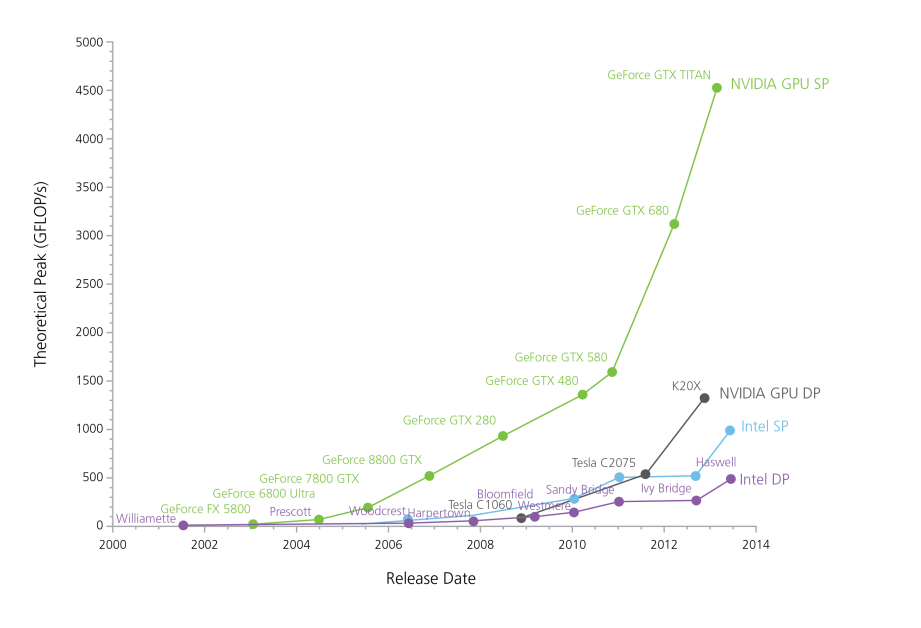
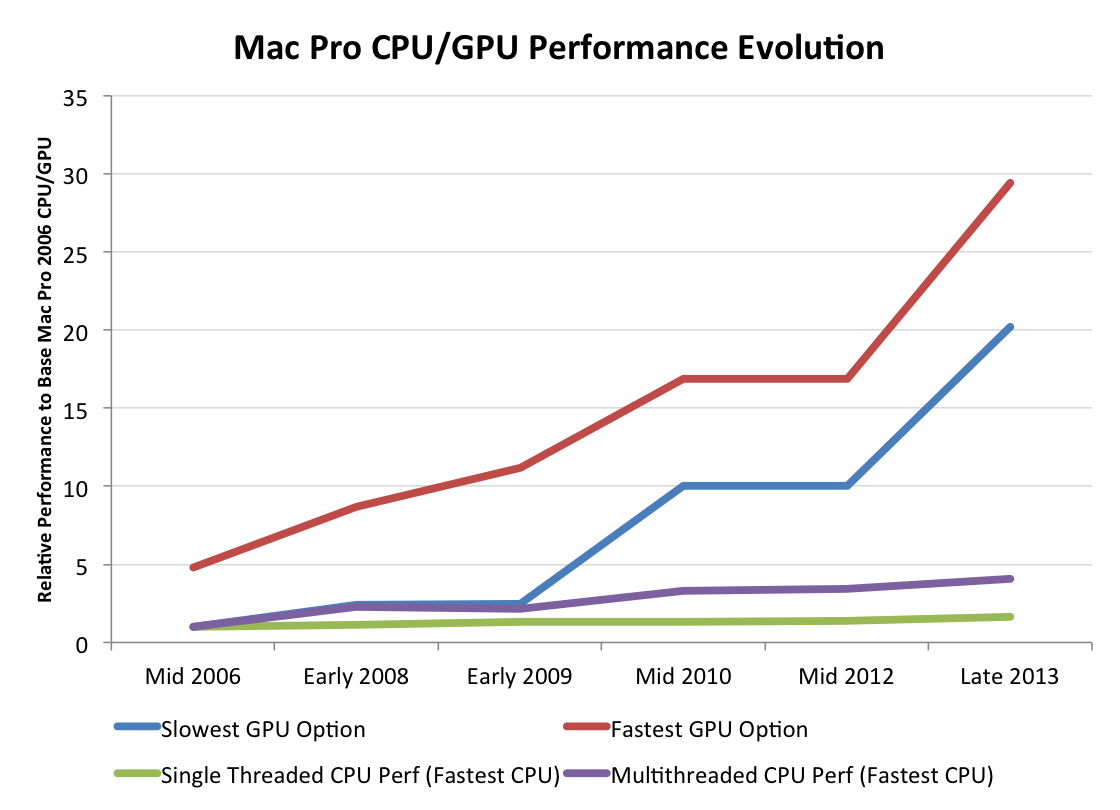
I said it's flatlined from seeing graphs like this[0] and this[1] (again, compared to GPUs).

But I'm far from an expert here (just an enthusiastic consumer), so what you're saying is news to me. The more flowers you can lay at what looks like the grave of Moore's law, the better. I don't like being a pessimist! :3

0: http://www.carestreamblog.com/blog/wp-content/uploads/2015/0...

1: https://images.anandtech.com/reviews/mac/MacPro2013/cpugpu.p...

Re: Intel Stockpiling 10nm Chips

#124
post #13

Earlier quoted context omitted.

My impression is that they know moore's gravy train is over and they're scrambling to figure out new tricks to allow them to sell a new generation of processors every year. Personally, while I'm a little disappointed that processors 20 years from now might not be 4+ orders of magnitude faster than the one I have now, I wouldn't mind being able to buy a computer and not have to worry about upgrading it for 10 years (I…

I'm hoping we see a big purge of all the cruft that's built up in the software layer over the years because processing power has been expendable.

I think that's going to be a gradual process, but it will likely happen. IMO Python will either have to move to including a JIT with the standard interpreter, or it will be replaced.

Re: Intel Stockpiling 10nm Chips

#125

Earlier quoted context omitted.

I'm hoping we see a big purge of all the cruft that's built up in the software layer over the years because processing power has been expendable.

I think that's going to be a gradual process, but it will likely happen. IMO Python will either have to move to including a JIT with the standard interpreter, or it will be replaced.

CPython is already a JIT

Re: Intel Stockpiling 10nm Chips

#126

Earlier quoted context omitted.

According to that image,10nm isn't due until 2Q 2021, in Tiger Lake and Rocket Lake U series and Y series.

Sure, it's due in 2021 now . At this point, Intel's 10nm has been two years away for about 5 years.

The project is always x time away, where x is a const. You just stop working on it and ship it as is when needed.

Re: Intel Stockpiling 10nm Chips

#127

The intel CPU situation is pretty embarrassing. I built back in 2009 a desktop with the intel i7-920 @2.66GHz (the first real quad core from intel) which I bought for less than $300. I look today and the cpu I can get for less than $300 is a 6 core i5 9600K @3.7 GHz. According to Passmark [1], this new CPU, is less than 2.5x faster overall, despite the additional 2 cores, and the much higher frequency. Intel just spe…

The TDP is a lot lower for the newer processor. Performance per Watt has improved quite a bit over the last years. Given that datacenters and mobile applications are increasingly more important than traditional "TDP doesn't matter" desktops, I think this is a positive development.

Intel changed their definition of TDP lately, so actual consumption can be higher than TDP. So it is not trivial to compare energy consumption of last year processors with the older ones.

Re: Intel Stockpiling 10nm Chips

#128
post #42
post #23

Earlier quoted context omitted.

I actually think along similar lines but at a higher level of abstraction. I think we'll have to start moving towards multiple complete computer systems, each with their own internal busses, memory, etc., that operate as a unified whole. A bit like massively parallel systems do.

Well hello there! I've been running 2 computers this way for years. Works very well for some stuff that supports multiple nodes, but unfortunately useless for most software. By far, the 1GbE link is the most limiting factor. Almost 15 years and we still don't have 10GbE as standard.

Some Ryzen (not Threadripper) motherboards have on-board 10gbit Ethernet

Re: Intel Stockpiling 10nm Chips

#129
post #25

Earlier quoted context omitted.

> I wouldn't mind being able to buy a computer and not have to worry about upgrading it for 10 years (I think we're pretty close to this point already). Depending on your needs, we're been there for at least 10 years. I don't expect to have to upgrade (not counting increasing memory or storage as "ugrading") or replace any of the systems I own right now until they're over 10 years old. About half of my current machin…

But isn't that just the result of lack of hardware gains limiting new software application areas? If single threaded performance had been doubling every two years for the past 10 years like it did historically, then there would likely be new applications available that made use of that 30x performance gains to deliver functionality that would be popular enough that it would reinvigorate the upgrade process. It seems…

> But isn't that just the result of lack of hardware gains limiting new software application areas?

For my needs? No. It's not that more performant systems (including software) aren't available, it's that they don't offer me any real benefit that justifies the hassle of replacing and reconfiguring my existing systems.

Re: Intel Stockpiling 10nm Chips

#130

Earlier quoted context omitted.

A lot of the FLOPS on newer CPUs are like GPUs, yes. But the comparison is against an old CPU, without big vector units. Those non-vector calculations are very different, and far more flexible. A brand new CPU core can do 3-4x as many separate operations per cycle, and is clocked 6-10x as fast. Having more cores helps but it's still far behind. Also for a fair price/performance ratio you probably want to compare to t…

> and far more flexible They’re both very flexible, just different. For example, GPUs are better at vectorized condition code. CPUs were mostly fixed with AVX512 but these instructions are too new, only available on some servers. Sure, there’re algorithms which don’t work on GPUs. A stream cipher would be very slow because requires single-thread performance, also GPUs don’t have AES hardware. A compiler is borderline…

> For example, GPUs are better at vectorized condition code.

That's throughput, not flexibility. I would define flexibility in terms of how easily the instruction stream can vary per math operation. Full flexibility requires a lot more transistors per FLOP, which is why you can't use wildly different architectures to assess Moore's law, which is about transistor count.

And comparing transistors on Pentium 3 (including cache) to an RTX 2060 (including cache) it seems to be 34 million vs. 10800 million. That's two and a half orders of magnitude.

Post reply on HN