And who knows what's to come for the next generation, with an increasing wealth divide and heck knows what else.
Is Life Expectancy Finally Topping Out?
11–20 of 62 posts
Re: Is Life Expectancy Finally Topping Out?
#12I remember seeing the horrible decline in life expectancy when the Soviet Union collapsed. At the same time, the Soviet client state of Cuba saw a dramatic reduction in economic activity and caloric restriction. Cuban dietary belt tightening led to a massive reduction in cardio vascular disease with a correlated massive reduction in obesity. I’m not a doctor, nor a data scientist or economist. But I suspect we will s…
On a deeper level, the notion that humans put “the will to live” above everything else is itself problematic. See Schopenhauer’s concept of the will to live and Nietzsche’s commentary on it.
Re: Is Life Expectancy Finally Topping Out?
#13She:
- was born in a time with no antibiotics
- lived on a farm with all of it's inherent risks
- lived through World War 1 (granted in the United States)
- survived the "Spanish Flu" (although as someone under 10 whereas hardest hit were adults)
- lived through the Depression
- started having children post World War 2 (now with antibiotics available).
I've often thought, just making it to age 10 showed that she had a strong immune system. When she started having children, she benefited from having access to antibiotics at a time when there was no drug resistance.
Looking at my parents generation (the baby boomers) and suddenly you have a generation of children where infant mortality etc goes way down (again thanks to antibiotics). In other words, children that wouldn't have survived in 1912 are now living into adulthood. We applied selection pressure to have children (and then in turn adults) with weaker immune systems. (Not saying this is a bad thing).
Because of the above, I wonder how much of the life expectancy increase has to do with a kind of winning the demographic lottery of: "When I was little, my immune system kept me alive. When I was an adult, medicine took care of what my immune system couldn't."
Re: Is Life Expectancy Finally Topping Out?
#14Earlier quoted context omitted.
>How much will people pay for an extra 5-10 years? Everything. I doubt it, most people aren't even willing to pay the small price of feeling lactic acid when exercising. Or not consuming excess calories. Quality of life matters too. If you have children, I would be surprised if most people would want to spend their personal wealth for an extra 5 to 10 geriatric bed ridden years. It only happens now because the taxpay…
A lot of people in the 90s wish they have another 10 years of being 50 and would happily live 10-20 years less time for that. Nobody is talking about ways to become a Struldbrugg, this is about extending healthy lifetime. There is a huge difference between "exercise to uncomfortableness every day and you'll probably live longer" and "give us $10M for a genetic modification treatment that extends your 50s for another…
Re: Is Life Expectancy Finally Topping Out?
#15Re: Is Life Expectancy Finally Topping Out?
#16My grandmother was born in 1912 and live to 97. She: - was born in a time with no antibiotics - lived on a farm with all of it's inherent risks - lived through World War 1 (granted in the United States) - survived the "Spanish Flu" (although as someone under 10 whereas hardest hit were adults) - lived through the Depression - started having children post World War 2 (now with antibiotics available). I've often though…
The concept of a “strong” vs “weak” immune system also doesn’t correspond to reality: for the flu, it’s hypothesized that it’s too strong an immune reaction that kills you. Many of today’s leading causes of death also don’t have much to do with the immune system, from the opioid epidemic to heart attacks, strokes, and cancer. Autoimmune disease is far ahead as a public health issue compared to infectious disease, from MS to (probably) vascular disease (edit: see this other story currently on the front page https://news.ycombinator.com/item?id=19742188)
Re: Is Life Expectancy Finally Topping Out?
#17I don't doubt that we're approaching the max life expectancy that you can get from natural means... By that, I mean curing diseases and maintaining the right balance of nutrition. But I think we'll start to see improvements that aren't about just staying healthy, but instead are about actually reversing "the aging process" and the things we barely understand about what makes us change as we get older.
We seem to have got a lot worse at nutrition over the last thirty years.
Re: Is Life Expectancy Finally Topping Out?
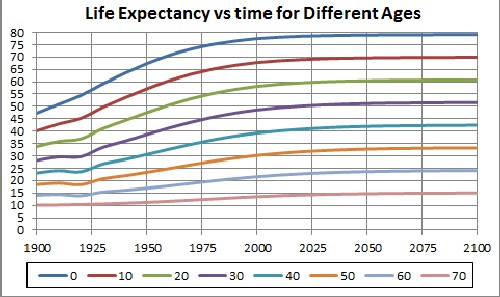
#18My understanding is that the doubling in life expectancy over the last 150-200 years was primarily due to the drastic reduction in infant mortality and elimination of most infectious diseases. If you only look at life expectancy from the point of reaching adulthood, the change hasn't been nearly as dramatic.
As an example, in the 20th Century, life expectancy at birth rose from about 40 to 77 years. But for 20 year olds, it also went from 34 to 59 additional years.
Re: Is Life Expectancy Finally Topping Out?
#19My grandmother was born in 1912 and live to 97. She: - was born in a time with no antibiotics - lived on a farm with all of it's inherent risks - lived through World War 1 (granted in the United States) - survived the "Spanish Flu" (although as someone under 10 whereas hardest hit were adults) - lived through the Depression - started having children post World War 2 (now with antibiotics available). I've often though…
There are lots of auto-immune disorders, where the immune system is intensely over active, and many a hypothesis is put forward as to why.
Having an immune system that reacts to anything and everything is awful. Ask anyone with allergies. And we're left scratching our head at why.
Why so many deadly peanut allergies? Latex? Soy? Bees? It used to just be hayfever, but now we need epipens.
Re: Is Life Expectancy Finally Topping Out?
#20My grandmother was born in 1912 and live to 97. She: - was born in a time with no antibiotics - lived on a farm with all of it's inherent risks - lived through World War 1 (granted in the United States) - survived the "Spanish Flu" (although as someone under 10 whereas hardest hit were adults) - lived through the Depression - started having children post World War 2 (now with antibiotics available). I've often though…