A progressive reading list or process to follow would be awesome
Ask HN: Best place to start learning about Markov Chains?
1–10 of 69 posts
Re: Ask HN: Best place to start learning about Markov Chains?
#2Here is an excellent place to start:
Re: Ask HN: Best place to start learning about Markov Chains?
#3You can find a copy of “Markov Chains and Mixing Times” online, which is good and relatively accessible.
Re: Ask HN: Best place to start learning about Markov Chains?
#4Tough one, I'd have to say:
45% http://setosa.io/ev/markov-chains/
30% https://en.wikipedia.org/wiki/Markov_chain
25% Youtube
Re: Ask HN: Best place to start learning about Markov Chains?
#5If you are not already intimately familiar with them learn about FSA (= finite state automata), aka FSM (finite state machines).
Most interesting facts about Markov chains (e.g. the Stationary Distribution Theorem) really are probabilistic generalisations of simpler facts about FSAs (e.g. FSAs cannot be used to "count"). In my experience, understanding them first for FSAs and then seeing how they generalise for the probabilitic case is a good way of approaching this subject.
Re: Ask HN: Best place to start learning about Markov Chains?
#6My personal favorite introduction to MC(MC) is lecture 1 of statistical mechanics and computations [1]
Re: Ask HN: Best place to start learning about Markov Chains?
#7For a broad introduction to Bayesian analysis, MCMC and PyMC I'd suggest Bayesian Methods for Hackers[1]
[1] http://camdavidsonpilon.github.io/Probabilistic-Programming-...
Re: Ask HN: Best place to start learning about Markov Chains?
#8I’ve got a couple of links here:
https://github.com/melling/MathAndScienceNotes/tree/master/s...
Re: Ask HN: Best place to start learning about Markov Chains?
#9markov chains are very simple at their core (e.g. simple version could be: take the probability of the next word given the known probabilities of words that follow the previous word)
it can be implemented in a few lines of code, that's the beauty of it: https://github.com/justindomingue/markov_chains/blob/master/...
obviously then you could take the previous n words into account, tweak the starting word, add randomness, etc.
now replace "word" with "state" and "probability(next state | previous state)" to edges of a graph: https://static1.squarespace.com/static/54e50c15e4b058fc6806d...
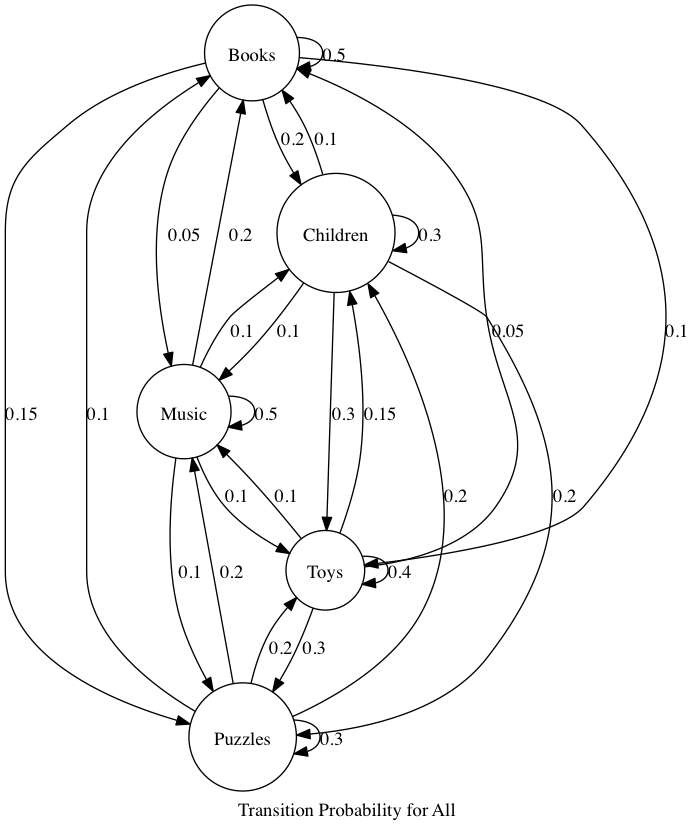
and you got a generic markov chain :)
footnotes: p(A | B) is probability of A given B, e.g. p(rain | clouds) > p(rain | sun) :)
Re: Ask HN: Best place to start learning about Markov Chains?
#10Personally, I started with Eugene Charniak's Statistical Language Learning [1] then continued with Manning and Schütze's Foundations of Statistical Natural Language Processing [2] and Speech and Language Processing by Jurafsky and Martin [3].
The Charniak book is primarily about HMMs and quite short, so it's the best introduction to the subject. Manning and Schütze and Jurafsky and Martin are much more extensive and cover pretty much all of statistical NLP up to their publication date (so no LSTMs if I remember correctly) but they are required reading for an in-depth approach.
You will definitely want to go beyond HMMs at some point, so you will probably want the other two books. But, if you really just want to know about HMMs, then start with the Charniak.
______________
[1] https://mitpress.mit.edu/books/statistical-language-learning