Live data from Hacker News

Windows 3.1 in my BIOS? It's more likely than you think

hackaday.com

21–30 of 62 posts

Re: Windows 3.1 in my BIOS? It's more likely than you think

#21
>"Windows 3.1 in my BIOS? It's more likely than you think".

That is a pretty misleading title to me, it sounds like they discovered many bios's have embedded windows 3.1 to run the user interface.

Instead its about someone purposefully loading windows 3.1 onto their bios flash chip, and how they made it functional. "How i embedded windows 3.1 into my bios" or something would be a more descriptive title.

edit: Or even "Windows 3.1 Flash edition", as the original page & hn post have, https://news.ycombinator.com/item?id=19630502

Re: Windows 3.1 in my BIOS? It's more likely than you think

#24

> This was achieved via a DOS USB driver (if the device got hotplugged, R:\WINDOWS\USB\USB.BAT is your friend) DOS has USB drivers. This is the weirdest part.

DOS is still surprisingly usable in the modern world with a little work. That isn't super surprising though given how simple a system it is and how ubiquitous it was in the relatively recent past.

Re: Windows 3.1 in my BIOS? It's more likely than you think

#25

>"Windows 3.1 in my BIOS? It's more likely than you think". That is a pretty misleading title to me, it sounds like they discovered many bios's have embedded windows 3.1 to run the user interface. Instead its about someone purposefully loading windows 3.1 onto their bios flash chip, and how they made it functional. "How i embedded windows 3.1 into my bios" or something would be a more descriptive title. edit: Or even…

I seem to remember that Compaq business PCs in the late 1990s/early 00s had BIOS/NVRAM setup that looked suspiciously like a customized build of Windows 3.1. You held ESC or something during boot and you got a mouse-driven interface to set various hardware settings. I remember it being quite the contrast to the more common text-mode menu based BIOS setups.

I never looked into it whether it was actually in ROM/Flash or whether it booted off a special disk partition.

Here are some screenshots I found that kind of match what I remember:

https://www.flickr.com/photos/55026075@N00/4140236576/in/pho... https://www.flickr.com/photos/55026075@N00/4139477409/in/pho...

Re: Windows 3.1 in my BIOS? It's more likely than you think

#26

>"Windows 3.1 in my BIOS? It's more likely than you think". That is a pretty misleading title to me, it sounds like they discovered many bios's have embedded windows 3.1 to run the user interface. Instead its about someone purposefully loading windows 3.1 onto their bios flash chip, and how they made it functional. "How i embedded windows 3.1 into my bios" or something would be a more descriptive title. edit: Or even…

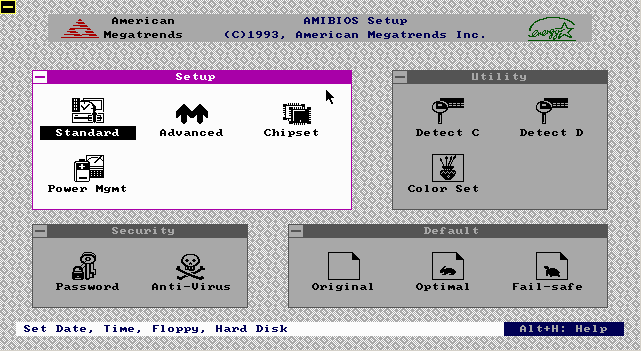
I thought it was about someone (re)discovering AMI WINBIOS: https://media.moddb.com/images/groups/1/4/3107/winbios.gif

Re: Windows 3.1 in my BIOS? It's more likely than you think

#27
post #25

>"Windows 3.1 in my BIOS? It's more likely than you think". That is a pretty misleading title to me, it sounds like they discovered many bios's have embedded windows 3.1 to run the user interface. Instead its about someone purposefully loading windows 3.1 onto their bios flash chip, and how they made it functional. "How i embedded windows 3.1 into my bios" or something would be a more descriptive title. edit: Or even…

I seem to remember that Compaq business PCs in the late 1990s/early 00s had BIOS/NVRAM setup that looked suspiciously like a customized build of Windows 3.1. You held ESC or something during boot and you got a mouse-driven interface to set various hardware settings. I remember it being quite the contrast to the more common text-mode menu based BIOS setups. I never looked into it whether it was actually in ROM/Flash o…

Sadly, I can't view your images on my device, but I have a '96 Presario that's fairly close in vintage; it has what I presume you are describing. The program resides on a hidden DOS partition on the HDD. While novel, it's a bit unfortunate, as there's no configuration program in ROM, so without that partition (or the multi-disk floppy set) you can't configure the CMOS settings.

Re: Windows 3.1 in my BIOS? It's more likely than you think

#28
Regarding the audio: I don't know about that specific model but I believe it uses standard Intel HD Audio (Azalia) --- and someone has written an HDA driver for Win3.x that goes by the name of "HDADRV9J" (complete with source code, albeit somewhat messy, in Pascal):

http://www.vcfed.org/forum/showthread.php?50867-Windows-3-1-...

http://turkeys4me.byethost4.com/programs/index.htm

(This stuff is notoriously difficult to find. I only found out about HDADRV9J from Google a few months back, and there were quite a few sites about it, now there's almost no results...)

Re: Windows 3.1 in my BIOS? It's more likely than you think

#29

>"Windows 3.1 in my BIOS? It's more likely than you think". That is a pretty misleading title to me, it sounds like they discovered many bios's have embedded windows 3.1 to run the user interface. Instead its about someone purposefully loading windows 3.1 onto their bios flash chip, and how they made it functional. "How i embedded windows 3.1 into my bios" or something would be a more descriptive title. edit: Or even…

It's a reference to an ancient internet meme.

https://knowyourmeme.com/memes/its-more-likely-than-you-thin...

Re: Windows 3.1 in my BIOS? It's more likely than you think

#30
post #19

Reminds me of the 486 motherboard which would boot DOS with no SIMMs (RAM) in it. It had 64 kbyte cache on the motherboard...

Wait, wow, I've never heard of this. Do you have a link of this phenomena?

Don't know about the 486 specifically, but this sort of thing wasn't unheard of. I have a pentium-era machine with 8MB EDO built into the board. It can stand alone or complement whatever you put in your DRAM slots (though curiously, if you max it out at 4x32MB, you get 128MB, not the 136MB you might hope for...)

Edit: wait... I thought we were talking about something unusual because he mentioned SIMMs, and the 486 specifically, but I guess he's just talking about the conventional memory on x86 that peaked at 640KB. This is not what I was describing above (that system has extended EDO built in in addition to the conventional 640).

Don't have a specific link for you, but just look into the memory model of the IBM PC, conventional vs extended RAM, etc... 640KB (or less!) was all we used to have, plugged right into DIP sockets.

When, in the late 80s, computing technology started increasing in power like mad, we quickly needed access to more RAM, but the original memory model held us back, so we had to hack around it in various awkward ways. So we ended up with the original on-board chips + SIMM expansion slots.

Looking back, we were so terribly shortsighted in our designs, and Moore's Law just continually blew everything to hell.
Post reply on HN