1st 2nd 3rd choice
John Adams [ ] [ ] [ ]
Ben Franklin [ ] [ ] [ ]
Tom Jefferson [ ] [ ] [ ]
Betsy Ross [ ] [ ] [ ]Approval Voting versus Instant Runoff Voting
11–20 of 96 posts
Re: Approval Voting versus Instant Runoff Voting
#12Does Approval Voting really pass the "favourite betrayal criterion"? There are scenarios where if you don't vote for both Good and Ideal, bad will win, and scenarios where if you do vote for both Good and Ideal, Good will win (over Ideal) You obviously don't know which scenario you're in when you vote, so you don't know whether you should vote for both good+ideal or just ideal - both options can cause a worse result…
So if candidate #1 would win a simple majority (50.01% of voters), but is absolutely hated by everyone else, but #2 is "acceptable" or second best to 100% of the voters, should #1 win?
We are used to the binary "simple majority takes all" in elections, but maybe the compromise "everybody is pretty OK with this one" _should_ win.
If it were a group of friends going to a restaurant, or playing a game, #2 sounds like a much better option.
Re: Approval Voting versus Instant Runoff Voting
#13Article makes some good arguments for approval voting, but the "Ballot Spoilage" argument is a bit disingenuous. Ballots can't be spoiled in approval voting because any set of circles can be filled in. However it's a lot easier to corrupt a ballot undetected. Just fill in more bubbles for your candidate.
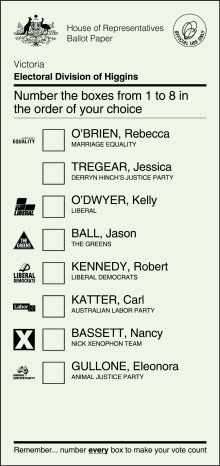
They seem to have tried to intentionally tried to create a much more complicated ballot paper for IRV
Here's a sample of an Australian IRV voting form:
https://upload.wikimedia.org/wikipedia/commons/thumb/4/48/20...
Re: Approval Voting versus Instant Runoff Voting
#14As a libertarian anything that increases the ability of a 3rd party go gain traction interest me but something smells very off about the recent uptick in discussion of alternatives. If these changes were actually beneficial to the underdog in the general case you'd see them being pushed by the left or the right on a state by state basis depending on the political make up of any given state. The parties aren't run by…
And political scientists! (No-one listens to us, of course).
More seriously, the case for standard First-Past-The-Post voting is really bad in terms of its decision-making properties. It's really only as dominant as it is, where it is, because of its historical position. Exactly what you might replace it with is a trickier question, with multiple plausible candidates, all better than FPTP and all different from each other. I lean towards Single Transferable Vote, and its special case AV/IRV in single member elections, but reasonable people can disagree.
Intriguingly, the British Parliament has just effectively used approval voting to try to break its Brexit deadlock. It failed in this case largely because many members voted highly tactically for their 'ideal' option only, not for what they could live with. AV/IRV would have been a better choice, I think, if a compromise winner was actually wanted.
Re: Approval Voting versus Instant Runoff Voting
#15It's a bit silly to argue that candidates take up too much space on a IRV ballot when it would suffice to duplicate only the box and not their name, as in 1st 2nd 3rd choice John Adams [ ] [ ] [ ] Ben Franklin [ ] [ ] [ ] Tom Jefferson [ ] [ ] [ ] Betsy Ross [ ] [ ] [ ]
Re: Approval Voting versus Instant Runoff Voting
#16Does Approval Voting really pass the "favourite betrayal criterion"? There are scenarios where if you don't vote for both Good and Ideal, bad will win, and scenarios where if you do vote for both Good and Ideal, Good will win (over Ideal) You obviously don't know which scenario you're in when you vote, so you don't know whether you should vote for both good+ideal or just ideal - both options can cause a worse result…
Re: Approval Voting versus Instant Runoff Voting
#17Article makes some good arguments for approval voting, but the "Ballot Spoilage" argument is a bit disingenuous. Ballots can't be spoiled in approval voting because any set of circles can be filled in. However it's a lot easier to corrupt a ballot undetected. Just fill in more bubbles for your candidate.
This is easily prevented by additionally marking the number of candidates chosen.
Re: Approval Voting versus Instant Runoff Voting
#18As a libertarian anything that increases the ability of a 3rd party go gain traction interest me but something smells very off about the recent uptick in discussion of alternatives. If these changes were actually beneficial to the underdog in the general case you'd see them being pushed by the left or the right on a state by state basis depending on the political make up of any given state. The parties aren't run by…
Of course, the simple and well-tested solution is to reduce the power of the Executive, move power to Parliament, and assign power proportionally to parties.
Re: Approval Voting versus Instant Runoff Voting
#19Re: Approval Voting versus Instant Runoff Voting
#20Article makes some good arguments for approval voting, but the "Ballot Spoilage" argument is a bit disingenuous. Ballots can't be spoiled in approval voting because any set of circles can be filled in. However it's a lot easier to corrupt a ballot undetected. Just fill in more bubbles for your candidate.
The argument for "Ballot Simplicity" is misleading too They seem to have tried to intentionally tried to create a much more complicated ballot paper for IRV Here's a sample of an Australian IRV voting form: https://upload.wikimedia.org/wikipedia/commons/thumb/4/48/20...