Live data from Hacker News

Preliminary conclusion MCAS misfired in Ethiopian's 737 max crash

cnbc.com

61–70 of 145 posts

Re: Preliminary conclusion MCAS misfired in Ethiopian's 737 max crash

#61
post #39

Earlier quoted context omitted.

Because if you did that, you'd have to alert the pilots when the AoA sensors disagree and MCAS has been disabled. And you can't do that without training them on what that means, notably how the plane will now fly differently with what you might call "relaxed stability" at high angles of attack. And Boeing really really wanted to avoid retraining of pilots because apparently they had a contract with SouthWest that wou…

$1M sounds like pocket change after all that has happened.

If those victims would be primarily from western country, especially US, there would be almost immediate class action lawsuit against Boeing from families (US citizens seem more trigger-happy to fire lawsuits when feeling wronged, at least from my perspective).

But I guess Ethiopian/Indonesian cries for some sort of compensation/justice would have to go very viral in western media to force a corporation like Boeing into anything (since it is also a clear admission its purely their fault, which it seems to be).
Re: Preliminary conclusion MCAS misfired in Ethiopian's 737 max crash

#62
post #9

Earlier quoted context omitted.

Simply search for the title on Google, and they’ll let you in based on that. https://www.google.com/search?q=Investigators+Believe+Boeing...

This didn’t work for me (neither did the “web” link under op title). Wonder if it was because I’d already visited?

Not working for me either, not even in an incognito window.

Re: Preliminary conclusion MCAS misfired in Ethiopian's 737 max crash

#63
post #52

Earlier quoted context omitted.

If it happens to a brand new plane? I'd say: Yes; that's reasonable. At least until the cause is known. Edit : Some clarification

Cause is always complicated in an air crash. We don't officially know the cause of either of these crashes. When MCAS was established to be a likely factor in the first crash, Boeing issued an emergency airworthiness directive to all operators of the 737 Max, alerting pilots to the possibility of undesired nose down trim, and reminding them that the runaway trim procedure would disable it.

Which was far from enough as we can see. Full retraining and perhaps other actions should have happened immediately so Boeing could hold any form of moral high ground here.

When it comes to mass transport, safety should definitely have higher priority than pushing some potentially new cool tech ASAP (which is debatable, making plane unstable ain't cool by any measure)

Re: Preliminary conclusion MCAS misfired in Ethiopian's 737 max crash

#64

Earlier quoted context omitted.

40 seconds is an eternity to accomplish the memory items on runaway stab trim non-normal checklist. It’s literally “control column - hold firmly” (already a given, since MCAS only affects manual flight and the increased back pressure required is the cue that something is amiss), “autopilot and autothrottle - disengage” (click-click, click-click), (if runaway continues) “stab trim cutout switches - cutout (both)”, (if…

Going from previous discussion, apparently it would be hard for pilots to recognise it as trim runaway. The last description mentions: stall warning going off, column shake, incorrect airspeed (on one side, due to the faulty sensor), trim wheel doesn’t move, plus the fact MCAS operates in 10s intervals. Has the information disclosed to pilots after the LyonAir incident been made public?

Yes, easy to imagine a chaotic situation causing distraction, or hyper focus on the wrong thing, etc.

What I have gathered from reading other forums about this, many pilots say they would interpret any significant undesired trim as a runaway condition, regardless of whether it was happening in intervals or it was literally continuous.

Others say that depending on training, and the policies of the operator, a much more literal reading of procedures is enforced.

I don't fly, but apparently trim is a very fundamental control for a pilot. It's easy to recognize when the aircraft is out of trim, and reacting to it is about as natural as it is for a driver of a car to use the steering wheel to keep the car centered in a lane.

So my assumption is, that with the AoA disagreement, and resulting multiple alerts and chaos in the cockpit, the pilots lost awareness of what the trim was doing.

I'm wondering if there's not a deeper problem within the air data systems. Why are the AoA sensors on new aircraft failing? They are just simple vanes, normally very reliable. The same ones are used on many different aircraft. So I don't think the actual sensor is a problem. But maybe there's something different downstream of the sensor itself. I would think if there were persistent problems with bad AoA data in 737s generally, it would have been addressed. Because the stick shakers, unreliable air speed, and everything else would still be happening regardless of MCAS.

Re: Preliminary conclusion MCAS misfired in Ethiopian's 737 max crash

#66
post #11

Earlier quoted context omitted.

Maybe time was an issue? Saw in an earlier post that the issue had to be mitigated within 40 seconds of it occurring.

40 seconds is an eternity to accomplish the memory items on runaway stab trim non-normal checklist. It’s literally “control column - hold firmly” (already a given, since MCAS only affects manual flight and the increased back pressure required is the cue that something is amiss), “autopilot and autothrottle - disengage” (click-click, click-click), (if runaway continues) “stab trim cutout switches - cutout (both)”, (if…

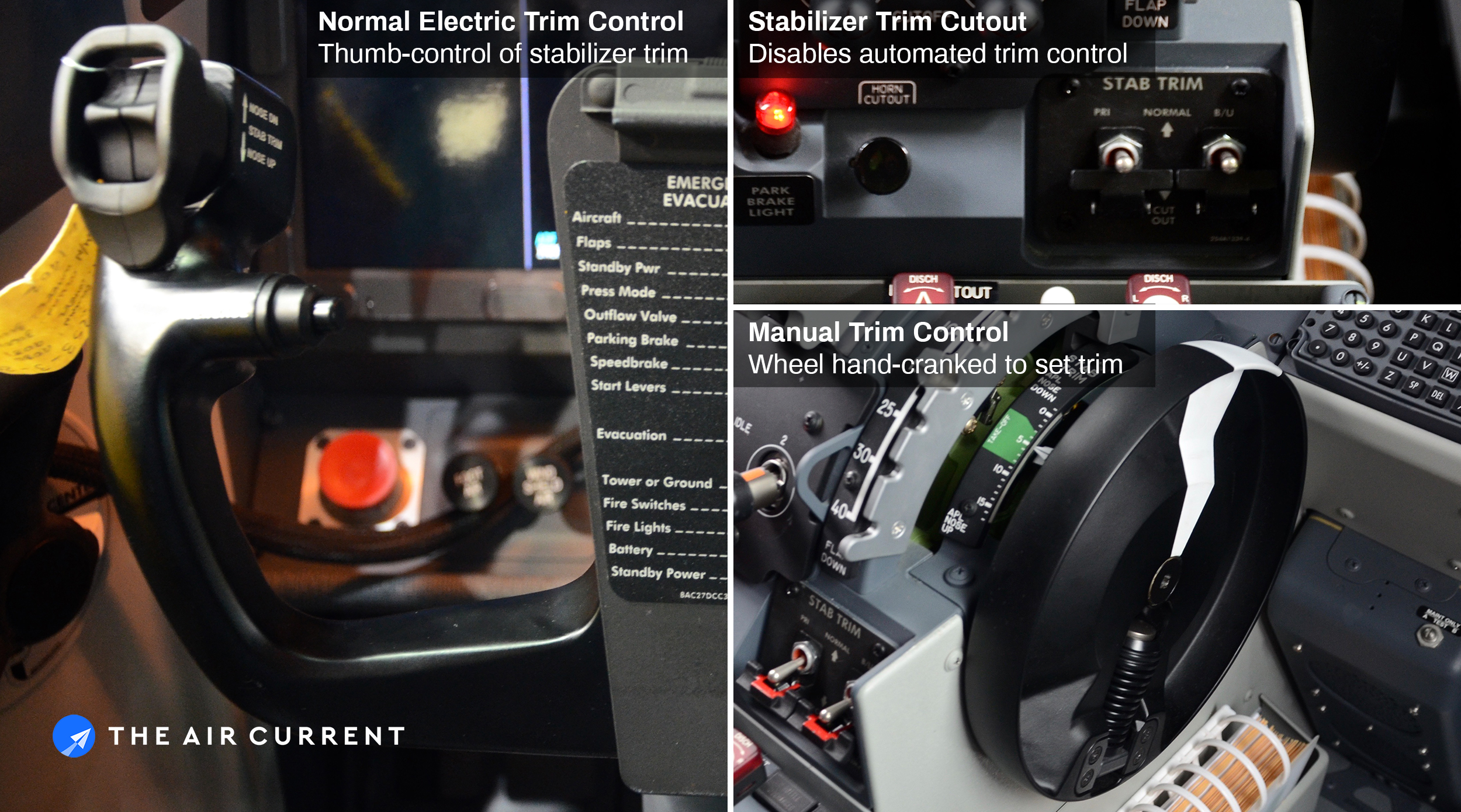
I wonder if the difference in behavior between the trim buttons on the stick and trim cutout switches on the panel was the problem?

If I've read correctly, the former only temporarily disengages MCAS. The pilots may have repeatedly hit the button on the stick, but then 20s later, MCAS re-engages and sends the plane nose down again.

I agree that the procedure calls for flipping the switch on the panel. But, not sure that's actually what the pilots were doing.

In the image below, you can see the electric trim control on the stick in the left portion, and the manual trim cut-out switch on the panel in the top right.

https://theaircurrent.com/wp-content/uploads/2018/11/737-max...

Re: Preliminary conclusion MCAS misfired in Ethiopian's 737 max crash

#68
Still doesn't answer the question of, why if MCAS is required during critical portions of the flight to prevent stalling is disabling of MCAS an acceptable solution for this aircraft?

Introducing a new condition of "We think MCAS is on, but we're not quite sure / it's cutting in and out due to censor disagreements" is preposterous.

Re: Preliminary conclusion MCAS misfired in Ethiopian's 737 max crash

#69
post #16
post #9

Earlier quoted context omitted.

Simply search for the title on Google, and they’ll let you in based on that. https://www.google.com/search?q=Investigators+Believe+Boeing...

The little "web" link under the title of every HN post does that for you :-)

It does the search for you, but WSJ is paywalled even in private browser sessions. But, there are other sources for this particular topic, as it's covered extensively by the MSM.

Re: Preliminary conclusion MCAS misfired in Ethiopian's 737 max crash

#70
post #51
post #38

Earlier quoted context omitted.

Ah, so that indicator would have been abnormally in the "nose down" area after MCAS over adjusted it. Interesting. Information overload, and nobody looked because that amount of auto adjustment wasn't anticipated. And also means they didn't correlate the fairly noisy/visual turning off the wheels to get it in that position.

There was a PDF incident report going around earlier with a chart showing a graph of the inputs from MCAS and the pilots over a period of time. There was a "nose down" command from MCAS, followed by a "nose up" command from the pilot, then a "nose down" command from MCAS, a "nose up" command from the pilot... repeated about 20 times in a row...

Yes, right, they would have had to figure out they needed to hold the wheel to keep it from auto-adjusting. Which wouldn't be real intuitive if you didn't know MCAS existed. Though holding the wheel is supposedly part of the normal runaway stabilizer trim checklist.
Post reply on HN