While certainly Germany has done a lot right and deserve credit for their current economic strength, we have to recognize that they've both chosen a very different path: i.e. stability over growth, and also have a very different culture than we Anglo-Saxons - which I would argue are quite inter-related. When it comes to quality manufactured goods, Germany is legendary and has strongly biased its economy over the past…
I suggest that people don't go too overboard in praising Germany. Their unemployment rate over the past 20 years has been a disgrace and do not forget that though their trade surplus is healthy some consider it also reflects the weakness in German commodity consumption. Some food for thought (though the later figures don't seem accurate): http://www.wolframalpha.com/input/?i=us+gdp+growth+since+199... http://www.wolf…
How Germany got it right on the economy
31–40 of 77 posts
Re: How Germany got it right on the economy
#32The problem with this article is that is glosses over one major problem: if Germany's currency moved in accordance with its economy rather than the entire European Union then its exports would be grossly overpriced and uncompetitive. It's the formation of the EU and a single currency that has allowed it to remain an exporting country rather. The article can not compare apples to oranges and make sense.
If a country like Greece or Ireland is basically collapsing, it survives because countries like Germany and France pay for it. There is no such thing as a free lunch. What Germany gains now because of the weak Euro, it had to pay a few months ago to help Greece.
However, Greece has been paid by the government, not small businesses. Small businesses only have to bear that burden gradually by paying taxes.
Re: How Germany got it right on the economy
#33While certainly Germany has done a lot right and deserve credit for their current economic strength, we have to recognize that they've both chosen a very different path: i.e. stability over growth, and also have a very different culture than we Anglo-Saxons - which I would argue are quite inter-related. When it comes to quality manufactured goods, Germany is legendary and has strongly biased its economy over the past…
Just as a plug for German innovation -- consider the 19th century: if you include Austria/ Vienna, people who spoke German (and were often Jewish) basically invented modern thought, ranging from mathematics to chemistry to music to philosophy to psychology etc. England was great in applied physics and math, France in dynamics and biology, but in theoretical math, music, and philosophy Germany TOWERS above anyone in t…
Re: How Germany got it right on the economy
#34Earlier quoted context omitted.
I suggest that people don't go too overboard in praising Germany. Their unemployment rate over the past 20 years has been a disgrace and do not forget that though their trade surplus is healthy some consider it also reflects the weakness in German commodity consumption. Some food for thought (though the later figures don't seem accurate): http://www.wolframalpha.com/input/?i=us+gdp+growth+since+199... http://www.wolf…
Their unemployment is 6.7%, which observing from the US (9% after massive government stimulus), I have a real hard time seeing that as a disgrace.
This makes most employees of Starbucks, McDonalds etc. count as unemployed.
Re: How Germany got it right on the economy
#35Earlier quoted context omitted.
But you could make the same argument against any US state that remains cost competitive due to the currency. And it also discounts the fact that Germany did very well during the period when it did have it's own currency. As it is, German economic performance does have an effect on the Euro, being the largest member state.
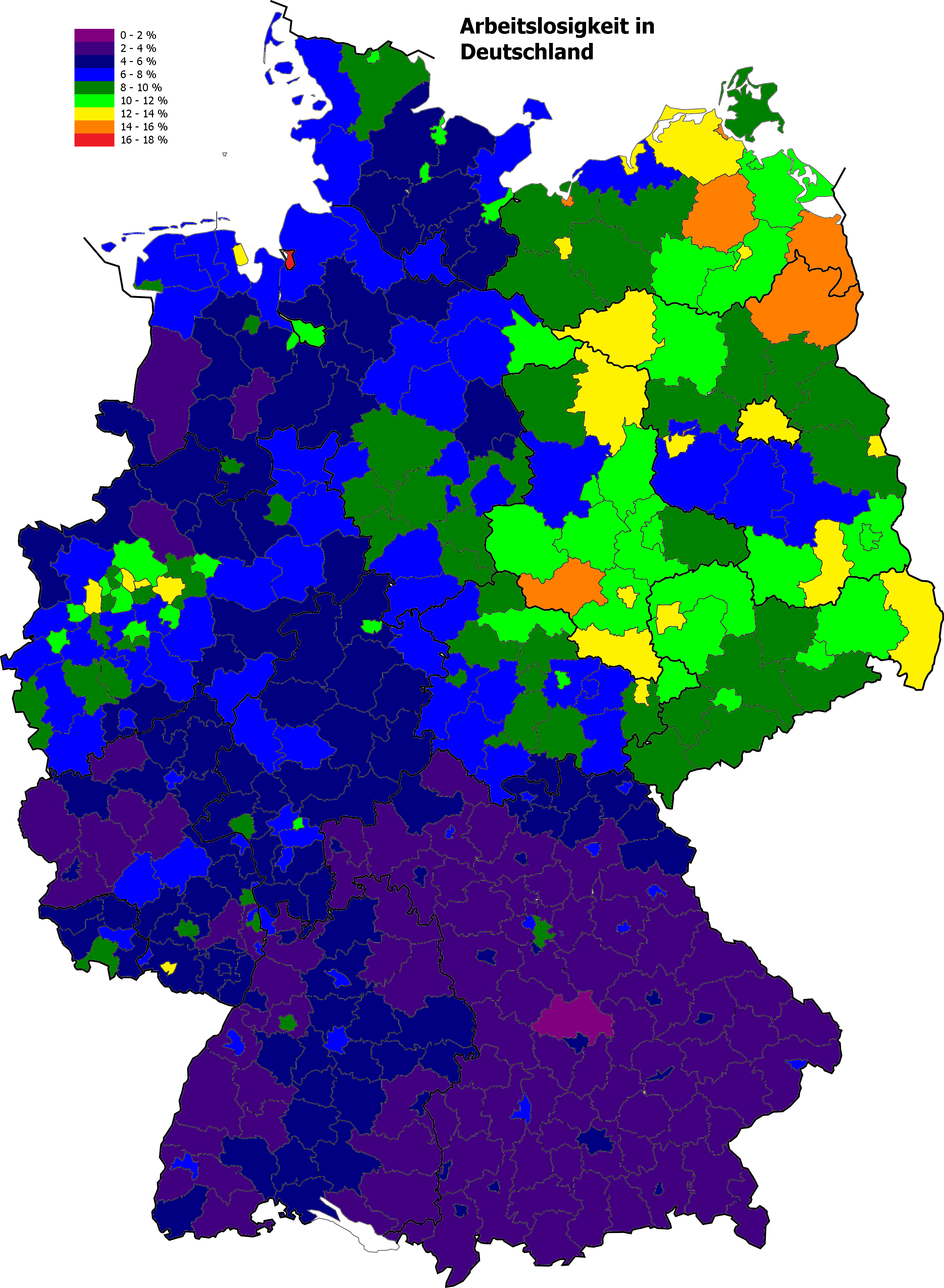
>But you could make the same argument against any US state that remains cost competitive due to the currency. Indeed you can. >And it also discounts the fact that Germany did very well during the period when it did have it's own currency. This is true. However Germany also gets decent manufacturing benefits from the income disparity in the east. >As it is, German economic performance does have an effect on the Euro,…
Strangely enough, the east has (by far) the highest unemployment rate in Germany:
http://upload.wikimedia.org/wikipedia/commons/6/6f/Arbeitslo...
The big German manufacturing plants for e.g. cars are usually also found in the south/west (Daimler + Porsche around Stuttgart, BMW in Bavaria). This goes even as far as adding a "solidarity surcharge" to help the east:
http://en.wikipedia.org/wiki/Taxation_in_Germany#Solidarity_...
Re: How Germany got it right on the economy
#36The problem with this article is that is glosses over one major problem: if Germany's currency moved in accordance with its economy rather than the entire European Union then its exports would be grossly overpriced and uncompetitive. It's the formation of the EU and a single currency that has allowed it to remain an exporting country rather. The article can not compare apples to oranges and make sense.
What you are missing here is that the Euro only works if the stronger countries support the weaker ones financially. Without this, the Euro could not be a stable currency. If a country like Greece or Ireland is basically collapsing, it survives because countries like Germany and France pay for it. There is no such thing as a free lunch. What Germany gains now because of the weak Euro, it had to pay a few months ago t…
Re: How Germany got it right on the economy
#37Earlier quoted context omitted.
What I meant to say was that any statement saying that Germany is an "uninnovative" country is just hogwash. The downvote -- why? Because you disagree?
I didn't downvote you, and I also didn't say they didn't innovate. Rather, modern German innovation rarely takes the form of transformation, more of incremental innovation. I can't think of any modern industries revolutionized by German companies. Automotive saw a steady stream of good innovation no doubt, but hardly very transformative.
Re: How Germany got it right on the economy
#38Earlier quoted context omitted.
Their unemployment is 6.7%, which observing from the US (9% after massive government stimulus), I have a real hard time seeing that as a disgrace.
Remember that in Germany, you are legally unemployed if you earn less than 400 Euros (500-600$) per month. If you are unemployed, you don't have to pay taxes. This makes most employees of Starbucks, McDonalds etc. count as unemployed.
I've also read that they do more accurate accounting of unemployment than the US. Some say the real unemployment rate in the U.S. is around 17%.
Re: How Germany got it right on the economy
#39Earlier quoted context omitted.
Their unemployment is 6.7%, which observing from the US (9% after massive government stimulus), I have a real hard time seeing that as a disgrace.
Remember that in Germany, you are legally unemployed if you earn less than 400 Euros (500-600$) per month. If you are unemployed, you don't have to pay taxes. This makes most employees of Starbucks, McDonalds etc. count as unemployed.
Re: How Germany got it right on the economy
#40Earlier quoted context omitted.
Their unemployment is 6.7%, which observing from the US (9% after massive government stimulus), I have a real hard time seeing that as a disgrace.
Remember that in Germany, you are legally unemployed if you earn less than 400 Euros (500-600$) per month. If you are unemployed, you don't have to pay taxes. This makes most employees of Starbucks, McDonalds etc. count as unemployed.