Live data from Hacker News

How the car industry hid the truth about diesel emissions

theguardian.com

141–150 of 157 posts

Re: How the car industry hid the truth about diesel emissions

#141

Earlier quoted context omitted.

There would be less need for safety technology if everyone was driving around at 60kph, not 100kph. A lighter battery would last much further.. lower cost vehicles.. less environmental impact.. less noise around populated areas etc. It would take longer to cover long distances, but.. smell the roses, or take a train? Pipe dream obviously.

> There would be less need for safety technology if everyone was driving around at 60kph, not 100kph. That's like saying you don't need to wear a helmet while bicycling as long as you don't go faster than X. When in reality just falling over while standing still, can already give you quite a good knock on your head, depending on where you are landing with it. Just like you can't control the speed of other traffic par…

There is very effective technology to prevent speeding. We just need to build more of it.

Re: How the car industry hid the truth about diesel emissions

#142
post #55
post #50

Earlier quoted context omitted.

I think this reasoning pins down the wrong variables of the equation. You can pick your housing and location based on not owning a car (among other criteria). And it scales too. And for decision-makers it's responsible to nudge your citizenship to this direction.

While urbanisation overall is probably a net plus for the environment, do keep in mind that, say, farming is quite area intensive. Someone needs to work at those farms - and they are not going to commute to work by high-speed rail. (Granted, there are experimental urban farms out there, but I don't see those feeding the planet on a short-term scale.)

Farming is area intensive, but the number of farmers we need has been steadily declining.

Re: How the car industry hid the truth about diesel emissions

#143
post #73
post #54

Earlier quoted context omitted.

Assuming one can get a house at an affordable rate to start with. It doesn't scale because not everyone is rich enough to live close to transportation hubs nor they can take everyone that wants to live nearby.

Housing supply and transport infra mostly responds to demand without pricing out people. Outside of urban hotspots where rent seeking rules. Most cities, and most people's home vicinities, are not land cramped like the world's megacities.

Come to Europe to the cities where one actually finds a job and then try to use the public transportation for that 1h 30m commute time, easily done in 30m with a car.

Re: How the car industry hid the truth about diesel emissions

#144
post #71
post #56

Earlier quoted context omitted.

>You can pick your housing and location based on not owning a car Only if you want to live in a large city and don't do anything outdoors. I go skiing, hiking, mountain biking, camping 3-4 times a week. Where I live (the Alps), it is extremely difficult to not own a car. There is no infrastructure and the terrain is unfriendly. There isn't a housing or location option in Europe that allows me to give up my car and ha…

Usually you can also comfortably live in a small city few km from its center and have good outdoor options. People will need to compromise of course. The alternative, not beating global warming is a big compromise too.

> The alternative, not beating global warming is a big compromise too.

It's not either-or. Owning a private car in the Alps and using it for the occasional shopping or skiing trip is far from being the main source of CO2 emissions for their respective country, let alone for the world.

Re: How the car industry hid the truth about diesel emissions

#145
post #74

Earlier quoted context omitted.

> You can pick your housing and location based on not owning a car If all I ever wanted from life was to go to work and back to my apartment, via a grocery store. As a matter of fact, I can't choose where my friends and relatives live, and I'd probably have to drop some of my hobbies too if I were to live without a car.

You will probably have to drop some of your hobbies too if we don't manage to limit Global Warming to below 2 degrees.

Yeah, well, I did things the other way around and picked my job around not having a commute. That means remote, I work from my apartment.

I still have a car, but I drive much less than those who commute by car every day. It might be sitting unused in the lot for weeks (I have my feet & bicycle for grocery store trips). But when I need it, I need it, the public infra and ridesharing simply isn't there. (But I occasionally give rides and haul stuff for people who don't own a car, hey, isn't that exactly what we need?)

As far as global warming is concerned.. well, one glance at the statistics shows that my car ownership couldn't matter less. For example, if you take the top polluters (China & USA) and compare to my country (Finland), and break it down by sector, you'll find that our transportation's contribution to CO2 emissions in the world is a fraction of nothing.

As far as domestic energy consumption goes, we've cold winters, and heating is the biggest drain. There's a lot that could be done to improve the energy efficiency of older homes without spending too much money but the will isn't there. The only way we get heat efficient buildings reliably is via regulation that applies to new buildings.

Re: How the car industry hid the truth about diesel emissions

#146
post #144
post #71

Earlier quoted context omitted.

Usually you can also comfortably live in a small city few km from its center and have good outdoor options. People will need to compromise of course. The alternative, not beating global warming is a big compromise too.

> The alternative, not beating global warming is a big compromise too. It's not either-or. Owning a private car in the Alps and using it for the occasional shopping or skiing trip is far from being the main source of CO2 emissions for their respective country, let alone for the world.

The cost structure of private cars (big fixed cost, thereafter low marginal cost per km) and convenience works against this. Yeah, there are always exceptions, but these planning decisions should be made by considering people in aggregate.

Re "not the main source" - the co2 emission pie is very fragmented. We can't afford to go after only the biggest source of emissions. This is the divide-and-not-conquer method of losing this battle, to consider all the little parts in isolation and on each decide that it's not significant!

Re: How the car industry hid the truth about diesel emissions

#147
post #143
post #73

Earlier quoted context omitted.

Housing supply and transport infra mostly responds to demand without pricing out people. Outside of urban hotspots where rent seeking rules. Most cities, and most people's home vicinities, are not land cramped like the world's megacities.

Come to Europe to the cities where one actually finds a job and then try to use the public transportation for that 1h 30m commute time, easily done in 30m with a car.

Already there, but it's not like that. 1h 30m in public transport would get me to another town.

Re: How the car industry hid the truth about diesel emissions

#148
post #137
post #133

Earlier quoted context omitted.

> Unless the dashboard tells me why the Tesla website and marketing (not to mention its CEO) make all the false/misleading claims I don’t think we need to talk about anything else. Honest question. Do you have a short position on the stock?

Maybe just a few bricks short of a load. All their points have been refuted but they still don’t get it.

Were they? As I said (I'll say again it but slower) Tesla is the only manufacturer with multiple driver fatalities while "self driving". Plus the countless crashes with no fatalities.

Either the description of the Autopilot's capabilities is misleading making drivers assume it's more capable, or drivers with severe comprehension issues are over represented among Tesla drivers, to the point where they actually kill themselves. The car or the driver have a problem. You pick.

Re: How the car industry hid the truth about diesel emissions

#149
post #138

Earlier quoted context omitted.

Yes... it perfectly reasonable to make claims that even the supplier of your HW refutes. Really says a lot about your willingness to say whatever it takes to get more PR and push a few more sales. In the meantime Tesla is the only company with autonomous driving driver fatalities. Multiple. Unless you’re going to claim Tesla buyers are more predisposed to... laziness and inability to process information, then somethi…

They are not autonomous driving fatalities. They can’t be, because there is simply no autonomous driving. You are very confused. Autopilot is not autonomous driving.

It's self driving. It's not L5 but the car was taking the decisions in that limited set of conditions.

And that's the whole point, the car is unable to take the correct decisions but people still trust it to do so. Why would they? Unless you'll tell me Tesla drivers are intellectually challenged then it must be that they somehow get the wrong impression of what the car can do.

How come this doesn't happen to any other manufacturer building cars with this type of limited automation? I see a some people victoriously claiming I've been proven wrong yet all avoid answering this direct question. If nobody can explain why so many Tesla drivers are suicidal then the blame must lie with the system or the way it's described.

Re: How the car industry hid the truth about diesel emissions

#150
post #144

Earlier quoted context omitted.

> The alternative, not beating global warming is a big compromise too. It's not either-or. Owning a private car in the Alps and using it for the occasional shopping or skiing trip is far from being the main source of CO2 emissions for their respective country, let alone for the world.

The cost structure of private cars (big fixed cost, thereafter low marginal cost per km) and convenience works against this. Yeah, there are always exceptions, but these planning decisions should be made by considering people in aggregate. Re "not the main source" - the co2 emission pie is very fragmented. We can't afford to go after only the biggest source of emissions. This is the divide-and-not-conquer method of l…

> Re "not the main source" - the co2 emission pie is very fragmented. We can't afford to go after only the biggest source of emissions. This is the divide-and-not-conquer method of losing this battle, to consider all the little parts in isolation and on each decide that it's not significant!

You're right, we're all responsible, and we can't just point at the biggest offender and not do anything about ourselves. But at the other extreme of the spectrum, hyperbole and guilt tripping of people who could be wiped from the face of earth without making a statistically significant impact on CO2 emissions isn't right either. Simply framing things as "cars or the planet" is wrong on so many levels.

As per 2017 statistics, the eight Alpine countries (including Europe's biggest polluter, Germany) accounted for about 4% of the world's CO2 (a third of US's numbers), half of it due to Germany. I'm not going to look up the statistics but I believe a large proportion of Germany's output is due to industry, and aluminum production in particular. It does not help that their atomic energy fears have driven up coal power plants. Even so, all but one of the Alpine countries have reduced their CO2 output since the 90s. Meanwhile over the same time period China has more than quadrupled its CO2 emissions and is the top polluter, and CO2 per capita both in China and the US is higher than in Europe.

> Yeah, there are always exceptions, but these planning decisions should be made by considering people in aggregate.

But we still (thankfully) allow people to make individual choices. If that means we improve the infrastructure required for a car-free life and still allow those who live in the Alps to choose a car (while strictening the emission & efficiency regulation), it's OK.

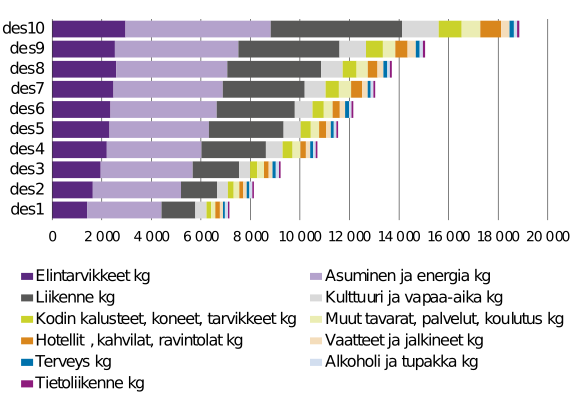
Or is it? Then why cars specifically? Right now there's no such thing as a personal carbon budget, but there's a whole bunch of things that contribute to the pie. The status quo is that if you're rich, you can consume more (income vs consumption): http://www.stat.fi/tietotrendit/media/uploads/tt2018/nurmela...

So far we've been very much accepting that some people produce more emissions than others. Should that change? I think that is something we should address before we ask if one should be allowed to choose to live in the Alps in a place where getting by without a car isn't feasible. In any case, private transportation in that region is not killing the planet. And for that matter, motorsport isn't either. I don't think we need to plan around those things, there are significantly more pressing areas to consider.
Post reply on HN