Live data from Hacker News

As Costs Skyrocket, More U.S. Cities Stop Recycling

nytimes.com

81–90 of 293 posts

Re: As Costs Skyrocket, More U.S. Cities Stop Recycling

#81

It makes me wonder if we were ever really recycling, or if "recycling" was a marketing buzzword for "cheaply dumping your trash in China". I seem to remember a lot of controversy over recycling in the 80s and early 90s, with my local town government insisting it was too expensive. Suddenly everything changed in the late 90s, right around the time that globalization took off, and recycle bins took off everywhere. By t…

It was an illusion. Specifically, it was an illusion that allowed capitalism as normal to largely continue, with a bit of greenwashing here and there.

Things you can actually recycle: Aluminium, iron/steel scrap, and to a lesser extent glass.

Plastic was never recyclable in the sense of "circular economy indefinitely".

Recycling was never an effective way to save resources, compared to its ugly stepsisters "reuse" and "reduce". But they didn't accord with "buy it, use it, bin it".

Re: As Costs Skyrocket, More U.S. Cities Stop Recycling

#82

It makes me wonder if we were ever really recycling, or if "recycling" was a marketing buzzword for "cheaply dumping your trash in China". I seem to remember a lot of controversy over recycling in the 80s and early 90s, with my local town government insisting it was too expensive. Suddenly everything changed in the late 90s, right around the time that globalization took off, and recycle bins took off everywhere. By t…

I suspect you are correct here. We were shoving "recycling" in otherwise empty shipping containers and sending them to China where they get dumped on the ground and the poorest of the poor pick through them for the few things that are actually recyclable. I saw at least one person say back in the 2000s that single stream recycling was basically a lie, but it was worth it to get people into the recycling mindset. This…

> I suspect you are correct here. We were shoving "recycling" in otherwise empty shipping containers and sending them to China...

This actually makes sense. The container trade imbalance leaves the U.S. with a large excess of containers (it costs more to return them than for China to make new ones apparently).

I actually just bought a condo on eastern shore of MD. The small town stopped recycling a few years ago to save $800K/yr, and is instead burning the trash in Pennsylvania at a power plant. I wrote the council an email and said I'm willing to pay more to reinstate recycling, and I bet many residents feel the same.

However, I do wonder, even if this hurdle is jumped, if the refuse is actually getting recycled in the end. Ignorance has been my bliss, but maybe it's time for me to stop being ignorant.

Re: As Costs Skyrocket, More U.S. Cities Stop Recycling

#83
post #8

Earlier quoted context omitted.

Plastic lasts essential forever - aluminum and steel do not

In countries with good waste management I assume they are burned if they are not recycled. Other containers such as paper might sometimes even be worse as it will cost more energy to produce them than plastic.

>>In countries with good waste management I assume they are burned if they are not recycled

Those countries are so rare that it's almost not worth mentioning. Vast majority of places around the world, including most of the developed world do not have "good waste management" by this definition. Even in countries as rich as UK, Germany and France most waste goes to a landfill, not an incinerator. Sure Sweden shows a good example how it can be done, but it's like dismissing the problem of car-related pollution because there exists one hydrogen car that you can actually buy. Yes, it doesn't have those problems but in the large scheme of things it's completely irrelevant.

Re: As Costs Skyrocket, More U.S. Cities Stop Recycling

#84

People keep saying that China was accepting recyclables. They weren't accepting them, they were buying them. It's hard to make a case that it was all just trash when somebody was paying for it.

I don’t know the industry but it seems to me that if the “trash” was bought by Chinese companies only to be dumped there for the most part then it’s still trash. Was it cheaper to ship this stuff to China than to pay American landfills to handle this stuff? I don’t think having someone pay for it matters. Isn’t it the end result that matters?

Re: As Costs Skyrocket, More U.S. Cities Stop Recycling

#85
post #16

Recycling was always a lipstick on a pig. Inefficient, subsidized, hypocrisy. Wanna help the environment? Reduce consumption overall.

very specifically: don't take the plane, don't got to work with your car, and live in high density housing.

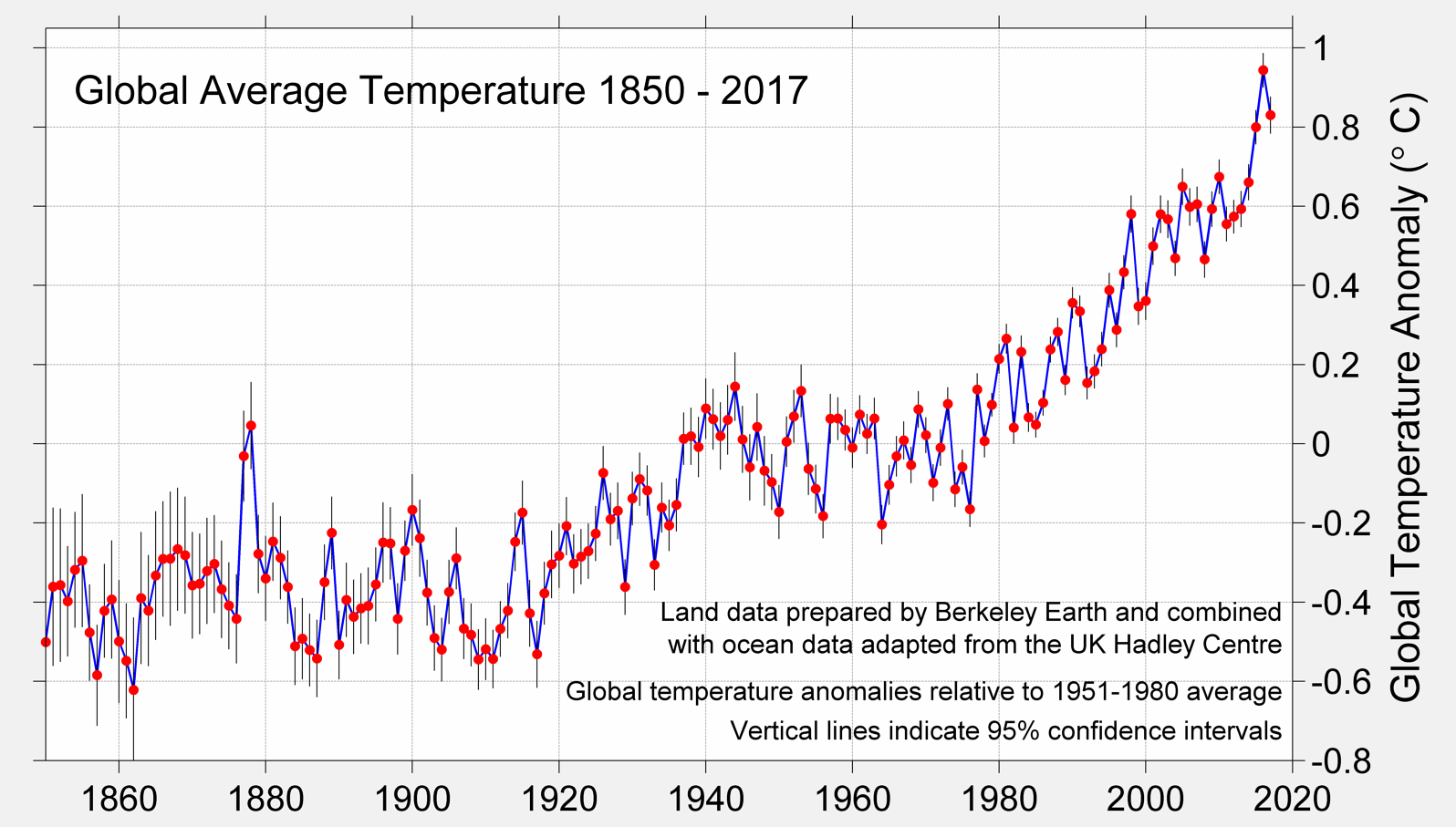
Not disagreeing, but looking at global temperature readings, temps were almost flat from 1940-1980. Weren't those decades characterized by interstates and polluting cars, and people living in suburbia? At least in the US.

Was the temperature ramp-up from 1980-2019 a delayed reaction? Or due to emerging nations getting industrialized?

Graph: http://berkeleyearth.org/wp-content/uploads/2018/01/TimeSeri...

Re: As Costs Skyrocket, More U.S. Cities Stop Recycling

#86

Earlier quoted context omitted.

very specifically: don't take the plane, don't got to work with your car, and live in high density housing.

And have a vegan/vegetarian diet.

And don't eat more food than you need! (Something 2/3rds of the American population--the ones that are overweight or obese--do!)

Re: As Costs Skyrocket, More U.S. Cities Stop Recycling

#87
post #12

In Germany you pay a deposit when you buy a bottle and when you bring it back, you get your money back. At least when I lived there the system worked well. there is always a lot of pressure from industry to go one-way though.

Isn't it also the case that the bottles are reused, rather than recycled?

In my state glass is neither reused nor recycled, it's crushed and used as filler for things like environmental drainage projects. A big part of the problem in rural areas is the cost to transport glass makes it worthless to buy and recycle, and there's a high contamination rate, so increasingly it's back to the landfill for glass.

Re: As Costs Skyrocket, More U.S. Cities Stop Recycling

#88
Recycling is good for the world.

NO! YOU COULD NOT BE MORE WRONG!!

Recycling is NOT good for the world. It is bad for the environment, it is bad for our health, and it is bad for our economy. I’m not kidding. Recycling is not good for the environment. It is destructive to the earth and it is a major contributor to global warming. Recycling is not good for our health. It contributes to obesity and diseases like heart disease and cancer. Recycling is bad for our economy. It increases the cost of a product, and in turn, the price of everything that is made with that product. Recycling is not good for our nation. We pay a tremendous price for the privilege of having the world’s most advanced and efficient recycling system. Recycling is a huge, colossal waste of time, energy, money, and resources. And THAT is why we need to get back to basics and get back to basics in our recycling efforts. One of the best ways to start is to look at the process of creating a paper product. When you make a paper product, it is basically a long chain of materials. Everything from the raw materials (wood, cardboard, paper, etc.), to the reagents (dyes, solvents, etc.) to the printing equipment (chemicals, glue, paper, ink, etc.), to the packaging, to the packaging materials (mercury, chemicals, etc.) to the processing equipment (heating, cooling, etc.), to the packaging materials, to the packaging materials that are shipped overseas and to the packaging materials that are used in the United States. Each step along the way creates tons of waste that we constantly have to clean up. The process of making a paper product is a very wasteful one. But the end result is something that all of us need to consume. And if we want to keep the recycling process running efficiently, then we really need to think about each and every step that goes into making a paper product.
Re: As Costs Skyrocket, More U.S. Cities Stop Recycling

#89

Earlier quoted context omitted.

Broadly speaking, I expect the answer is that plastic better prolongs shelf life and leads to less food waste. And plastic is cheaper.

For example, in the UK a punnet of strawberries in the supermarket has a little rectangle of bubble wrap glued into the bottom of it. It is there to reduce the amount of physical damage to the fruit. It looks like it couldn't do anything. But the food companies would love not to have the extra cost of the rectangle of bubble wrap and the gluing process. They do it because it works.

I always thought it's more like a nappy than bubble wrap; it's always stained with the colour of the fruit, so assumed it was there to absorb moisture from bruised fruit.

Re: As Costs Skyrocket, More U.S. Cities Stop Recycling

#90
post #12

In Germany you pay a deposit when you buy a bottle and when you bring it back, you get your money back. At least when I lived there the system worked well. there is always a lot of pressure from industry to go one-way though.

Isn't it also the case that the bottles are reused, rather than recycled?

Glass water and beer bottles are reused, thick-walled PET water bottles are reused, while most plastic (mostly PET) bottles and all cans are, at best, recycled.

For other and broken glass items there are glass containers pretty much everywhere, broken up by color (white glass, brown glass, green glass). Plastics delivered by consumers are separated but never recycled.

Post reply on HN