Live data from Hacker News

The $2M Urinal: Why Hard Work Doesn’t Cut It (2018)

behavioralscientist.org

91–100 of 188 posts

Re: The $2M Urinal: Why Hard Work Doesn’t Cut It (2018)

#91
post #74
post #67

Whenever people discuss about contemporary art I get reminded of these incredibly poignant Soviet war paintings [1] which manage to partially describe what the atrocities on the Eastern Front meant for the people involved, but which are nevertheless a lot less well-known compared to contemporary art "darlings" like Jackson Pollock whose works don't tell me absolutely anything and who had his career propped up by the…

Obviously very subjective, but modern art seems like a case of emperor's new clothes to me, a humble engineer. When I was in college I would see art around campus take the form of random metal shapes welded together, concrete blobs, or Pollock-esque splatters and shake my head. How can you judge a category of art for which there are no rules? I can look at Michelangelo's "The David" and be awed to the core at how he…

One thing to consider is that being a case of the emperor's new clothes is intentional. Consider The Fountain again:

The artist had the audacity to put a urinal in a gallery. It's not so much that this was a particularly lovely piece of ceramic (though some may think so). The point is the meta-awareness that urinals don't belong here.

The rule-breaking is the art. The fact the emperor has no clothes is the exact reason people were talking about it. It's not that no one has ever seen a naked person before! But the emperor?! That's not supposed to happen!
Re: The $2M Urinal: Why Hard Work Doesn’t Cut It (2018)

#92
post #67

Whenever people discuss about contemporary art I get reminded of these incredibly poignant Soviet war paintings [1] which manage to partially describe what the atrocities on the Eastern Front meant for the people involved, but which are nevertheless a lot less well-known compared to contemporary art "darlings" like Jackson Pollock whose works don't tell me absolutely anything and who had his career propped up by the…

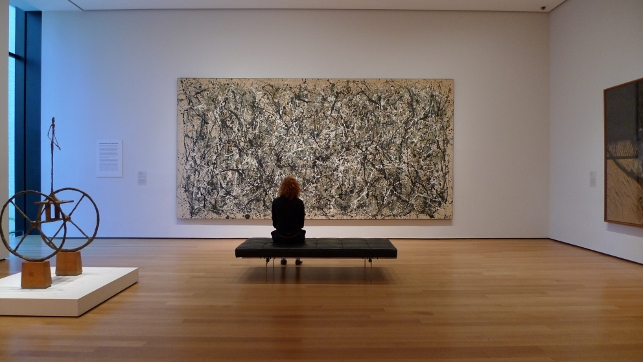
So, I personally get an emotional response to Pollock, especially that particular one, I actually have a MoMA catalog on my bookshelf with that entry bookmarked with my admission ticket from 2010 when I went to see it ( https://imgur.com/a/hFBR7Nu ). The size is a factor as well, there is no way to look at it on a computer screen that is close to how you look at it in person ( https://www.moma.org/wp/inside_out/wp-content/uploads/2012/0... ). But we definitely have different tastes.

Regarding those soviet paintings, Goya depicted war and suffering, and is very well known and highly regarded: https://en.wikipedia.org/wiki/The_Third_of_May_1808 . But your point is the core of what the article is trying to get at. The people who evaluate art are looking for something that isn't being satisfied by the same criteria as i.e. journalism, cuisine, even music to a certain extent.

Re: The $2M Urinal: Why Hard Work Doesn’t Cut It (2018)

#93
post #74
post #67

Whenever people discuss about contemporary art I get reminded of these incredibly poignant Soviet war paintings [1] which manage to partially describe what the atrocities on the Eastern Front meant for the people involved, but which are nevertheless a lot less well-known compared to contemporary art "darlings" like Jackson Pollock whose works don't tell me absolutely anything and who had his career propped up by the…

Obviously very subjective, but modern art seems like a case of emperor's new clothes to me, a humble engineer. When I was in college I would see art around campus take the form of random metal shapes welded together, concrete blobs, or Pollock-esque splatters and shake my head. How can you judge a category of art for which there are no rules? I can look at Michelangelo's "The David" and be awed to the core at how he…

I'm generally pretty fond of taking a devil's advocate position when it comes to modern art. But regarding your specific example of "The David", let me ask you: which aspect of the sculpture is the art?

I would argue that replicating lifelike veins in marble is not the artistic part of David. That the craft - and surely many of Michaelangelo's contemporaries (and indeed many sculptors today) were also capable craftsmen when it came to sculpting. The art is the body language, expression, and overall "feel" of the piece.

This comes into sharp relief when you examine the work of someone like Robert Mapplethorpe[1] - who wanted to be a sculptor, but realized he could often achieve the same artistic goals with models and photography. He wanted to capture beauty and emotion through the human form - and the medium was just a means to an end.

All of this is to say that contemporary art is capable of communicating the same feelings as more classical artistic styles - and those feelings are really the point. The comparison between David and some college piece is also unfair. It has always been true 99% of everything is crap. What is the best contemporary art will only be apparent in retrospect. Stuff you see around a college campus is likely not even the best of contemporary art at the time it's created (that's why it's on a campus). Comparing that to art that has had 300+ years of societal filtering doesn't really make sense.

One of my favourite pieces of contemporary art is "Fuck Death" by Leon Golub[2]. I like its straightforward starkness and the way it seems hastily done - as if the painter was in a hurry because death is, indeed, coming. The technical aspects of this piece are, honestly, not very impressive. It's a very simple watercolour. But it speaks to me in a way that classical depictions of death, with all their craft and realism, really don't. That ability to communicate feeling is the art. The choice of medium or style is just aesthetic preference.

[1] https://en.wikipedia.org/wiki/Robert_Mapplethorpe

[2] http://interrum.tumblr.com/post/59580566966/bidartanalysis-f...

Edit: I am also a humble engineer, so I'm probably just re-inventing art theory 101 here. But I don't think contemporary art is as worthless as many seem to think.

Re: The $2M Urinal: Why Hard Work Doesn’t Cut It (2018)

#94
post #41

Seth Godin has a great line about how the first person to put a urinal in an art museum was an artist, but the second person to do it was a plumber. It makes an interesting thought experiment about what makes art, what it means to be "creative", and how the world may (or may not) appreciate your work...

I'm confused. Does this mean that the "real plumber" was an artist; or the art museum didn't have WC before putting a urinal art piece.

Yeah, I can see how that's confusing. My take is that the first person to display a urinal (as an art piece) was an artist - but the second person to _try_ to display a urinal (as an art piece) was just a plumber (meaning: not an artist).

Re: The $2M Urinal: Why Hard Work Doesn’t Cut It (2018)

#95
post #67

Whenever people discuss about contemporary art I get reminded of these incredibly poignant Soviet war paintings [1] which manage to partially describe what the atrocities on the Eastern Front meant for the people involved, but which are nevertheless a lot less well-known compared to contemporary art "darlings" like Jackson Pollock whose works don't tell me absolutely anything and who had his career propped up by the…

Not even a Pollock fan but the idea that a scan of a Pollock painting is at all similar to standing in front of one seems like a huge stretch. They absolutely huge and the paint is layered on very thick in a way that almost forces you to deconstruct the process of its production as you look at it.

This other painting on the other hand, I'd be very surprised if there's more to be gotten from seeing it in person that what's already on my screen. Going beyond that, a photo that captures the same emotions would be exponentially stronger for me personally too.

Re: The $2M Urinal: Why Hard Work Doesn’t Cut It (2018)

#96
post #74
post #67

Whenever people discuss about contemporary art I get reminded of these incredibly poignant Soviet war paintings [1] which manage to partially describe what the atrocities on the Eastern Front meant for the people involved, but which are nevertheless a lot less well-known compared to contemporary art "darlings" like Jackson Pollock whose works don't tell me absolutely anything and who had his career propped up by the…

Obviously very subjective, but modern art seems like a case of emperor's new clothes to me, a humble engineer. When I was in college I would see art around campus take the form of random metal shapes welded together, concrete blobs, or Pollock-esque splatters and shake my head. How can you judge a category of art for which there are no rules? I can look at Michelangelo's "The David" and be awed to the core at how he…

>How can you judge a category of art for which there are no rules?

Why are you assuming that modern art is arbitrary, random and has no rules?

For that matter, why do you seem to assume the purpose of art is to be "judged" according to some objective set of rules?

Have you tried to study any modern artistic movements, or artists, and what those movements or artists were actually trying to express? It seems like you're mistaking complexity and technical skill for meaning, or assuming that only realistic depictions of nature have any artistic credibility.

>But a sideways urinal with some marker on it? Anyone with no skill can do random things with random items and call it art.

Don't assume that because something appears simple or obvious, that there is no meaning behind it. Maybe sometimes there isn't. Maybe the art at your campus was literally just there to look cool. Maybe some modern artists are taking the piss, like Duchamp, who was trolling the art society he was a part of with that[0].

Yes, you could assume Jackson Pollock was just throwing paint against a canvas and that can't be art because anyone could throw paint against a canvas, but like Marcel Duchamp and a lot of other modern artists, he was trying to say something[1], and that's what makes it art, not its reproducibility or realism.

Artists like Picasso and Mondrian were capable of creating traditional artwork in the classical style, but they became famous for their abstract work. I think it would be a stretch to say these people lacked talent or understanding of what art was, rather, they were trying to express their ideas in as minimalist a style as possible.

>"Any sufficiently advanced art is indistinguishable from garbage"

And any sufficiently advanced criticism is indistinguishable from ignorance.

[0]https://www.tate.org.uk/art/artworks/duchamp-fountain-t07573

[1]https://www.quora.com/What-do-Jackson-Pollocks-paintings-rea...

Re: The $2M Urinal: Why Hard Work Doesn’t Cut It (2018)

#98
post #67

Whenever people discuss about contemporary art I get reminded of these incredibly poignant Soviet war paintings [1] which manage to partially describe what the atrocities on the Eastern Front meant for the people involved, but which are nevertheless a lot less well-known compared to contemporary art "darlings" like Jackson Pollock whose works don't tell me absolutely anything and who had his career propped up by the…

These paintings are interesting as a sort of juxtaposition of the soviet "Socialist Realism" style with the harsh reality of war. They are also clearly technically adept.

Jackson Pollock's paintings are interesting because he was the first to apply his technique in a studied way. They don't translate well to the digital era, but there is a certain arresting physicality to them when you see one in real life. Many of them are huge, and are not displayed within a frame. You can get very close and see the layers of paint rising up and the aging exposed canvas beneath.

Pollock is more famous than these painters because his work is distinctive. These soviet painters are good at painting, and you obviously connect to their subject matter, but comparing their work from [1], its hard to distinguish any of them as individual artists as their styles are only subtly different, much like Pollock's early work was fairly derivative of the original abstract expressionists and much like someone today deliberately aping a Pollock would not be celebrated in the same way (if not derided as a hack).

That said, I don't think figurative art is objectively better or worse than abstract art. Its purpose is different.

Re: The $2M Urinal: Why Hard Work Doesn’t Cut It (2018)

#99
>How? Replace the corporate ladder with a social bridge. We never work in isolation—even when we think we do. Our collective definition of success requires us to think about the ways that our work impacts others.

Collectivists hate art. Capitalists love art.

If you look at socialist countries like Cuba, there are 0 artists. You must get approval from the government to make a "Creative Production" https://havanatimes.org/?p=141068

This is why capitalism is amazing. Capitalism works so well that we can have $2M urinals.

I want artists in my society. Enough of this communism from this author.

Re: The $2M Urinal: Why Hard Work Doesn’t Cut It (2018)

#100
post #67

Whenever people discuss about contemporary art I get reminded of these incredibly poignant Soviet war paintings [1] which manage to partially describe what the atrocities on the Eastern Front meant for the people involved, but which are nevertheless a lot less well-known compared to contemporary art "darlings" like Jackson Pollock whose works don't tell me absolutely anything and who had his career propped up by the…

So, I personally get an emotional response to Pollock, especially that particular one, I actually have a MoMA catalog on my bookshelf with that entry bookmarked with my admission ticket from 2010 when I went to see it ( https://imgur.com/a/hFBR7Nu ). The size is a factor as well, there is no way to look at it on a computer screen that is close to how you look at it in person ( https://www.moma.org/wp/inside_out/wp-co…

I tried to understand contemporary art, up to a point, there was a time when I used to buy each issue of the FT - Weekend Edition so that I could read Georgina Adam’s articles on what was the hippest thing being transacted and the like, but in the end pretty much all of it meant nothing to me.

Reguarding the representation of war, I’m afraid 200-year old paintings don’t do it for me anymore, modern warfare is so much more different and more atrocious and industrialized compared to how things happened two or three centuries ago that we do need the power of art to make us, humans, help us understand at least some part of it all. I pretty much admire the new-Hollywood directors who had the guts to put on screen what the Vietnam war meant for all those involved, from the local Vietnamese population to the US soldiers to the relatives of the US soldiers at home. For comparison the Iraqi and the Afghan wars were pretty much invisible for today’s artists, with notable and very few exceptions (like Brian de Palma).

Post reply on HN