Live data from Hacker News

A letter to Steven Pinker about global poverty

jasonhickel.org

181–190 of 254 posts

Re: A letter to Steven Pinker about global poverty

#181
post #136

Earlier quoted context omitted.

> - Using $1.90 as the baseline to beat is too low for what we would consider as being out of poverty. It's called absolute poverty for a reason. Just because you're above the absolute poverty threshold doesn't mean you're not poor anymore. It just means that you can minimally survive. Whether you're poor or not depends on the society around you, because poverty determines how well you can participate in society. He…

> Yeah, it was just a coincidence that when China stated opening up their markets that their quality of life improved immensely and hundreds of millions are lifted out of extreme poverty. When you're talking about economic success in general then you can't forget the ex-Soviet states either. The ones that embraced free markets the most recovered the most. China is interesting because you can really use it both ways:…

>And the same holds for the ex-Soviet economies, too: The ex-Soviet economies that have done best are those that have joined the European Union, which most people especially on the American right would not exactly call a free market paradise.

But they did well even before they joined the EU. Arguably they did even better in terms of growth before joining, but it's difficult to fault the EU on this, because the financial crisis will definitely take (some of) the blame.

On the topic of China you could also argue that IP theft is what helped China succeed. We'll never know, but that IP issue and them not opening up their markets will probably bite them soon. There's only so much the EU and US are going to take once China becomes even richer.

>Also, I would add that the optimal level of state intervention probably also depends a lot on how corruption-free your government is:

I definitely agree with this, but I would like to add that I think it's not just strict corruption that's the problem. Heavy lobbying by certain small groups of people (corporations) to the detriment of the general population also plays a role in this. The government officials don't have to be corrupt for this to have a negative impact on regulations.
Re: A letter to Steven Pinker about global poverty

#182
post #13

One of the most amazing things I learned reading the excellent "Factfullness" by Hans Rosling [1] is that the poorest countries in the world are currently improving faster than any country ever did, at any point in history. That's correct - countries like Lesotho and Central African Republic are improving faster than his home country of Sweden ever did, at any time. In only his lifetime Sweden went from having an inf…

That argument is both true and deceiving at the same time. The poorest countries are improving the most because they are so far behind everyone else that any improvement is spectacular when viewed as a percentage.

Take a homeless person who has a penny to his name. You give him $100 and his wealth skyrockets by 1000000% in a day. Compare that to bill gates whose wealth probably increases by a "measly" 10% per year. But if you look at the wealth increase by absolute numbers rather than percentages, the picture is quite different. Bill Gates' 10% probably gets him $10 billion while the homeless man's 1000000% gets him $100.

$10 billion vs $100.

10% vs 1000000%.

Whereas the mainstream media may be too pessimistic, rosling is even more optimistic. The idea that the poorest countries ( like CAR ) is going to lead the world is unrealistic barring some apocalyptic event in the US, Europe, East Asia, Middle East.

Re: A letter to Steven Pinker about global poverty

#184
post #164

So this report came out yesterday: https://www.theguardian.com/environment/2019/feb/10/plummeti... . "The 2.5% rate of annual loss (of insect biomass) over the last 25-30 years is “shocking”, Sánchez-Bayo told the Guardian: “It is very rapid. In 10 years you will have a quarter less, in 50 years only half left and in 100 years you will have none.” So, in 100 years all insects will die. All of them. And therefore us,…

Needlessly apocalyptic thinking. No one knows what will happen as a result of this reduction in insect biomass, that is literally the definition of unprecedented... Every time some alarmist starts preaching apocalyptic nonsense because of a story like this, nature inevitably plugs the hole. Do you remember the climate alarmists telling us Florida would be underwater up to the panhandle by 2010? Yeah, we are still usi…

Having no more insects is needlessly alarmist? What would be worrying to you if not that? Yikes.

Re: A letter to Steven Pinker about global poverty

#185
post #75

I think the focus on money is misplaced, forget about GDP and start measuring GNH (Gross National Happiness); it is about time the rest of the world looked to Bhutan and realized there is much more to a pleasurable human existence than simply quantifying in terms of income/money/wealth. It is an over-simplification that degrades humanity and our potential.

Bhutan? Great, unless you're LGBT, in which case they lock you up. Or you're a journalist and write something critical of the government, in which case they lock you up. Or you practice a religion other than Buddhism or Hinduism, in which case they lock you up. Or you want to wear Nepalese clothing, in which case they skip right past locking you up and simply revoke your citizenship and kick you out of the country.

They were talking about happiness, you are talking about personal freedom. Two different things.

It's possible that people are most happy when minorities are done away with. Not exactly what I would prefer, but it's still possible.

Re: A letter to Steven Pinker about global poverty

#186
post #110
post #96

Earlier quoted context omitted.

> primarily social/cultural ones, that will halt the relative development of those countries, sooner or later. Hans addresses this in the book, actually. What you said has no basis in fact, and makes no sense. Do you think people said exactly the same thing about Sweden a generation ago? Why / why not? We in the West have this completely-made-up assumption that "they" can't develop like "we" did, with absolutely no g…

> We in the West have this completely-made-up assumption that "they" can't develop like "we" did, with absolutely no grounding in fact. They can. But "we" developed in a very turbulent and deadly ways. Just handful of decades ago, during WWI and WWII, "we" were killing millions of people, helping spread massive disease outbreaks that killed other millions in just a few years, created economy destroying monetary and i…

This is absolutely right. The wealth in the West was largely gained through colonialist/imperialist means. Developing countries don't have this option.

Re: A letter to Steven Pinker about global poverty

#187
post #166

Earlier quoted context omitted.

Even the data that Hickel picked (excluding China) shows is that the trend is down . I'm not sure Pinker is right in that the it's true for every single social stratum everywhere across the world , I would think that certain middle-class earners are poorer today in relative terms. However, for anyone considered poor by any reasonable standard, my guess is that the global trend is down , otherwise Hickel could've come…

> Even the data that Hickel picked (excluding China) shows is that the trend is down. In the infographic Gates tweeted, it claims to show a 75% reduction in global poverty between 1980 and today. In Hickels chart, it goes up 5% from 1980-2000 and down maybe 7% from 2000 to today. You’re claiming they both show a downward trend today so therefore they’re basically the same? That’s not just misleading, but also misses…

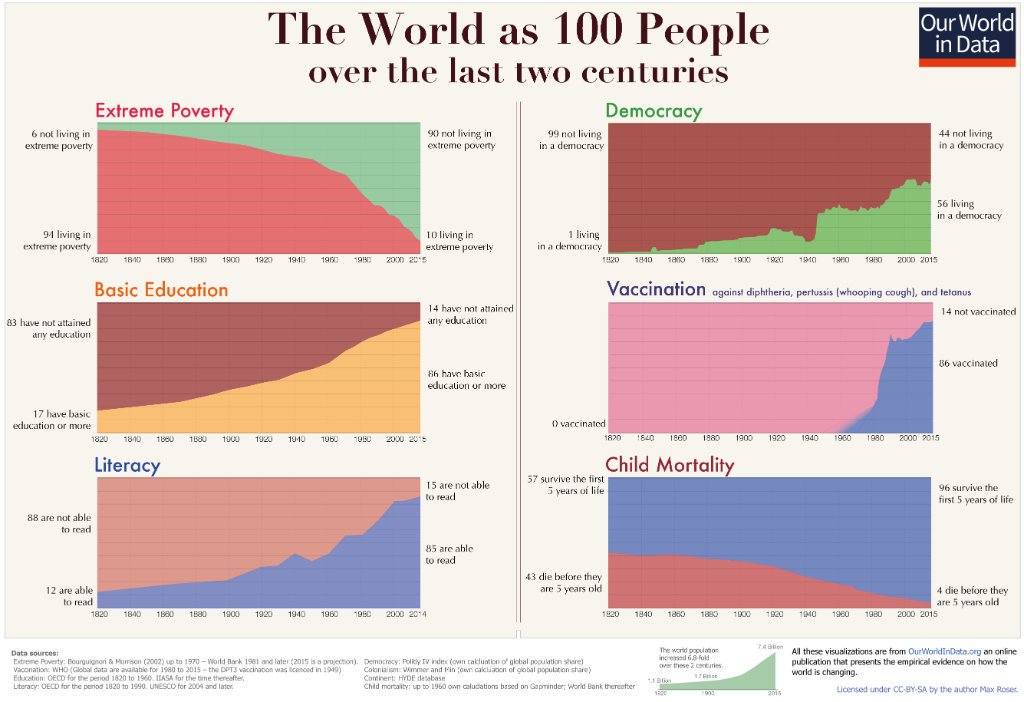
This is Bill Gates' infographic:

https://pbs.twimg.com/media/DxSZ58_XQAAoxM8.jpg:large

It does show a 75% in extreme poverty. That happens to be a straight down trend. Nobody even disputes this. It also shows a number of other things, such that "democracy" is actually stagnating. Bill Gates' actual remark on it is that people underestimate how much things have improved over the last two hundred years.

Hickel picks that one graph and turns it into the "Bill Gates says poverty is decreasing, he couldn't be more wrong" headline:

https://www.theguardian.com/commentisfree/2019/jan/29/bill-g...

That's dishonest. First of all, extreme poverty is decreasing. That's the actual claim and it is true. Secondly, poverty even by Hickel's standards is also decreasing. It may not have been decreasing consistently over every single past decade, but indeed is decreasing today and for the past decade. Hickel then goes on to say that "the number of people living in poverty" has increased. Indeed it has, as has the number of people living. The actual percentage of people living in poverty has gone down.

So what exactly is the problem with what Bill Gates actually said? He never claimed that poverty is solved, nor did he endorse "neoliberalism" as the solution.

Re: A letter to Steven Pinker about global poverty

#188
post #13

One of the most amazing things I learned reading the excellent "Factfullness" by Hans Rosling [1] is that the poorest countries in the world are currently improving faster than any country ever did, at any point in history. That's correct - countries like Lesotho and Central African Republic are improving faster than his home country of Sweden ever did, at any time. In only his lifetime Sweden went from having an inf…

"is that the poorest countries in the world are currently improving faster than any country ever did, at any point in history. " This isn't surprising and the reasoning isn't that hard. Economic advancement is very hard if you have to 'figure out how to do it' i.e. intensive R&D. But if you are 'far behind' and there are examples to copy, you can just copy. Developing nations not only have many examples, but they hav…

The post war countries you mention had access to massive investment from the US, e.g. the Marshall plan. It's no surprise they're doing well. In contrast, the post-colonial developing countries today were hit with extremely predatory debt by the IMF - as a form of "international aid" - so it's no surprise they are not as wealthy. Some of these places were also very developed prior to colonialism and could have "snapped back" given the chance.

Unless the exploitative nature of the relationships between wealthier and poorer countries changes, they will have a hard time reaching our economic standards.

Re: A letter to Steven Pinker about global poverty

#189
post #13

One of the most amazing things I learned reading the excellent "Factfullness" by Hans Rosling [1] is that the poorest countries in the world are currently improving faster than any country ever did, at any point in history. That's correct - countries like Lesotho and Central African Republic are improving faster than his home country of Sweden ever did, at any time. In only his lifetime Sweden went from having an inf…

>In only his lifetime Sweden went from having an infant mortality rate similar to that of the poorest countries today, to being one of the world leaders.

This simply isn't true. Between 1900 and 1905, Sweden's infant mortality rate was merely 2.3 per 1,000 live births [1] which is basically the same as they currently report (2.6 per 1,000 [2]) according to the CIA world factbook. Compare that with Lesotho's rate of 46.1 per 1,000 [2] and it's plain to aee that comparison is completely unfounded. Today's poorest countries have rates in the 60-80 range despite the best efforts of the Western world to share the basic knowledge which caused such a precipitous decline in infant mortality post-1850 with those nations.

[1]: https://www.ncbi.nlm.nih.gov/pmc/articles/PMC1448444/

[2]: https://en.m.wikipedia.org/wiki/List_of_countries_by_infant_...

Re: A letter to Steven Pinker about global poverty

#190
post #13

One of the most amazing things I learned reading the excellent "Factfullness" by Hans Rosling [1] is that the poorest countries in the world are currently improving faster than any country ever did, at any point in history. That's correct - countries like Lesotho and Central African Republic are improving faster than his home country of Sweden ever did, at any time. In only his lifetime Sweden went from having an inf…

That argument is both true and deceiving at the same time. The poorest countries are improving the most because they are so far behind everyone else that any improvement is spectacular when viewed as a percentage. Take a homeless person who has a penny to his name. You give him $100 and his wealth skyrockets by 1000000% in a day. Compare that to bill gates whose wealth probably increases by a "measly" 10% per year. B…

> The idea that the poorest countries ( like CAR ) is going to lead the world is unrealistic barring some apocalyptic event in the US, Europe, East Asia, Middle East.

I don't think that OP was arguing that will happen. He was just arguing that growth is happening and they are catching up.

Post reply on HN