Live data from Hacker News

Intel to Discontinue Itanium 9700 ‘Kittson’ Processor, the Last of the Itaniums

anandtech.com

201–210 of 211 posts

Re: Intel to Discontinue Itanium 9700 ‘Kittson’ Processor, the Last of the Itaniums

#201
post #182

Earlier quoted context omitted.

I wonder how did it happen? Intel has its own compiler, surely they could ask their compiler gurus to help with ISA design.

Intel has its own compiler, surely they could ask their compiler gurus to help with ISA design. Well that kinda was the concept - but they greatly underestimated the difficulty of producing a "sufficiently smart compiler". If VLIW had worked it would have greatly simplified processor design, no (or at least much less) need to worry about cleverly handling out-of-order execution for example. That in turn would have me…

It is also problematic to need to recompile code for every different micro architecture. Maybe it could be done if the OS shipped with some sort of JIT/AOT compiler and binaries were all something like LLVM IR.
Re: Intel to Discontinue Itanium 9700 ‘Kittson’ Processor, the Last of the Itaniums

#202
post #137

Earlier quoted context omitted.

It would be an awful waste of talent if it's just busy work.

The argument exists (I'm not saying it's true) that Google hoovers up the smartest people to stop them making another Google. People used to make the same argument about Microsoft.

That is why today we have Java and its IDEs instead of Smalltalk and its evolvents like StrongTalk

Re: Intel to Discontinue Itanium 9700 ‘Kittson’ Processor, the Last of the Itaniums

#203
post #10

Mixed feelings. On the one hand, Itanium (as a platform) was batshit insane, impossible to write good compilers for and the pinnacle of Intel overengineering. Good riddance. On the other hand, Itanium was ugly, but had its charm and uniqueness. Itanium is what EFI was first developed for. Itanium is where the C++ ABI got started. Itanium being discontinued further reduces mainstream CPUs to the most boring, safe desi…

> Itanium is what EFI was first developed for. Itanium is where the C++ ABI got started. I’m legit confused. Are those supposed to be good things.

People have different opinions on EFI, but in the time before the modern C++ ABI, every compiler (and often different versions of the same compiler) generated code with different ABI expectations, which made libraries and software distribution absolute hell.

Re: Intel to Discontinue Itanium 9700 ‘Kittson’ Processor, the Last of the Itaniums

#204
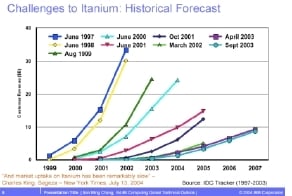
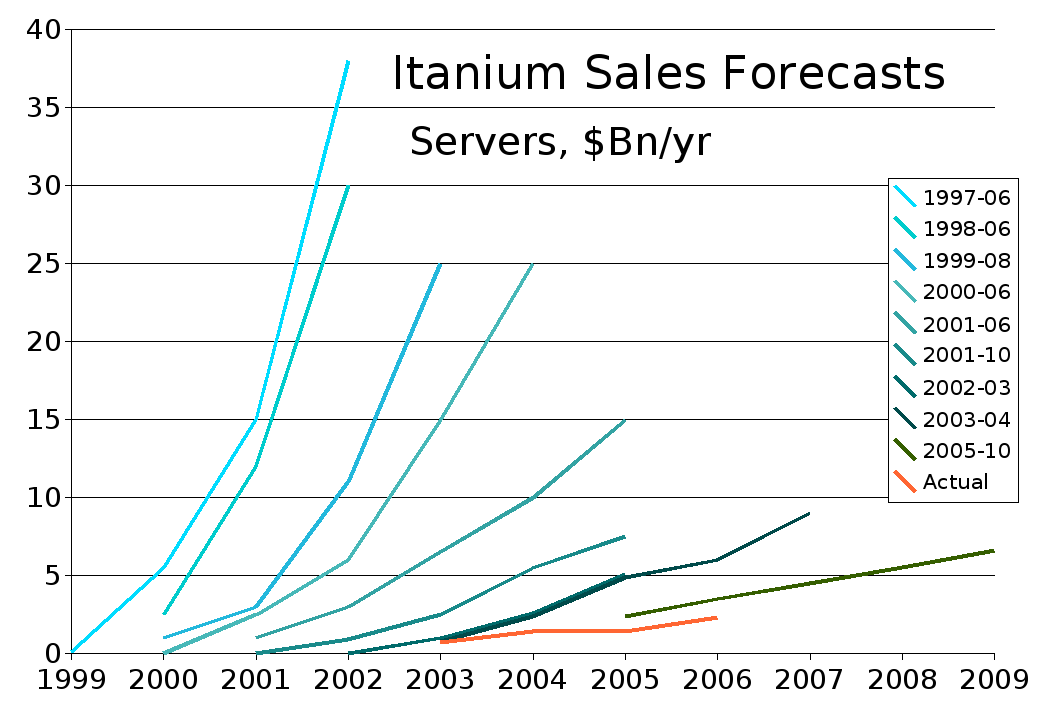
Itanic inspired what is unquestionably the best graph-based trolling of bullshit marketing ever: https://regmedia.co.uk/2004/09/19/itanium_sales_small.jpg

Wikipedia has an updated version as well: https://upload.wikimedia.org/wikipedia/commons/8/88/Itanium_...

Re: Intel to Discontinue Itanium 9700 ‘Kittson’ Processor, the Last of the Itaniums

#205

Earlier quoted context omitted.

MIPS today isn't what it used to be. It mostly occupies the "we're too cheap to use ARM" segment of the market these days, which is an ignominious fate for what used to be a great architecture. But it's well known and it still has its wonderful instruction set, so maybe someone can make it shine again once it goes fully open.

It also seems to be popular for countries playing catch-up on that whole "we can make our own computers from grounds up" metric - both China and Russia make their own MIPS CPUs, mostly for military use at the moment.

> It also seems to be popular for countries playing catch-up on that whole "we can make our own computers from grounds up" metric - both China and Russia make their own MIPS CPUs, mostly for military use at the moment.

I am no expert on this, but my personal impression is that projects of this kind slowly try to migrate towards RISC-V.

Re: Intel to Discontinue Itanium 9700 ‘Kittson’ Processor, the Last of the Itaniums

#206
post #184

Earlier quoted context omitted.

The argument exists (I'm not saying it's true) that Google hoovers up the smartest people to stop them making another Google. People used to make the same argument about Microsoft.

I don't remember the source, so I might be making this up, I kind of remember Bill Gates stating that they would rather hire someone and keep them busy as letting them work for the competition.

I have a similar vague memory. That being said, that also works as a pretty good post hoc justification for having some guys randomly doing research and not really delivering what you hoped they'd deliver ("Hey, at least they didn't go off and make another Microsoft!").

Re: Intel to Discontinue Itanium 9700 ‘Kittson’ Processor, the Last of the Itaniums

#207
post #180
post #170

Earlier quoted context omitted.

What ...? Yamhill was an answer to AMD64. The first rumors appeared in 2002 where AMD announced AMD64 in 1999, released the full specs in 2000 and actually shipped the first Opteron CPU in 2003 April, Intel shipped the Nocona in June 2004. This trailing remained for a while -- LAHF/SAHF in 64 bit was shipped in March 2005 by AMD but only December 2005 by Intel.

Well sure. Intel much preferred Itanium to succeed. Absent AMD, it’s possuble Itanium would have muddled through in the end. (Or something completely different would have played out.) it’s safe to say that Intel has some sort of contingency plan going back quite a while. Some analysts even thought they saw features in Pentium that suggested 64-bit readiness. But it wasn’t until Opteron’s success and its adoption by e…

You are correct. What people don't seem to appreciate are the internal conflicts within large organizations. There were in fact massive internal conflicts at Intel between the Itanic and the legacy. Companies that large doesn't "think with a single brain".

Random aside: Itanic was HP's brainchild that was adopted and refined at Intel (and far from all of Intel was excited about that). Having experienced a VLIW that _didn't_ suck (the internal engine of Transmeta's Astro 2/Efficieon) I'm sad that EPIC/Itanic gives VLIW as bad name. However, the future belongs to RISC-V.

Re: Intel to Discontinue Itanium 9700 ‘Kittson’ Processor, the Last of the Itaniums

#208
post #203

Earlier quoted context omitted.

> Itanium is what EFI was first developed for. Itanium is where the C++ ABI got started. I’m legit confused. Are those supposed to be good things.

People have different opinions on EFI, but in the time before the modern C++ ABI, every compiler (and often different versions of the same compiler) generated code with different ABI expectations, which made libraries and software distribution absolute hell.

Sure but as far as ABIs go it is absolute garbage and extremely difficult to work with.

Re: Intel to Discontinue Itanium 9700 ‘Kittson’ Processor, the Last of the Itaniums

#209

Earlier quoted context omitted.

It goes back way further than that - probably to the dawn of IRC or so.

I believe it dates back to the unix talk(1) program, quite a bit earlier than IRC.

The keystroke certainly does, but I was talking about people inserting ^h and ^w in the middle of conversations, which is a bit harder to nail down, though the practice is older than the parent thought.

Re: Intel to Discontinue Itanium 9700 ‘Kittson’ Processor, the Last of the Itaniums

#210

Earlier quoted context omitted.

Itanium was created precisely because HP thought it couldn't keep PA-RISC competitive. So they threw in with Intel to create the next great server architecture. As an aside, Merced too forever for Intel to tape out. Part of the agreements between HP and Intel was that they needed to ship chips for HP. As a result, Intel had to fab some of the last PA-RISC chips due to the schedule slip and contractual obligations. I…

>"Itanium was created precisely because HP thought it couldn't keep PA-RISC competitive." I'd be curious to hear why that had that outlook. Wasn't HP still doing gangbuster's business at that point? Or was it something else besides having the financial resources?

They thought that they couldn't compete in the future because they didn't have the fabs to do it. They thought that by throwing in with Intel they could make headway into the high end server space. Additionally, everyone was using Sun machines to develop on (this is before the stupid-long delays with UltraSPARC). They also thought that the future was code on Windows workstations connected to HP big server iron. That was Rick Belluzo's contribution to killing HP-UX workstations. He left after awhile to go try to sell the same sauce to SGI. Finally the wound up at MSFT.

Fast-forward and now Linux is dominant and who even uses HP-UX or the other proprietary UNIXes?

Post reply on HN