Live data from Hacker News

AlphaStar: Mastering the Real-Time Strategy Game StarCraft II

deepmind.com

161–170 of 459 posts

Re: AlphaStar: Mastering the Real-Time Strategy Game StarCraft II

#161

Earlier quoted context omitted.

I have played both games and a fan of both. Starcraft is definitely more complex than AoE for AI development and that's why the researchers must have chosen it. The complexity of AI depends on how many potential decisions you can make at any point of time. Here are a few reasons why: 1) Starcraft races have completely different build trees and different advantages. This has a large cascading effect of early decisions…

what do you mean exactly by "The Starcraft map terrain is hierarchical"? do you mean there are more choke points?

There is the concept of height. Units reveal the fog of war around them up to a certain distance unless they are a ground unit and the tile is higher than them. This leads to things like marching your units up a ramp, and not seeing that there's a ton of enemy units in there until you're right in the middle of them.

Also, if units are walking through a valley, units on the high ground can shoot the ones on the low ground but not vice versa.
Re: AlphaStar: Mastering the Real-Time Strategy Game StarCraft II

#162

Earlier quoted context omitted.

I understand the spirit of the proposal but that would be like limiting a computer to add at most two numbers per second. It's OK if we want an interesting contest against humans but it wouldn't be a fair estimate of a computer math capability. It's also not the point of using computers to do math instead of a room full of accountants. I'm OK with the AI going as fast as it can and play superhuman strategies because…

The purpose of limiting speed isn't to make an interesting contest, it is to accurately compare the "math" instead of the speed the math is done at. It isn't surprising that its fast, the surprising part is that it can make human-like decisions. The only way to compare whether its thinking is human-like is to restrain it from "brute forcing" the contest through speed. The model has likely learned that the faster it d…

But isn't the competency of a Starcraft player is also measured on his/her speed?

In that context, you can't really measure strategy without accounting for timing/speed because a lot of tactics and strategies only become viable once the player has the required speed to actually realize them aka "micro".

Re: AlphaStar: Mastering the Real-Time Strategy Game StarCraft II

#163
post #41

Every year or so we get another huge advance... Well, more accurately, something comes along to benchmark the state of AI research against a human activity. Then come the HN comments. For Alpha Go: Oh this is impressive but can't generalize. Wake me up when it doesn't have to have information precoded/doesn't learn from human players For alpha go 0: So this is cool but not amazing because they're all perfect informat…

I was impressed with DeepMind's work on Go and Chess. It seemed to truly grasp the strategy and "understand" the games better than any human, which is in stark contrast to previous engines that relied on brute-force tactical brilliance.

AlphaStar plays like I'd expect a computer to play. It makes some very stupid decisions that suggest a lack of real "understanding" or strategic thinking, such as its wacky unit compositions, the packs of five observers moving around together, and its miserable response to the immortal drop in the last game. It won through superhuman multitasking and micro, which is where I'd expect it to shine.

AlphaStar is, in some respects, awful at SC2.

Re: AlphaStar: Mastering the Real-Time Strategy Game StarCraft II

#164
post #146

Earlier quoted context omitted.

The results are obviously impressive, but even then there is a lot of work to do as far as learning efficiency goes: "The AlphaStar league was run for 14 days, using 16 TPUs for each agent. During training, each agent experienced up to 200 years of real-time StarCraft play. " MaNa probably played less than 2-3 years of Starcraft in his whole life (by that I mean 24hr x 365d x 3), and was learning with a much less foc…

Another way to think about it is that a human brain is mostly doing transfer-learning, on top of a 99%-baked deep net that was wired up during foetal development from our DNA, where that DNA-persisted model has "seen" hundreds of millions of years of training data. Humans don't have to learn to process, recognize, and classify objects in visual sense-data, for example. We can do that from the moment we're born, becau…

This is a widely underappreciated fact when it comes to comes to comparing the 'training experience' of humans versus bots. And it extends far beyond processing 'sense data' - A human likely has some level of understanding of how the game works based on experience from other games it has played and from 'real life' - we know almost instinctively that 'high ground' is likely to give a combat advantage without having test it in game.

Re: AlphaStar: Mastering the Real-Time Strategy Game StarCraft II

#165
post #46

This is really impressive, I didn't expect starcraft to be played this well by a machine learning based AI. I'm excited to read the paper when it comes out! That said, I'm not sure I agree that it was winning mainly due to better decision making. For context, I've been ranked in the top 0.1% of players and beaten pros in Starcraft 2, and also work as a machine learning engineer. The stalker micro in particular looked…

> While they have similar APM to SC2 pros

Wasn't the APM closer to half that of the pros?

https://storage.googleapis.com/deepmind-live-cms/images/SCII...

Re: AlphaStar: Mastering the Real-Time Strategy Game StarCraft II

#166
post #144

Earlier quoted context omitted.

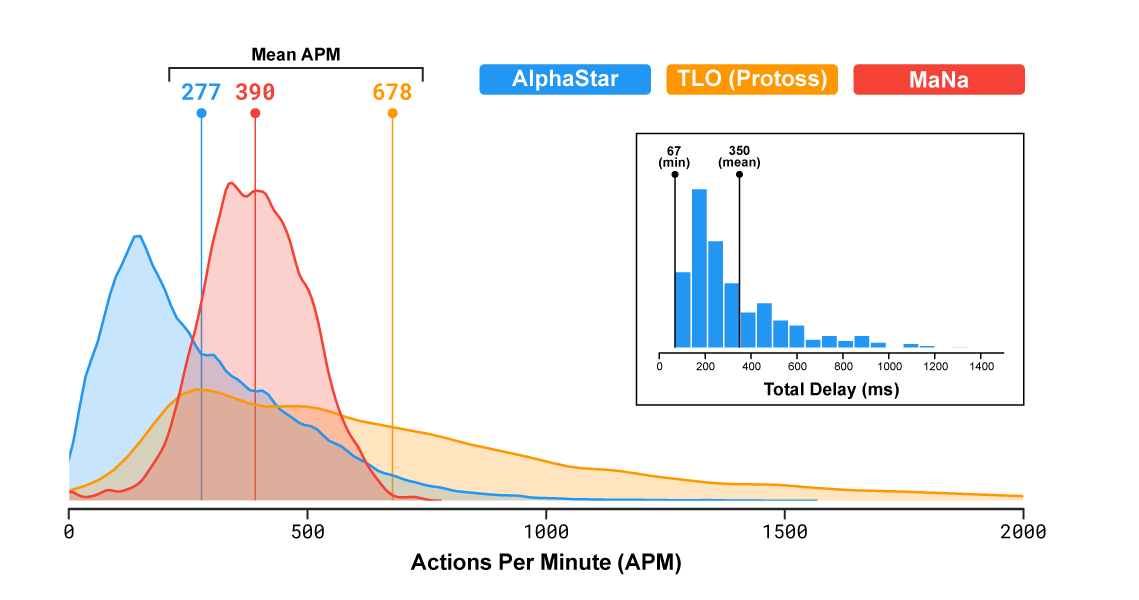
In the mass stalker battles, the AI APM exceeded 1000 a few times, and no doubt that most of that was precisely targeted. Whereas a human doing 500 APM micro is obviously going to be far more imprecise. I think a far more interesting limitation would be to cap APM at 150 or so, or to artificially limit action precision with some sort of virtual mouse that reduced accuracy as APM increased.

How many of those 500 actions are actually useful? I haven't watched competitive StarCraft games for years but back when I did, rates were more like 300APM and even then the players basically spam clicked the background or selected random units non-stop and were probably only doing 50-100 actual effective actions.

> How many of those 500 actions are actually useful?

Exactly, a human doing 500 APM during intense moments is going to be way different than an AI bursting 1000 APM with pixel-precision during the most crucial moment in a game.

TLO spent a ton of time at >1000 APM and walked his army directly into enemy shots all the time. MaNa had much better control at ~400 APM. So APM is really irrelevant to control - for humans.

I suspect the AI, on the other hand, makes each action precise & count for something.

This graph, which I think was supposed to show that the AI was being "human", IMO is pretty damning. We saw the APM spike to >1000 during a critical moment and we saw the APM at https://deepmind.com/blog/alphastar-mastering-real-time-stra...

Re: AlphaStar: Mastering the Real-Time Strategy Game StarCraft II

#167
While this is super impressive we should not forget - it was just a single matchup (1/9, requires a lot of adaption; especially on the three races) on a single map (1/N, granted in SC2 the maps are not as diverse as in the original StarCraft) using a single (outdated) patch. Humans are still master in knowledge transfer playing an unknown map and lesser known matchup with greater precision. Once an AI reaches a level where knowledge is transferred more efficiently than what we are capable of I will start getting worried - not beforehand.

Re: AlphaStar: Mastering the Real-Time Strategy Game StarCraft II

#168
post #150

Earlier quoted context omitted.

>I think a far more interesting limitation would be to cap APM at 150 or so, or to artificially limit action precision with some sort of virtual mouse that reduced accuracy as APM increased. IIRC OpenAI limits the reaction time to ~200ms when playing DoTA2. AI employing better strategies than humans will always be more interesting than AI that can out click humans.

Even the 200ms reaction time seemed overly slanted towards the AI. I don't think that is the actual reaction time of top pros, in the matches the AI played the human player would teleport in from complete invisibility and try to use an instant cast spell and the AI would have already teleported out. Yes the theoretically may have been constrained to a 200ms reaction time, but in practice the AI was playing at a super…

I've recently watched a TED talk explaining how human perception has a lag of about a third of a second. Pro players might be better, but after noticing they also need to take an action.

Re: AlphaStar: Mastering the Real-Time Strategy Game StarCraft II

#169
post #71

The gameplay was really interesting - i wonder if we'll start seeing the over-saturation of the main prior to first expand in pro games?

I was always wondering why this is not so common in SC2... I mean in StarCraft that was / is well-known and having good worker(-building) control is an essential skill (for Zerg even more than for the other races due to the natural decision where to spent the larva to).

Re: AlphaStar: Mastering the Real-Time Strategy Game StarCraft II

#170
post #2

They really should have used BroodWar for deep mind. SCII is way too volatile. Way more gimmicks available that will make it difficult for AI to come close to a human player.

Thought the same - especially since afaik no AI has yet beaten a Korean pro.

A few months (maybe 1 year ago) the best AIs tried vs some "retired" pro-gamers (like Stork) - it was not even close.

Would have loved to see DeepMind trying to show what's possible here.

Post reply on HN