The cult of rotary mixers
residentadvisor.net
The cult of rotary mixers
1–10 of 98 posts
Re: The cult of rotary mixers
#2I've been playing records for a few years and have had the pleasure of playing with a DJR400. Some personal additions to the article I'd like to share:
1. The physical feel of the device is amazing. Every knob feels and looks both smooth and incredibly sturdy. It's like the difference between driving a Mazda and a Porsche. Madza might be more versatile, practical, and cost-effective. But which one of them is more fun to use?
2. Simpler design. Sometimes less is more, especially at DJ gigs. The article kind of hints at this, but part of the feel is not just the quality of the parts but how little (visible) parts the device has. Just compare how the Xone (one of the most respected lines of mixers) looks: https://i.pinimg.com/474x/35/52/dd/3552dd4fbb206be6a4425523e... to the DJR-400:http://www.electronique-spectacle.com/media/DJR400.jpg Yet the tools in DJR-400 are just fine. I definitely wouldn't want a DJR-400 for a 10-hour minimal techno set, but for blasting out house music in a packed club there might not be anything better at that price point.

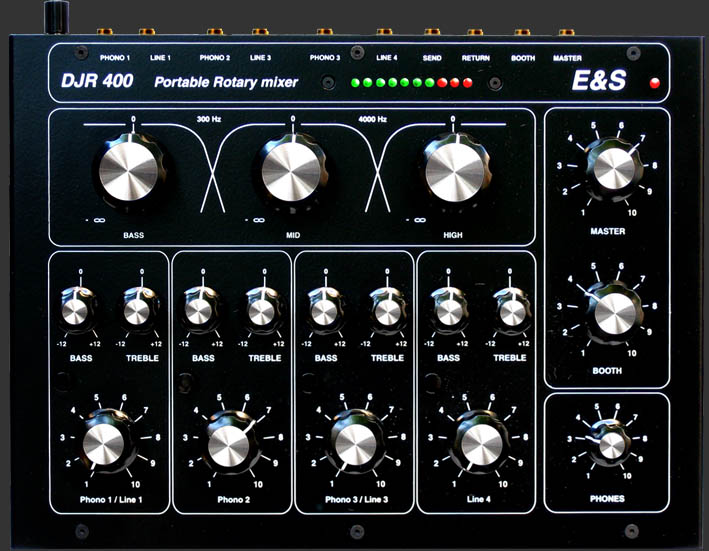
3. You can do amazing tricks with the above mentioned Xone mixer (you could argue that it's almost a musical instrument of its own), but the way of operating reminds me more of a computer than an analogue device. There's a reason why so many DJs still prefer vinyl. The digital XDJ stations are even "worse" in this aspect with their LCD touchscreens and endless configuration options behind menu trees. After a long day sitting on a computer, the last thing I want is to feel like going to stand next to another computer.
4. If a problem occurs on an analogue device there are only a few things that could have gone wrong; there's some dust where there shouldn't be, some cable is loose, there's problems with electricity or some part is physically bent. But with these increasingly digital tools it's more like debugging and fixing a computer with proprietary software. There's an endless amount of error modes and although the reliability of the high-end models is still excellent, it's just another thing to keep in the back of your mind when you're trying to focus on your music and expression. The new rotary mixers are a statement against this trend of increasing digitalisation that has entered the mixer market, too.
Re: The cult of rotary mixers
#3By the title I expected the article to be about kitchen blenders, as they are called mixers in my mother tongue. Do native speakers have this confusion?
Re: The cult of rotary mixers
#4By the title I expected the article to be about kitchen blenders, as they are called mixers in my mother tongue. Do native speakers have this confusion?
Native speaker here and I thought the exact same thing. Was actually a little disappointed it wasn't about the kitchen appliances.
Re: The cult of rotary mixers
#5By the title I expected the article to be about kitchen blenders, as they are called mixers in my mother tongue. Do native speakers have this confusion?
Yes, I thought that too hehe, Australian here. My friend uses a Thermomix in our kitchen to do everything - I can hear it now - they're absolutely a cult. :-)
Re: The cult of rotary mixers
#6By the title I expected the article to be about kitchen blenders, as they are called mixers in my mother tongue. Do native speakers have this confusion?
Didn't occur to me for a second that it was anything other than kitchen mixers. Not blenders though.
I was interested to see where my KitchenAid fell in the grouping.
Re: The cult of rotary mixers
#7Growing up my mum had a Kenwood. Massive beast of a machine. Fully analogue controls. Sounded terrible, but very loud. Could take your arm off if you weren't careful. Even had a mincer attachment.
Not really sure how you would make a non-rotary mixer TBH.
Re: The cult of rotary mixers
#8Growing up my mum had a Kenwood. Massive beast of a machine. Fully analogue controls. Sounded terrible, but very loud. Could take your arm off if you weren't careful. Even had a mincer attachment. Not really sure how you would make a non-rotary mixer TBH.
They're talking about DJ mixers in the article ya silly :)
Re: The cult of rotary mixers
#9By the title I expected the article to be about kitchen blenders, as they are called mixers in my mother tongue. Do native speakers have this confusion?
Yes, I thought that too hehe, Australian here. My friend uses a Thermomix in our kitchen to do everything - I can hear it now - they're absolutely a cult. :-)
We had a Thermomix, it died (started coming up with errors) and it was out of warranty so obviously I disassembled it. You would not believe how many cockroaches were living (and had died) inside it. Ick.
Re: The cult of rotary mixers
#10Growing up my mum had a Kenwood. Massive beast of a machine. Fully analogue controls. Sounded terrible, but very loud. Could take your arm off if you weren't careful. Even had a mincer attachment. Not really sure how you would make a non-rotary mixer TBH.
I have a Braun MX32 my mother gave me. Older than me, and I am old.
This thing is so loud you want to use hearing protection.
But it can knead 1kg heavy dough for e.g. pizza. Or whip the whites of 12 eggs.
(Yes, I know the article is about audio mixers).