Live data from Hacker News

50 Years Ago, the Sugar Industry Paid Scientists to Blame Fat (2016)

npr.org

241–250 of 307 posts

Re: 50 Years Ago, the Sugar Industry Paid Scientists to Blame Fat (2016)

#241
There is no research that proves saturated fat is in any way harmful to humans. Quite the contrary, humans are designed to digest saturated fat effortlessly and saturated fat provides the majority of our energy needs, regardless of what we eat.

The available studies only show that high fat diets can lead to an increase of LDL particles in the bloodstream but there are two problems with such studies ...

For one LDL isn’t bad per se, LDL providing just transport for triglycerides in the bloodstream and it’s more important what those particles contain. Saturated fat leads to big, fluffy LDL particles which aren’t considered to be a threat.

On the contrary it is sugar that leads to LDL particles that are low density and dangerous. If you’re worried about LDL, it’s much better to cut the sugar and the poly-unsaturated fat.

The second problem with such studies are the common confounders: sugar and PUFAs. Whenever you see negative claims about fat in studies, read the actual study and more often than not you’ll see sucrose or PUFAs being used in the diet of the subjects.

What’s absolutely ridiculous is that excess carbohydrates get converted to saturated fat. Our body only needs about 600 calories per day from carbohydrates, the rest being converted to fat.

It is saturated fat that provides a majority of the daily energy needs, not just in humans, but in all mammals.
Re: 50 Years Ago, the Sugar Industry Paid Scientists to Blame Fat (2016)

#242

Earlier quoted context omitted.

I rather suspect this is because the market for butter creates a complementary market for skim milk. Skim milk isn't great, so the producers have little choice but to heavily market 'low-fat' products. There's only so much ricotta that the market will bear.

I've never understood the market for skimmed milk; normal milk has so little fat anyway, it seems pointless to remove any, especially since it ruins the flavour. I can only guess that the milk producers want that milk fat for something else, butter and cream perhaps, so created an artificial market by claiming skimmed is healthier.

One case where I like skimmed milk is when I'm using it to accompany a peanut butter, banana, and honey sandwich. I get plenty of fat from the peanut butter, and a modest amount of healthier unrefined sugar from the banana and honey, but in that context my meal doesn't need the extra calories from the milk fat and already has enough strong flavours that the milder taste of skimmed milk works well.

And yes, I use the natural kind of peanut butter with just peanuts and sometimes salt. The bread is commercial loaf bread but of a healthier variety than white, with several whole grains and nontrivial protein, for example.

Re: 50 Years Ago, the Sugar Industry Paid Scientists to Blame Fat (2016)

#243

This is way bigger than sugar or even one segment of research. This type of corrupting influence (direct or indirect) provides enough uncertainty to allow people to ignore all research that doesn't confirm their personal bias. It also fuels the anti-science groups that claim conspiracies to hide the 'truth'.

Both sides have convincing arguments and research to back it up. They have good answers to the seemingly contradictory research that the other side uses. They both provide a consistent picture. One or both of the theories has to be wrong but I cannot decide. I can learn and read all about it and take both viewpoints into account but I still cannot decide. I could do my own research but I would come up with one or the…

For me it’s simple ... I ask myself what did my grandparents used to eat?

I’m not from the US and in our country the industrialization of the food supply happened much later, along with obesity and diabetes, which back in my grandparents’ time were very rare. My grandparents lived on the countryside, working on their farm, raising their own crops and animals.

Grandpa died at 99 years old and worked his land until 95.

He ate 6 to 8 eggs per day (they had a lot of chickens). Meat was more expensive, sacrificing an animal about once per week, but they were cooking with lard and butter all the time. They also had plenty of milk and cheese from their own goat or cow. You know, the kind of really fat milk that you can’t find in stores. They also drank their own wine, daily.

They were not eating sugar. Or vegetable oils.

Re: 50 Years Ago, the Sugar Industry Paid Scientists to Blame Fat (2016)

#244
post #69
post #38

While there is no doubt that this happened, any one has any idea why there was no reverse push from the fat industry? Was it less organized than the sugar industry or were the profit margins more slender?

> While there is no doubt that this happened, any one has any idea why there was no reverse push from the fat industry? The "fat" industry is the animal agriculture industry and it has heavily swayed and influenced American dietary guidelines for decades. Various food industries presented their side of the argument at a second senate hearing in 1977. This meeting resulted in a watered down version of the Dietary Goal…

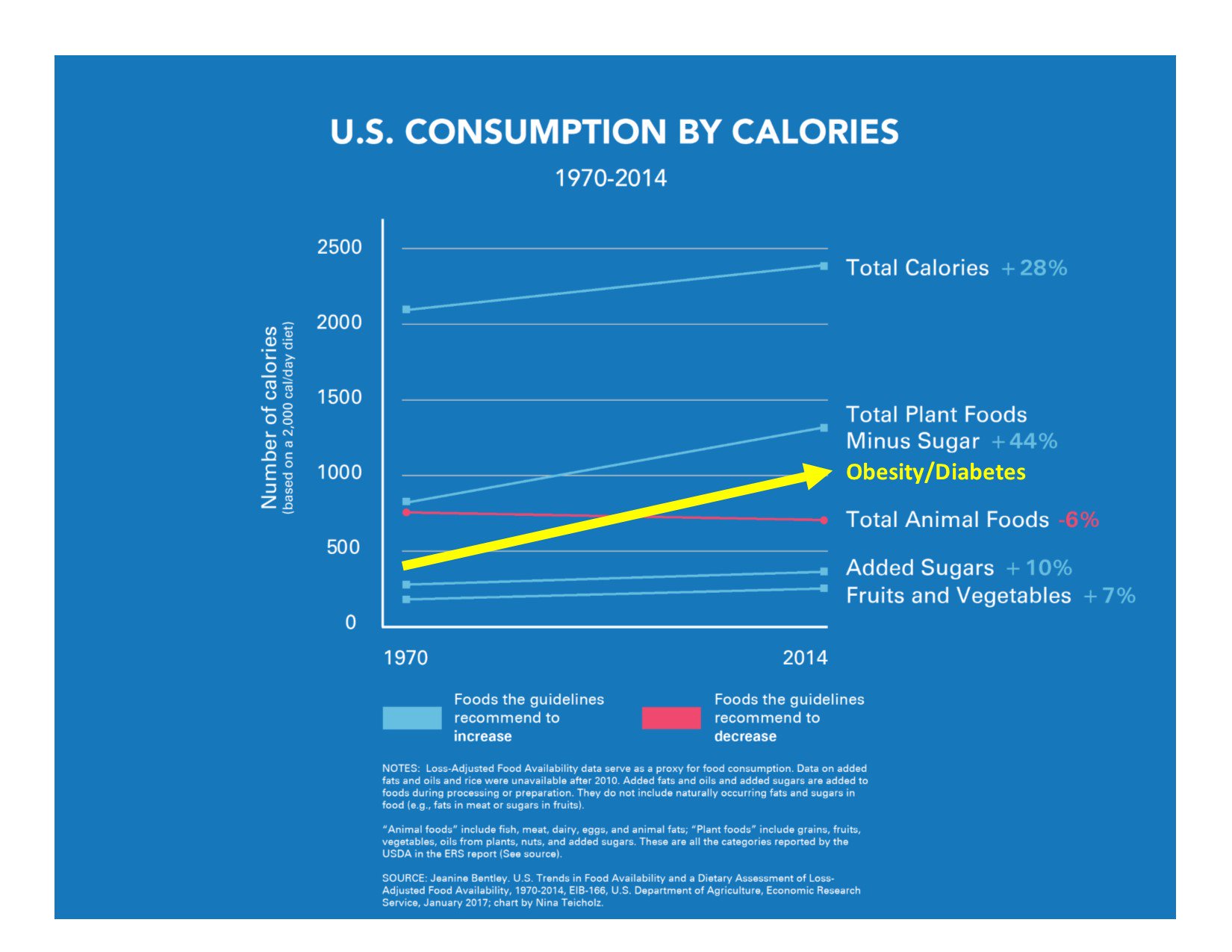
Total animal food consumption declined, as advised by guidelines...

https://pbs.twimg.com/media/DxMoxXqWsAAjlso.jpg:large

Re: 50 Years Ago, the Sugar Industry Paid Scientists to Blame Fat (2016)

#245
post #105

Earlier quoted context omitted.

You could use artificial sweeteners. Also, there's plenty of lean meats or plant-based diets that are low in fat and sugar while remaining reasonably palatable.

Where is the energy supposed to come from if there is neither fat nor sugar?

Protein. And there are carbonhydrates besider sugar...

Re: 50 Years Ago, the Sugar Industry Paid Scientists to Blame Fat (2016)

#247

Earlier quoted context omitted.

This is way bigger than sugar or even one segment of research. In one sense maybe but it's hard for any one other factor to be larger than sugar in contributing to the decline of American (and world-wide) health.

> decline in world-wide health Wat. Data please.

US life expectancy is dropping. Globally obesity is on the rise. Those things are correlated.

Re: 50 Years Ago, the Sugar Industry Paid Scientists to Blame Fat (2016)

#248
post #102

Relevant talks by Robert Lustig: https://www.youtube.com/watch?v=gmC4Rm5cpOI "Sugar -- the elephant in the kitchen" (20 minutes, year 2013) https://www.youtube.com/watch?v=dBnniua6-oM "Sugar: The Bitter Truth" (90 minutes, year 2009)

The guy is a quack. Bunch of stuff he says in his Bitter Truth talk is false.

For example, Japanese consume much more fructose sugars than an average USA citizen. He somehow skipped that, when he used the Japanese as an example of healthy diet people. Japanese individuals consume 1000kcal less than USA daily average. That's probably the only thing that matters.

Re: 50 Years Ago, the Sugar Industry Paid Scientists to Blame Fat (2016)

#249

There is no research that proves saturated fat is in any way harmful to humans. Quite the contrary, humans are designed to digest saturated fat effortlessly and saturated fat provides the majority of our energy needs, regardless of what we eat. The available studies only show that high fat diets can lead to an increase of LDL particles in the bloodstream but there are two problems with such studies ... For one LDL is…

Yet the longest lived populations on the planet eat diets loaded with carbs and mostly unsaturated fats.

https://www.bluezones.com/2018/09/news-study-finds-low-carb-...

Re: 50 Years Ago, the Sugar Industry Paid Scientists to Blame Fat (2016)

#250

Earlier quoted context omitted.

I rather suspect this is because the market for butter creates a complementary market for skim milk. Skim milk isn't great, so the producers have little choice but to heavily market 'low-fat' products. There's only so much ricotta that the market will bear.

I've never understood the market for skimmed milk; normal milk has so little fat anyway, it seems pointless to remove any, especially since it ruins the flavour. I can only guess that the milk producers want that milk fat for something else, butter and cream perhaps, so created an artificial market by claiming skimmed is healthier.

The taste or lack thereof depends entirely on what you’re used to. I drink semi-skimmed 1.5% milk; 0% milk tastes really bland and ~3% milk is way too sweet and rich-tasting. But IME it doesn’t take long for your taste to adjust to either lower or higher fat content. Anyway, to me it makes perfect sense to separate the cream for other uses (what would be the alternative of selling the skimmed milk? Just throwing it away?)
Post reply on HN