Live data from Hacker News

The West Coast is beating the East Coast on transportation?

nytimes.com

201–205 of 205 posts

Re: The West Coast is beating the East Coast on transportation?

#201
post #179

Earlier quoted context omitted.

>It's quieter than the train. Huh? What kind of trains have you been riding? Buses are noisy and have herky-jerky motion because they drive in traffic and have noisy diesel engines and are constantly accelerating and braking and turning. Trains ride on metal rails with no traffic in their way. Of course, the shitty subways in America's east coast cities somehow manage to be extremely noisy and bumpy; I'm not sure how…

>What kind of trains have you been riding? Subway trains roll on tracks in concrete tunnels that reverberate sound. They're extremely loud. It's metal on metal with grinding disc brakes. >Buses are noisy and have herky-jerky motion because they drive in traffic Buses are huge. They're generally too huge to accelerate or decelerate rapidly, so I have no experienced this herky-jerky motion you're talking about. That's…

>Subway trains roll on tracks in concrete tunnels that reverberate sound. They're extremely loud. It's metal on metal with grinding disc brakes.

The German subways I've ridden manage to be reasonably smooth and quiet.

>Buses are huge. They're generally too huge to accelerate or decelerate rapidly, so I have no experienced this herky-jerky motion you're talking about. That's much more likely in a car.

I guess you've never ridden a bus in a city. Buses can brake very effectively, like most vehicles with air brakes, and lots of riders have to stand on them, so you get thrown around a lot more than a rider in a car who's belted into a bucket seat.
Re: The West Coast is beating the East Coast on transportation?

#202

Earlier quoted context omitted.

>20 minutes is practically an entire commute. It’s not at all reasonable to burn that much time on the last mile alone. If 20 minutes is "practically an entire commute" then you're already in a dense enough area to where transit coverage should minimize the number of people who are a mile away. At that point, proximity to transit just becomes part of what you pay for in your house. If the transit is there, developmen…

The median commute time in the US is 25 minutes, up to 32 in the most congested metro areas. This is overwhelmingly due to driving on freeways across suburbia, enabled by sufficiently low density.

>The median commute time in the US is 25 minutes, up to 32 in the most congested metro areas. This is overwhelmingly due to driving on freeways across suburbia, enabled by sufficiently low density.

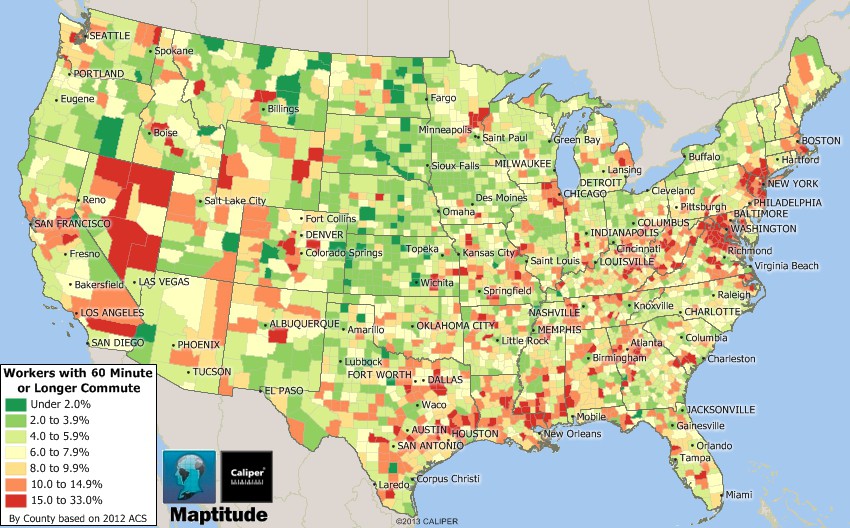
Firstly, that's more like exurbia than suburbia. Suburbia is characterized by low density sprawl surrounding a denser, urban core that acts as the economic anchor. This is also where the nightmarishly long commute times tend to be: (https://www.caliper.com/featured-maps/xus-commute-time-mapti...).

Secondly, people decide where to live and work based on commute times. In other words, people consciously choose to live in places that are within a 30 minute commute from work, and they structure their days (when they wake up, when they leave the office, etc) around minimizing it. This same mechanic works if the transit is available. People will consciously choose to live closer to the transit hubs that minimize the lengths of their commutes, promoting density around the bus or train routes.

This is why the "last mile" problem is not as relevant of a consideration as people think once you get past the "windshield bias" a bit. Firstly because if everyone is within a mile of a transit option then that means the [i]worst case scenario[/i] is that someone has to walk a mile, and most people will choose to live within a space that's even less than that.

And secondly, because a mile isn't actually that terrible of a walk, especially if you make the walk a pleasant one. I live 2 and a half miles from my office. If I ride the bus it takes me about 20 minutes door to door with maybe 5 of those minutes involving walking to/from the bus-stop. If I walk the whole way it takes me about 45 minutes. Despite the walk being more than twice of long, though, I'm honestly indifferent between the two options. My only real consideration is whether I'm in a hurry or not, and usually if I'm in a REAL hurry I'll take a cab.

Even if it's raining, I often just take my umbrella and walk the commute because the walk is, in itself, enjoyable. It's not just a means of conveyance, it's a stroll and a source of exercise. There are plenty of murals to look at, a park to stroll through, flowers and landscaping to see, shop windows to look in on, sidewalk cafes to people watch people on awkward first-dates, etc.

Re: The West Coast is beating the East Coast on transportation?

#203
post #201

Earlier quoted context omitted.

>What kind of trains have you been riding? Subway trains roll on tracks in concrete tunnels that reverberate sound. They're extremely loud. It's metal on metal with grinding disc brakes. >Buses are noisy and have herky-jerky motion because they drive in traffic Buses are huge. They're generally too huge to accelerate or decelerate rapidly, so I have no experienced this herky-jerky motion you're talking about. That's…

>Subway trains roll on tracks in concrete tunnels that reverberate sound. They're extremely loud. It's metal on metal with grinding disc brakes. The German subways I've ridden manage to be reasonably smooth and quiet. >Buses are huge. They're generally too huge to accelerate or decelerate rapidly, so I have no experienced this herky-jerky motion you're talking about. That's much more likely in a car. I guess you've n…

>The German subways I've ridden manage to be reasonably smooth and quiet.

That's probably more about good soundproofing for inside the train. But even in Tokyo I found the trains to be rather loud.

>I guess you've never ridden a bus in a city.

I ride one every morning, usually standing. It hasn't been a problem and I actually find our subway trains to be more prone to hard stops and starts. Intra-city buses rarely exceed 30 miles an hour anyway. I usually feel bad for the elderly, the injured, and the pregnant because it actually can be hard for them if they're stuck standing. But my ire is usually reserved for people who fail to give up their seats rather than the concept of riding a bus.

Re: The West Coast is beating the East Coast on transportation?

#204
post #92

Earlier quoted context omitted.

One simple fix Seattle could do downtown would be to make all the crosswalks all way, and increase the walk times. At the same time, make it illegal for cars to turn right on red and you’d dramatically increase pedestrian safety and increase car throughput. However it won’t happen with our current city council.

As a pedestrian, I would be happier if cars could only turn right on red. I have nearly been run over multiple times by some jackass who doesn't look where he's going making a right turn when I have a walk signal.

I should have been explicit, with all way walks it would also be illegal for pedestrians to cross on traffic green lights.

Re: The West Coast is beating the East Coast on transportation?

#205

Earlier quoted context omitted.

Its also almost uselessly infrequent. As a poor sod needing to go to the Aussie consulate between Beverly hills and Santa Monica from Irvine, I'm incredibly lucky that the train was 5 mins late, because there wasn't much else to do that day: last train for the morning left 9:02am, next train 4:30pm! And I thought Perth's public transport was shit in comparison to Singapore/Hong Kong/London/Berlin, boy have I got new…

Irvine is not part of LA's public transportation system... And in the case of London and Berlin, you're comparing national rail systems to that of a single city that could easily fit the 4 cities you mentioned within its borders and still have room for Paris and Tokyo. And let's not even get started on the LA metropolitan area, which is geographically the largest in the Western world.

Irvine is about as far out as Mandurah from Perth and it goes about that far again north: if LA's public transport system was actually well designed it would be.
Post reply on HN