Live data from Hacker News

New research on the cost of colonization to India

aljazeera.com

81–90 of 111 posts

Re: New research on the cost of colonization to India

#81
post #3

My government uses my taxes to buy goods and services in the local market. Is that defrauding or just the nature of providing government? This article is on somewhat loose economic grounds, I fear. People paid taxes, albeit to the coloniser, some people could sell their goods at market prices. Things we still find pretty reasonable. On top of that compounding at 5% for 250 yrs is not a good way to create current doll…

Well, a representative government taxing its own people to provide services (e.g. manage externalities) is not theft, wild-eyed libertarian rants notwithstanding.

Showing up unasked and extract taxes to fund projects in your own interest, only some of which are even of use to locals, is unambiguously theft.
Re: New research on the cost of colonization to India

#82
post #15

Earlier quoted context omitted.

When the government buys things with tax money, the things are supposed to be used for the benefit of people who paid the taxes. It doesn't seem like the Company even pretended that this was the case.

Most tax dollars in most countries are not spent on goods and services for the benefit of the people who paid them.

I doubt that's actually true, especially in the 21st century.

Re: New research on the cost of colonization to India

#83
post #17

Hang on a minute... is this guy saying the country that * had the largest supply of slaves[1], * tried to levy taxes on American tea, * broke China and forced them to buy their own Opium * invented concentration camps to defeat the Dutch Boers[2] * used Gibraltar as a control point for the entire Mediterranean * erased most Tasmanian Aboriginals [3] did something dodgy in India ?? [1] http://www.slate.com/articles/li…

> [Britain] tried to levy taxes on American tea,

BTW there's an Indian connection there too (I assume you're talking about the Boston Tea Party).

The cause of that episode was the British eliminating the tax on tea and at the same time giving the East India Company a tea monopoly in the North American colonies.

When I was in school in Boston the official line was that the tea party demonstrators were smugglers upset at the monopoly and reduction in tax (the New England coastline is well structured for and remains a big smuggling area, especially heroin and human trafficking).

I have no idea if the story is still told that way in the Boston schools. I was also taught that the clever colonists used to hide behind the bushes and pop out to shoot the stupid British marching down the streets in their bright red uniforms. I know that by 1970 that narrative had been replaced as the guerrilla warfare in Viet Nam was now being presented as "unfair"

None of which is a criticism of the USA or UK, merely a comment on how our narratives "evolve".

Re: New research on the cost of colonization to India

#84
post #79
post #67

Earlier quoted context omitted.

Doesn't this line of reasoning apply equally to the Swiss? They had no colonies, and are richer than Britain today. Probably were in 1952 as well.

Actually by 1952, probably not. Switzerland's economy was pretty much agricultural up to the second world war (remittence payments from the Vatican were a noticeable source of foreign income into the early 20th century!). WWII offered a source of capital (people stashing their money into a neutral state, and many never asking for it back) and some industrialization, but the Switzerland we think of today is really a p…

Indeed. But German industrialisation didn't seem to need much from tropical colonies.

And conversely, all those fabulous silver mines didn't exactly leave the Spaniards with a head-start in modernisation.

Re: New research on the cost of colonization to India

#85
post #79
post #67

Earlier quoted context omitted.

Doesn't this line of reasoning apply equally to the Swiss? They had no colonies, and are richer than Britain today. Probably were in 1952 as well.

Actually by 1952, probably not. Switzerland's economy was pretty much agricultural up to the second world war (remittence payments from the Vatican were a noticeable source of foreign income into the early 20th century!). WWII offered a source of capital (people stashing their money into a neutral state, and many never asking for it back) and some industrialization, but the Switzerland we think of today is really a p…

Most places were pretty agricultural in 1952 :) This dataset has Switzerland at #2 in 1950, and a comment says UK would have been #7.

Economic growth in europe only really took off to levels we think of as "today" after 30+ years of intense postwar growth. It was rich before that, but still very rural. Movies of the era are quite revealing.

I an genuinely curious if there is an argument against Switzerland et al being counterexamples to the colonialism/wealth argument. The strongest one I can think of would be that Switzerland et al benefitted from proximity to capital and to the new techniques discovered by capital.

https://www.nationmaster.com/country-info/stats/Economy/GDP-...

Re: New research on the cost of colonization to India

#86
post #40

Earlier quoted context omitted.

I never read any account from travellers (from Europe/China) describing India as poor before colonialism. So, i think this article does have some validity.

If you mean ordinary people, then everywhere was poor, so travel authors would not have seen a shocking contrast. We actually have numbers on all this stuff, e.g. you can track a slow decline in day-labor wages, and IIRC (around Delhi maybe?) they decline slowly from about 1600 to 1800. There are comparable-sized rises and falls in other parts of the world, too. But all very low by modern standards. Only with industr…

Nope, this is typical of the crap that you see quite frequently.

We're not comparing 1600's wages to today, we're comparing them to wages in that era. Of course this was a pre-industrialized society, but it wasn't a society mired in poverty as most people imagine it to be.

Re: New research on the cost of colonization to India

#87

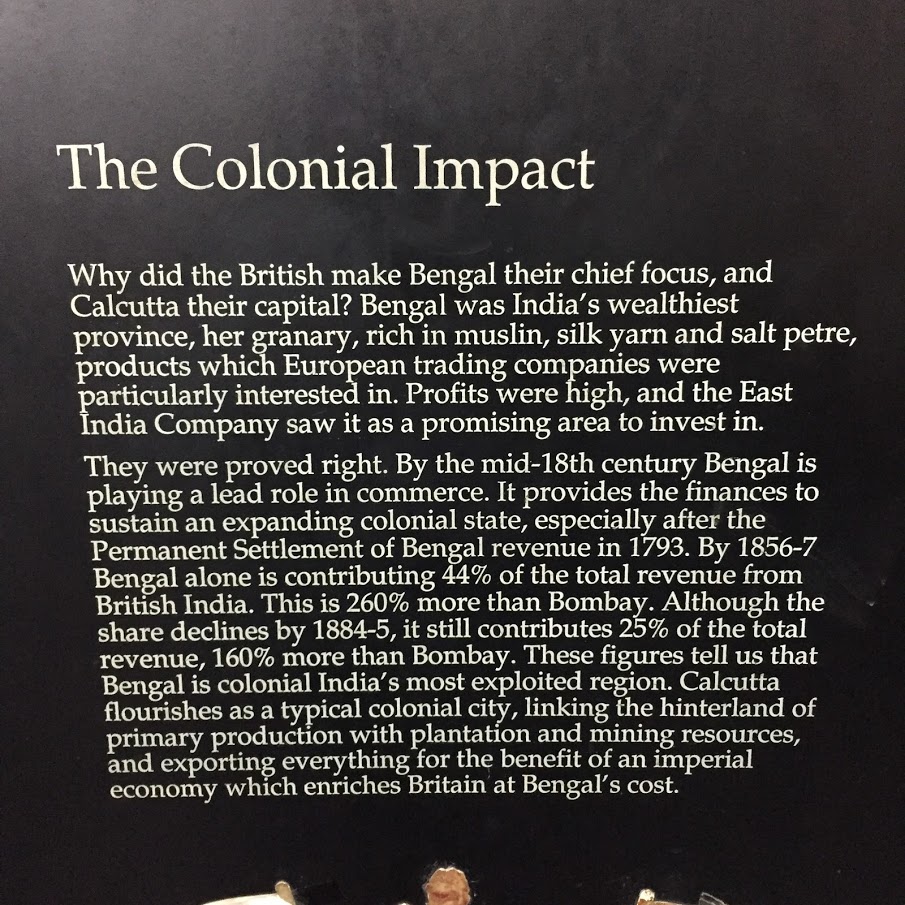
I was in India last month after being away for over 2 decades. Visited Calcutta for the very first time. Our Driver and Tour Guide at the Taj took us around the city and told us about a lot of history about the City. At one point he said that over 1 million people live on the sidewalks (called footpaths) in Calcutta. I have seen abject poverty in India while growing up there, but not to this level. There are generati…

HN is not letting me edit, so here's the source: [ From the Museum Plaque / Card]. This is a photo I took when I was there.

https://raw.githubusercontent.com/theShiva/public-domain/mas...

The only thing incorrect in my original statement was, it was the province of Bengal (now the state?), not Calcutta.

Please read this entire thing. I've typed out the text in the photo verbatin. Last line says it all.

The Colonial Impact

Why did the British make Bengal their chief focus, and Calcutta their Capital? Bengal was India's wealthiest province, for her granary, rich in muslin, silk yarn, and salt petre, products which European trading companies were particularly interested in. Profits were high, and the East India Company saw it as a promising area to invest in.

They were proved right. By the mid-18th century, Bengal is playing a lead role in commerce., It provides the finances to sustain an expanding colonial state, especially after the Permanent Settlement of Bengal, revenue in 1793.

By 1856-7 Bengal alone is contributing 44% of the total revenue from British India. This is 260% more than Bombay. These figures tell us that Bengal is colonial India's most exploited region. Calcutta flourishes as a typical colonial city, linking the hinterland of primary production with plantations and mining resources, and exporting everything for the benefit of an imperial economy witch enriches Britain at Bengal's cost.

Re: New research on the cost of colonization to India

#88
post #37

I was in India last month after being away for over 2 decades. Visited Calcutta for the very first time. Our Driver and Tour Guide at the Taj took us around the city and told us about a lot of history about the City. At one point he said that over 1 million people live on the sidewalks (called footpaths) in Calcutta. I have seen abject poverty in India while growing up there, but not to this level. There are generati…

This is not correct, Calcutta was some villages where it happened to be convenient for the east india company to set up shop: "The area where the city is now located was originally inhabited by the people of three villages: Kalikata, Sutanuti and Gobindapur." https://en.wikipedia.org/wiki/History_of_Kolkata Delhi on the other hand was a great city, many times over (and sacked, and re-built, by rules of many tongues).…

I guess it was the province of Bengal, not Calcutta. Bengal was India's wealthiest province at that time.

See my follow up response to this thread.

Re: New research on the cost of colonization to India

#89
post #37

I was in India last month after being away for over 2 decades. Visited Calcutta for the very first time. Our Driver and Tour Guide at the Taj took us around the city and told us about a lot of history about the City. At one point he said that over 1 million people live on the sidewalks (called footpaths) in Calcutta. I have seen abject poverty in India while growing up there, but not to this level. There are generati…

This is not correct, Calcutta was some villages where it happened to be convenient for the east india company to set up shop: "The area where the city is now located was originally inhabited by the people of three villages: Kalikata, Sutanuti and Gobindapur." https://en.wikipedia.org/wiki/History_of_Kolkata Delhi on the other hand was a great city, many times over (and sacked, and re-built, by rules of many tongues).…

Nope, op is correct. One rule of the thumb in India is that closer the area is to British rule, the more poor and plundered it is.

Auroville in South was plundered and the colonists burnt the forests around it leaving it completely barren. It was recently rebuilt and is still work in progress to return it back to the original state

Re: New research on the cost of colonization to India

#90
post #56
post #35

Earlier quoted context omitted.

The topic is inflammatory, which means flamebait guarantees flamewars. The comment was flamebaity in the ways I described. It's possible to write about these things in a less flamebaity way—that's just not the style people reach for by default on the internet. I agree with your second sentence btw.

as i said it was more lighthearted. i wrote it at a bus stop after work in London, nothing snarky intended. ive used bullet points A LOT in many comments over the years. it used to be “citation needed” back in the day, so i still supply them.

It sounds like I misread you - sorry about that! Moderation is pattern matching and that means making mistakes when the pattern doesn't really match.

Unfortunately, there's a sense in which it still makes no difference because the comment fits the flamewar-starting pattern whether you were posting in that spirit or not. But I would have phrased my reply differently if I'd read you more precisely.

Post reply on HN