Live data from Hacker News

Seagate Announces 16TB HDD

nexthive.com

61–70 of 223 posts

Re: Seagate Announces 16TB HDD

#61
post #45

Earlier quoted context omitted.

Things do get more expensive as demand increases. Have you not bought enterprise SSDs up until 6 months ago? https://cdn.pcpartpicker.com/static/forever/images/trends/tr... This is the average price of a 256GB SSD. In May 2017 they were just above $100. Soon after that demand pushed that near $175. Just recently that price has dropped as new processes have increased inventories. > why wouldn't someone undercut the cu…

It seems you are much smarter than the rest of us when it comes to understanding supply and demand curves, but why don't you help us walk through an example, okay? Suppose it costs -- and I am making this up -- $10 to produce the first 1000 units, but only $1 after that. Suppose people are charging a lot of money, say $50 for a unit. Won't you increase production to try to capture that demand. After that, because you…

Increasing production of semiconductors means bringing up a new fab. It's incredibly expensive and takes years.

Samsung et al do build new fabs, but at a significant lag to demand for logistic and risk-mitigation reasons.
Re: Seagate Announces 16TB HDD

#62

From the article: "In a world where SSDs have become more and more common, one might ask what the point of even developing newer and bigger HDDs is." Solid state drives still cost about 10 times more per gigabyte. I'm just a web developer, but a spinning-disk drive looks 100 times more complicated to me to manufacture. I know at the beginning that hard drives would be cheaper, simply because SSDs were newer, and ther…

>Solid state drives still cost about 10 times more per gigabyte I think you should go shopping, because the time where SSDs cost 10x as much as an HDD is over. When a WD Blue 1TB SATA 6 Gb/s 7200 RPM 64MB is $46 on Amazon and a Crucial MX500 1TB 3D NAND SATA 2.5 Inch is $134. Unless you're comparing the cheapest 1TB HDD you can find to a Samsung 970 pro 1TB or something... which really isn't a reasonable comparison i…

I agree that for 0.5-1 TB disk there really is no reason to not to get an SSD. However the price difference jumps significantly once you're looking at larger disks though. The cheapest 4TB SSD costs about to 8 times more than the cheapest 4TB HDD for example.

Re: Seagate Announces 16TB HDD

#64
post #5

I don't quite recall when it happened, but at some point my reaction to announcements like this changed from, "Yay, more space!" to "Good, the size I need will be even cheaper when I upgrade 2-3 years from now."

I record and produce my own music as a hobby. Each project can easily reach gigabytes in size, and my biggest projects are eight gigabytes or so (eight drum mics, guitar, bass, vocals, and synthesizers, all uncompressed 24/96 audio, often with a number of different takes). I go through HDDs very quickly. I know that for development and most uses bigger HDDs are unnecessary, but for media production these improvements…

Why not use FLAC? It gets 50-70% compression and is lossless.

Re: Seagate Announces 16TB HDD

#65
post #45

Earlier quoted context omitted.

Things do get more expensive as demand increases. Have you not bought enterprise SSDs up until 6 months ago? https://cdn.pcpartpicker.com/static/forever/images/trends/tr... This is the average price of a 256GB SSD. In May 2017 they were just above $100. Soon after that demand pushed that near $175. Just recently that price has dropped as new processes have increased inventories. > why wouldn't someone undercut the cu…

It seems you are much smarter than the rest of us when it comes to understanding supply and demand curves, but why don't you help us walk through an example, okay? Suppose it costs -- and I am making this up -- $10 to produce the first 1000 units, but only $1 after that. Suppose people are charging a lot of money, say $50 for a unit. Won't you increase production to try to capture that demand. After that, because you…

Because supply and demand curves aren't smooth - Increasing production scales linearly up to a point, and then you need to build a new factory. Samsung is pumping out all the SSDs it can produce. It is probably also building new factories, but the capital investment and lead-time on that are significant, and until those factories come online, they're simply sunk cost.

Customer demand is not smooth. I will buy precisely 0 SSDs at prices > $125 per 1T drive, and I will suddenly buy 4 as soon as the price drops below there. There are thousands to millions of other customers will scattered plot points around that area, but while you can draw a smoothed graph over them and be reasonably correct, they do not actually represent a mathematical law.

Further - Information is imperfect and markets, for all their elasticity, are only trending towards efficiency.

This all assumes you're arguing in good faith. This in itself is an unreasonable assumption - Your last, mocking line seems to belie it. As does this line.

Re: Seagate Announces 16TB HDD

#66

Earlier quoted context omitted.

It seems you are much smarter than the rest of us when it comes to understanding supply and demand curves, but why don't you help us walk through an example, okay? Suppose it costs -- and I am making this up -- $10 to produce the first 1000 units, but only $1 after that. Suppose people are charging a lot of money, say $50 for a unit. Won't you increase production to try to capture that demand. After that, because you…

Because supply and demand curves aren't smooth - Increasing production scales linearly up to a point, and then you need to build a new factory. Samsung is pumping out all the SSDs it can produce. It is probably also building new factories, but the capital investment and lead-time on that are significant, and until those factories come online, they're simply sunk cost. Customer demand is not smooth. I will buy precise…

Nothing in the argument I laid out has anything to do with smooth curves. The same arguments apply for lumpy or unsmooth curves.

OP was talking about 10 year lags! Please read the whole thread in context.

Re: Seagate Announces 16TB HDD

#67
post #45

Earlier quoted context omitted.

By that logic things should get more expensive, not cheaper, as the demand increases. To put it another way, why wouldn't someone undercut the current suppliers and sell at just above their marginal cost and take over the whole market.

Things do get more expensive as demand increases. Have you not bought enterprise SSDs up until 6 months ago? https://cdn.pcpartpicker.com/static/forever/images/trends/tr... This is the average price of a 256GB SSD. In May 2017 they were just above $100. Soon after that demand pushed that near $175. Just recently that price has dropped as new processes have increased inventories. > why wouldn't someone undercut the cu…

Sure, that's the economical aspect of it.

On the other hand it means the technology is established and people prefer to buy SSDs over HDs. Speaking of myself, I wouldn't consider buying an HD laptop ever again.

This means companies can invest in very long-term endeavours to transform their HDD production businesses into SSD production businesses. The costs are high but the risk is low, lower or at best equally high of continuing with HDDs if you ask me.

Re: Seagate Announces 16TB HDD

#68

From the article: "In a world where SSDs have become more and more common, one might ask what the point of even developing newer and bigger HDDs is." Solid state drives still cost about 10 times more per gigabyte. I'm just a web developer, but a spinning-disk drive looks 100 times more complicated to me to manufacture. I know at the beginning that hard drives would be cheaper, simply because SSDs were newer, and ther…

>Solid state drives still cost about 10 times more per gigabyte I think you should go shopping, because the time where SSDs cost 10x as much as an HDD is over. When a WD Blue 1TB SATA 6 Gb/s 7200 RPM 64MB is $46 on Amazon and a Crucial MX500 1TB 3D NAND SATA 2.5 Inch is $134. Unless you're comparing the cheapest 1TB HDD you can find to a Samsung 970 pro 1TB or something... which really isn't a reasonable comparison i…

>When a WD Blue 1TB SATA 6 Gb/s 7200 RPM 64MB is $46 on Amazon and a Crucial MX500 1TB 3D NAND SATA 2.5 Inch is $134.

those are cherrypicked numbers because 1TB is at the very low end for HDD sizes. compare with a more typical HDD size (3TB or 4TB) and you'll see the differences become more obvious.

Re: Seagate Announces 16TB HDD

#69

Earlier quoted context omitted.

Because supply and demand curves aren't smooth - Increasing production scales linearly up to a point, and then you need to build a new factory. Samsung is pumping out all the SSDs it can produce. It is probably also building new factories, but the capital investment and lead-time on that are significant, and until those factories come online, they're simply sunk cost. Customer demand is not smooth. I will buy precise…

Nothing in the argument I laid out has anything to do with smooth curves. The same arguments apply for lumpy or unsmooth curves. OP was talking about 10 year lags! Please read the whole thread in context.

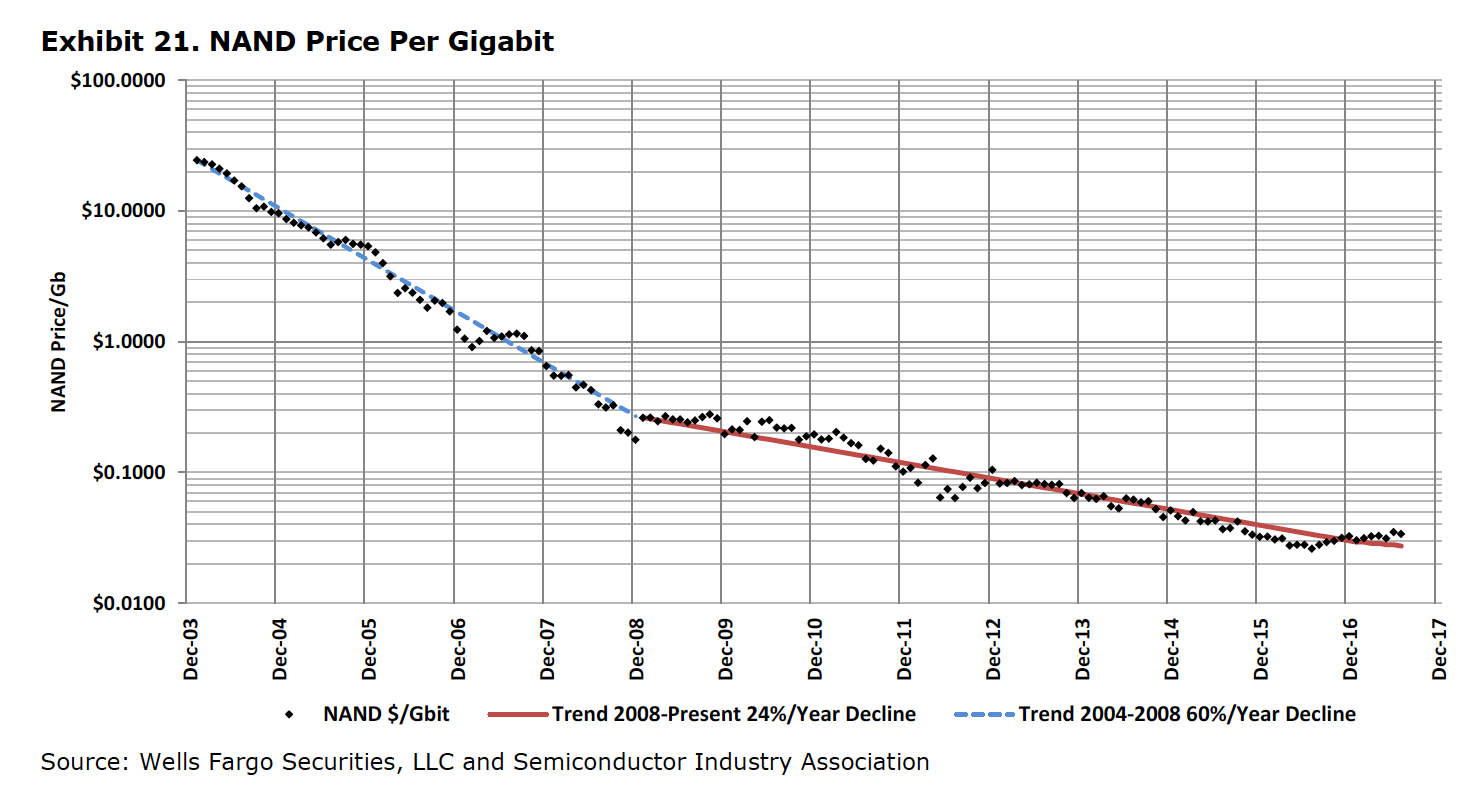
NAND prices have dropped considerably over the last 10 years, but not as fast as hard drive prices.

https://static.seekingalpha.com/uploads/2017/9/24/9577541-15...

Re: Seagate Announces 16TB HDD

#70
post #45

Earlier quoted context omitted.

Things do get more expensive as demand increases. Have you not bought enterprise SSDs up until 6 months ago? https://cdn.pcpartpicker.com/static/forever/images/trends/tr... This is the average price of a 256GB SSD. In May 2017 they were just above $100. Soon after that demand pushed that near $175. Just recently that price has dropped as new processes have increased inventories. > why wouldn't someone undercut the cu…

It seems you are much smarter than the rest of us when it comes to understanding supply and demand curves, but why don't you help us walk through an example, okay? Suppose it costs -- and I am making this up -- $10 to produce the first 1000 units, but only $1 after that. Suppose people are charging a lot of money, say $50 for a unit. Won't you increase production to try to capture that demand. After that, because you…

It seems that you assume that if one producer sells its product for slightly less than its competition, then it will get all the customers, à la Bertrand competition.

But if it is not the case, and lowering your price only wins you _some_ but not all customers, then there is no reason to expect that the price point that balance gaining new customers vs selling each product for less will be equal to the marginal cost and not above.

Post reply on HN