Live data from Hacker News

Protect the last of the wild

nature.com

91–100 of 123 posts

Re: Protect the last of the wild

#91
So how do you incentivize/coerce governments and companies to conserve natural resources, not dump toxins into the air, land and water, and generally limit the negative influences on our health and environment?

"A world given over entirely to the engine of industry becomes a world no longer fit for creatures, human or otherwise; it becomes a world without hope." - Tim Winton

Re: Protect the last of the wild

#92

Earlier quoted context omitted.

>One of the best examples I can give, though I have many, is this: my grandfather was a logger and firefighter in this forest in the 70s. During my lifetime though, the PhD environmentalists came to dominate the forest service, and as logging waned they stopped listening to the old timers about how to take care of the forest. My grandfather would try to tell them they needed to let loggers thin the forest out, and to…

> This is just flat out false, anti-science disinformation. Fire suppression as a policy started in the 1930s and actually reverted in the 60's and 70's. No it's not. I didn't say fire suppression as a policy started then. I said they stopped listening to locals for advice about, primarily, the control burns, and the needs for forest thinning. You are attacking an argument I never made. Strawman fallacy.

But they did allow controlled burns, thats what his link says. So you created a strawman in the scientists.

The 1964 Wilderness Act, Tall Timbers Research Conferences, and Southern Forest Fire Lab research demonstrated the positive benefits derived from natural and prescribed fire. As a result, national fire policy began to evolve to address both the economic and ecological benefits of not aggressively controlling, and even using, fire. In February 1967, the USDA Forest Service permitted leeway for early- and late-season fires. In 1968, the National Park Service changed its policy to recognize the natural role of fire, allow natural ignitions to run their course under prescribed conditions, and use prescribed fires to meet management objectives.

Re: Protect the last of the wild

#93
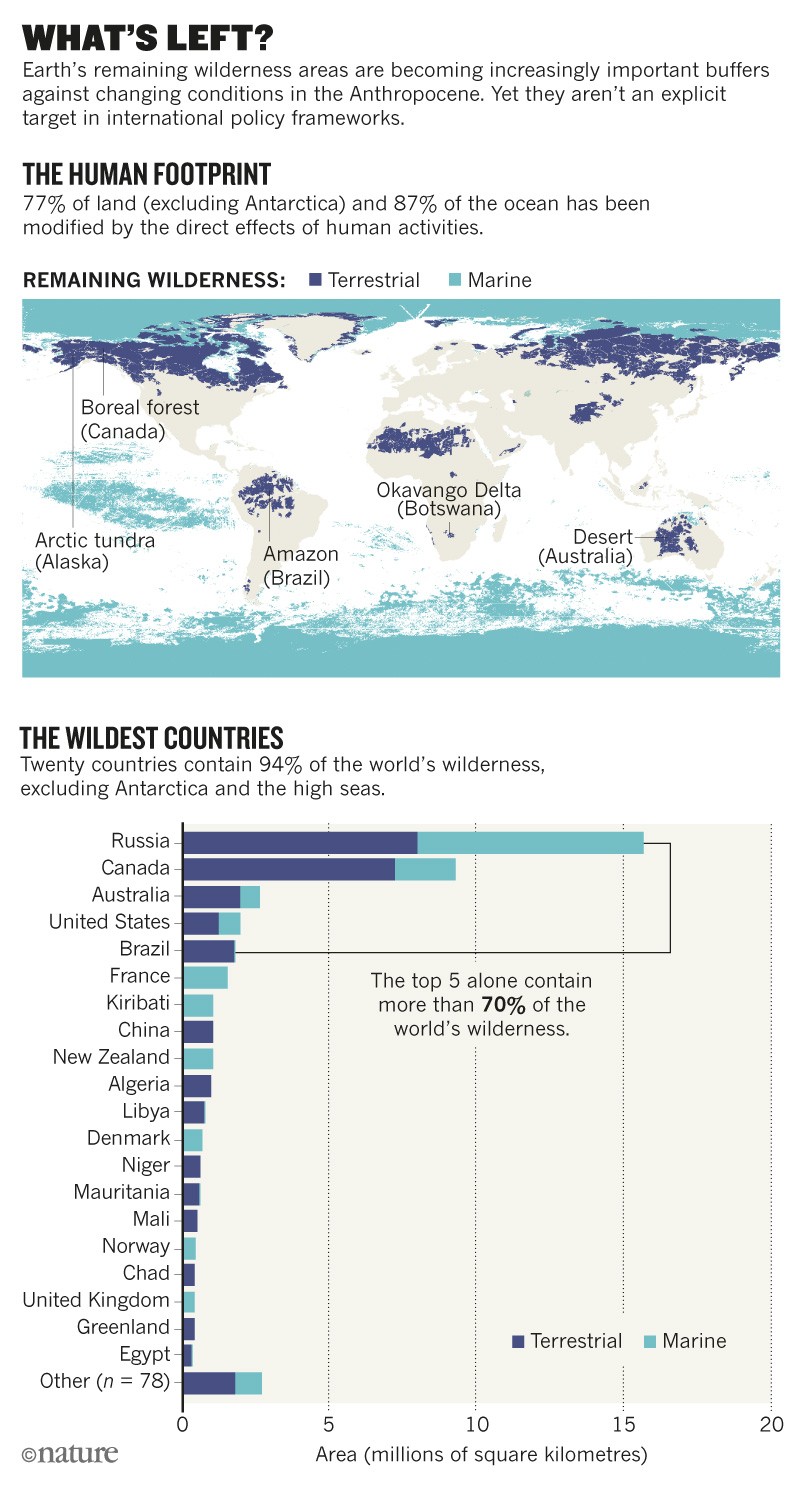
If you look on the map, there's a small patch of wilderness in the lower 48 (direct link):

https://media.nature.com/w800/magazine-assets/d41586-018-071...

That's most likely the Frank Church River of No Return Wilderness here in Idaho, as well as the various national forests surrounding it:

https://en.wikipedia.org/wiki/Frank_Church–River_of_No_Retur...

There is almost no wilderness left, and what remains is only there because people spent lifetimes working to defend it. I highly encourage anyone who reads this to make a stand in your personal discussions to always choose protecting wild lands over financial gain.

I see the recent attacks on things like the Bears Ears and Grand Staircase national monuments to be sabotage, undermining the decades-long efforts of conservationists:

https://www.nytimes.com/2017/12/04/us/trump-bears-ears.html

As a native Idahoan I respect opposing arguments but recent trends have gone too far. I heard discussions while growing up that when the national debt reached a certain level, the US government would begin selling off its public lands. So look at who stands to benefit from that and other debts, and you'll see a giant circle of corruption. Meta-level critical thinking is needed now more than ever in these times.

Re: Protect the last of the wild

#94

Having grown up with a national forest as my literal backyard, its amusing and sad to hear so much nonsense spewed in this thread. Yes, we need to protect the wild, and inculcate respect for it in those that live in and visit it. My issue is with the naivety of proposed "solutions". One of the best examples I can give, though I have many, is this: my grandfather was a logger and firefighter in this forest in the 70s.…

When I was growing up in Oregon the biggest forestry controversy was a halt to logging in national forests to conserve habitat for the endangered Northern Spotted Owl. Outside of the Portland area, it seemed like most news outlets and people were against this intervention. I kind of went along with adult sentiment and thought that the federal government shouldn't destroy our state's logging jobs with their meddling.

As an adult, I have a completely different perspective. Loggers had been cutting down old-growth trees faster than they grow back for generations. If they'd been managing the forests sustainably all along nobody would have forced them to do things differently. Blaming environmentalists and government for the end of old growth logging is like blaming the gas gauge for your empty fuel tank. The underlying resource was depleted and the logging community plan was, apparently, to ensure it ran out completely before changing.

https://en.wikipedia.org/wiki/Northern_spotted_owl#Controver...

Re: Protect the last of the wild

#95

Earlier quoted context omitted.

Changing their name is not really changing what they do. I realize they are diversifying into other areas(which is only sensible), but they are still also doing what they have always been doing. Push for more drilling. And i'm not sure i buy their argument that since someone else will just pick up the slack we should keep doing it. I realize that oil is what has brought us our wealth, but this is what i meant by hard…

I don't know why you insist on a choice being "hard". What matters is the outcome. Taking billions of dollars out of foreign FF stocks has a good outcome for the environment and leads the way for even more to be taken out. The economy is unaffected. Government gets their petrorevenues to spend on reducing the country's emissions. Stopping drilling just means another producer fills the void, and the Norwegian economy…

Its not that they have to be hard choices. Its rather that we are only commiting to try the easy ones.

And i do agree that what matters is the outcome. I just don't think we are changing the outcome as much as we should be doing given our beneficial position in the world. There are only so many easy "things", for lack of a better word, we can do. The rest are hard. And it seems to me that we are stopping short of committing to doing anything "hard".

I could be wrong about what produces the best outcome with regards the environment considering wether to stopping or continue drilling(edit: in norway). But our carbon emmisions are still climbing while most of the europe that we should be comparing ourselves to has either stopped or reduced their emmisions. We are still not contributing to a carbon negative world other than not being as bad as we could have been.

Re: Protect the last of the wild

#96
post #45

Earlier quoted context omitted.

It's fascinating how human beings cling to old habits. It's like we as a species couldn't go vegetarian by choice.

Depending on humans to do “the right thing” when it goes against our instincts is not a good way to approach these problems. You need to offer ways for humans to satiate their needs AND do the right thing.

Yeah I agree. Though I don't think that lab meat will be a panacea.

Re: Protect the last of the wild

#97
post #40

I live in southeast Alaska, where we have a relatively healthy population of coastal brown bears. When we go into the woods, there is always a chance a bear could be nearby. Your first encounter with a brown bear in the wild can be unnerving. It's a really different feeling to see an animal that could easily kill you in the woods, without a wall or a fence between you and that animal. It's really humbling, and makes…

Was out in the wilderness on Vancouver Island, a place with the highest concentration of cougars in North America. You're right, it is a vastly different experience walking around an area like that knowing you're just a fragile voyeur in another animal's environment (especially something as silent and murderous as a big cat).

I live on the San Francisco peninsula. A mountain lion killed a deer in our back yard once, and then the buzzards came and cleaned it up. Not that I wish to dispute the premise of the OP in the slightest, but you can still find wildness in some unexpected places.

Re: Protect the last of the wild

#98

Earlier quoted context omitted.

> We evolved to adapt to our environment and we are not some kind of 'final form' that we are stuck with forever, we are still evolving. As a species we are evolving, as an individual you are not. You can argue that humans might become herbivores in the next few 10,000 years, but don't expect to see it in your lifetime. I also would argue that the individuals who are trying to consciously work against where we've evo…

Individuals can and do evolve, and then they pass that on to their children, that's how evolution works. Biological evolution is a very long and slow process, technological evolution is not. That's why our teeth are a poor indication of what we should be eating because of this revolutionary thing called cooking. Our teeth are records of our past evolution, not rules for our future or current evolution. The claim that…

Bzzzt, no.

Individuals do not evolve new genetic features after birth. You will not change your teeth structure genetically in your lifetime, unless if you take up hockey or bare knuckle boxing. Your kids might have a mutation from you that’ll change their teeth, but statistically they won’t.

There’s also an ongoing debate about to what degree humans face evolutionary pressures anymore. Without some selection to pick one mutation over the other, it’s unclear which direction we will evolve.

Teeth are a good record of how the individual evolved to eat, which is indeed in the past. But you have no idea where the evolution will take us, and that’ll take thousands of years, and again individuals do not evolve. So yes, teeth still matter.

I’m glad you have good teeth, but I’ll remind you that anecdotes are not data.

Re: Protect the last of the wild

#99
post #76

Earlier quoted context omitted.

Ahem: https://en.wikipedia.org/wiki/Healthy_user_bias There are some studies that are coming out that undermine your idea that vegans are inherently healthier, such as the notice that vegetarians appear to have higher rates of cavities than the population at large. If you ask an anthropologist you'll know this is a big deal, because dental health is a great indicator of overall health. I think all the arguments about…

So that was not the case for my brother; his numbers were significantly worse and he was on medication, before he switched to veganism and greatly improved. In the study I posted, the meat-eaters were in the study too so I don't think that bias exactly applies, though in general dietary studies are always difficult. I think I've read the same books as you, and agree with much of what you say. I would love to see us s…

The bias absolutely applies. Vegans care about their health, so they’re likely to do a lot of behaviors that are unambiguously healthy. If someone believes that meat is bad for them and continues to eat it, then they are obviously valuing something else over their health, and are more likely to do other unhealthy things like smoke, drink too much, etc.

I’d be far more interested in comparing vegans to people who believe that meat is good for them and are very health aware. Paleo or Keto individuals would be a good cohort to pick. That would measure technique and not intention, because both paleos and vegans are intending to be healthy.

I’m curious what your results were on low carb. I work out with a cohort of low carb eaters, and we lost an avg of 30lbs when we switched. I personally lost 40, most of it fat (thanks Dexa scan!). I’d also be curious about what your brother cut out from his food supply that helped. Obviously we’re deep into anecdote land at this point though.

I’m dubious about lab grown meat. As previously mentioned in an edit, 84% of the worlds calories are just straight up plants, and it doesn’t seem to be helping much. But if it provides cheaper meat to the masses, I might be persuaded.

I am however very conservative when it comes to introducing new ingredients into the human food supply. I think we’ve done a lot of harm in the past 30 years by adding a lot of seed (sorry, “vegetable”) oils into our food supply. Just because something isn’t acutely toxic doesn’t mean you should be eating it all the time, and I will personally take the exact same approach to lab grown meat. I’ll probably be the last person to switch over, if I ever do.

Edit: it turns out the original study claiming that meat was producing half of the greenhouse gasses was flawed, and the authors had to revise it. The actual number is 3.9% of US emissions, with the rest of agriculture representing 5.1% of US emissions.

Source: https://www.eco-business.com/opinion/yes-eating-meat-affects...
Re: Protect the last of the wild

#100
post #53

Earlier quoted context omitted.

Cattle are good for forests? I'm sorry but you're going to have to backup that statement.

I can't speak for what the OP meant, but at least out West cattle fill a critical role in the wilderness ecosystem vacated by bison. If you remove the cattle, you would need to find a suitable replacement with similar grazing patterns. As a well known example, pronghorn antelope benefit significantly from coexisting with cattle/bison populations, due to reduced predation and increased food supply (they have complemen…

I thought we were talking about forests, not grasslands.
Post reply on HN