The author Russ Roberts runs the EconTalk podcast and is a well respected economist/journalist/thinker in the field, definitely worth reading for a fair assessment.
Here he presents a few studies that go against general economic consensus popularized mainly by Piketty in "Capital in the 21st century" and through papers/writing by Krugman, Saez, Zucman, Stiglitz, etc. that most of the economic gains in the past 100 years have gone to a concentrated few owners of capital.
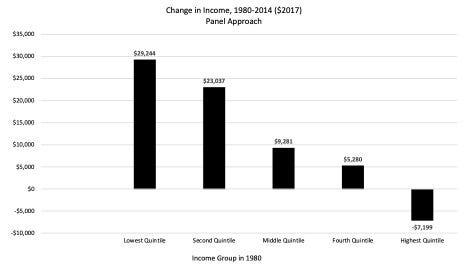
Roberts highlights a few studies that use panel data (same people tracked over time) instead of cross-section data (snapshots of different populations at different times) and show that 70% of children from low-income households generally earn more than their parents, and usually end up with about 2x more income (only 33% of high-income children earn more than their parents.)
Another study looks at people age 35-40 in 1987 and then how they did when they were 55-60 in 2007. Median income was down for the top 5%, middle quintile was up 27%, and bottom quintile median income rose 100%.
Basically - absolute mobility (how much people gain over time) is still decently healthy today in percentage terms in the US, but relative mobility (how easy it is to move between classes) is widening and the wealthy in 1980 still have a much higher income on average than the poor in 1980.
Also, the poor in 2014 were actually worse off than the poor in the 1980s which Roberts attributes to poor people reporting less income in 2014, that there could be more poor immigrants in 2014 with less education, and that 2014 could be an unrepresentative year.
Personally I don't buy Robert's "glass half full" argument, but I appreciate him bringing some panel data into the discussion to temper the prevailing economic narrative.
I think if he looked at studies that include wealth and net worth panel data, not just income, that account for assets such as homes, the results would be much much different.