Live data from Hacker News

Japan's Hometown Tax

kalzumeus.com

131–140 of 260 posts

Re: Japan's Hometown Tax

#131
post #83

Earlier quoted context omitted.

It's actually interesting because in the US it's enshrined in the constitution with the way the senate is set up, so it's not even viewed as a problem. In Japan the central government isn't supposed to work this way and it is as least viewed as a problem: the disparity in the power of votes is considered unconstitutional, but the supreme court isn't willing to actually invalidate election results (they made up a dist…

Just one nitpick: the anti-democratic nature of the Senate (and the Electoral college, while we're at it) is very much seen as a problem by a lot of people living outside the sparsely populated rural states; For those of us living in urban areas, we're simply vastly underrepresented in federal government, and quite a few of us don't like it.

> Just one nitpick: the anti-democratic nature of the Senate (and the Electoral college, while we're at it) is very much seen as a problem by a lot of people living outside the sparsely populated rural states;

It really depends on how you conceptualize it: there isn't much of an issue if you think of the Senate as a body that represents states as sovereign political entities not population. IIRC, Senators were originally elected by state legislatures, which made that role clearer.

If the Senate is to be reorganized to be proportional to population, some other "anti-democratic" compromise will need to be implemented to prevent small states from becoming neglected backwaters. The current comprise means neither small nor large states can ram through legislation that neglects the other's interests.

But to be honest, the cleaner solution to the problem is more federalism: increase the power of state governments over their own state, and correspondingly decrease the scope of the federal government over areas that aren't truly national concerns. The sacrifice there is that many groups would have to abandon their dreams of national dominance and satisfy themselves with regional influence.
Re: Japan's Hometown Tax

#132
post #104

Earlier quoted context omitted.

At the risk of opening the world's largest pressurized can of worms... sort of. There is an argument to be made that The South cared about state's rights only in the instrumental sense that it allowed them to protect slavery. They were also in favor of stronger federal government when it protected slavery, e.g. fugitive slave laws.

My point is that states’ rights and freedom aren’t really related. Often the federal government forces freedom on the states against their will. Slavery is a really obvious example.

Few states would institute slavery or really anything else remotely so monstrous if they were released from the Union tomorrow.

Re: Japan's Hometown Tax

#133
post #111

Earlier quoted context omitted.

Are Souther Italians their own race?

I thought that the current consensus was that races don't really exist. "Modern" racism can be more subtle than that, more about xenophobia or just classism.

> I thought that the current consensus was that races don't really exist.

Races do not exist biologically[0][1], but they do 'exist' as a social construct[2][3][4]. And I second your second sentence :)

[0] https://www.youtube.com/watch?v=ZrKrGkgeww4&index=4&list=PLy...

[1] https://www.scientificamerican.com/article/race-is-a-social-...

[2] https://en.wikipedia.org/wiki/Social_constructionism

[3] https://www.theatlantic.com/national/archive/2013/05/what-we...

[4] https://www.psychologytoday.com/us/blog/without-prejudice/20...

Re: Japan's Hometown Tax

#134

Earlier quoted context omitted.

I highlighted Camden and Great Neck specifically because they were specifically named in the book cited by OP, and show how the funding gap has closed since 1991. As to the idea that aggregating by state doesn't capture what we're interested in: the second image in your link shows that, accounting for federal funding, poor school districts get more money in almost every state, including most of the most populous ones…

It's not misleading. If each state is internally equal, but richer states have much higher funding, that's still a case where richer districts get more funding, just not one that's visible within any one state. Something related has happened in recent elections: higher income is correlated with voting Republican in every state, but richer states are typically bluer. So if you aggregate by state, it looks like there's…

> If each state is internally equal, but richer states have much higher funding, that's still a case where richer districts get more funding, just not one that's visible within any one state.

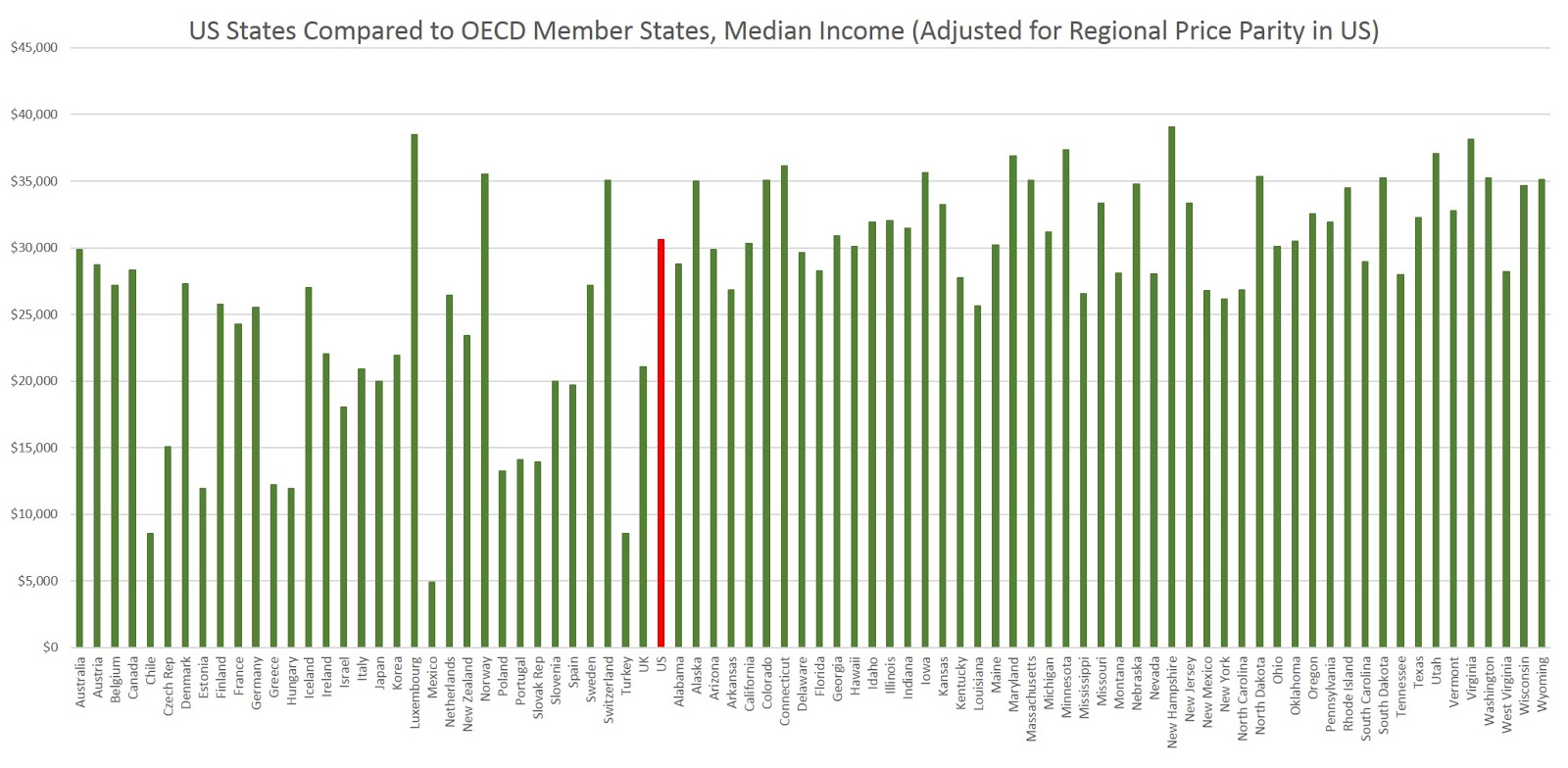
The U.S. isn't like the EU, where there are "rich" states and "poor" ones. Adjusted for purchasing power, the states are fairly closely clustered in terms of income: http://1.bp.blogspot.com/-vwpy8_glsgc/Vi5llZ9ZILI/AAAAAAAAIv.... New Jersey and Mississippi differ by about 25%, whereas Camden and its rich neighbors differ by 600-700%.

That means that if school funding within states is even, there is a pretty low upper bound on how big the disparity can be between "rich states" and "poor states."

Re: Japan's Hometown Tax

#135

Earlier quoted context omitted.

Tax redistribution inside nations or in nation unions (like the EU) is pretty much an investment. It generally generates more money than spent on it. E.g. Germany is the largest net contributor to the EU, but guess what would happen if Germany decided to stop putting out those few billions a year. Yeah, not so good for the economy (not just of Germany, pretty much everyone). Turns out, those few billions spurred trad…

There is nothing wrong with some sticks working together to get better deals on medical supplies or defend from other sticks in time of need. The issue is that you are forcing the stick to give up its national identity, borders, fishing rights, and laws in order to be part of the bundle.

The different national identities within Europe are not going anywhere. Broken English is already the common language of Europe, but the regional language and culture every part has won't disappear. A little traveling is enough to confirm this for oneself.

As for all the rest, they can't disappear soon enough. None of those things work in favor of the general people. And while we keep cultural and national identities, we could also do away with nationalist politics. They are irrational and nowadays it just feels like Religion Wars 2.0.

Re: Japan's Hometown Tax

#136

Earlier quoted context omitted.

There is nothing wrong with some sticks working together to get better deals on medical supplies or defend from other sticks in time of need. The issue is that you are forcing the stick to give up its national identity, borders, fishing rights, and laws in order to be part of the bundle.

The different national identities within Europe are not going anywhere. Broken English is already the common language of Europe, but the regional language and culture every part has won't disappear. A little traveling is enough to confirm this for oneself. As for all the rest, they can't disappear soon enough. None of those things work in favor of the general people. And while we keep cultural and national identities…

The EU is dedicated to preserving national culturalisms (if that's the word), they passed so much legislation related to that, that this is fairly self-evident.

Re: Japan's Hometown Tax

#137
I really like the basic idea of being able to choose a town or region where an alloted part of one's taxes will go. I live outside my hometown for business reasons, so I'm paying taxes on the most well-funded region in my country. Even if the government redistributes tax money, I'd love to have a small say in where my money goes.

Re: Japan's Hometown Tax

#138

Earlier quoted context omitted.

> On the other hand I have always lived in Northern Italy, and around half of my taxes go to the poorer regions of Italy, mostly to be squandered by corruption, clientelism, and organized crime. Heh, funny that richer parts of the EU say this about Italy itself.

Italy generally pays ~3-4 billion euros more into the EU budget than it receives from the EU. Ireland is much more of a mooch than Italy https://english.eu.dk/en/faq/net-contribution

That chart is a very welcome contribution to this discussion... but man is it terribly designed at both the web-design level and the data-presentation level.

Re: Japan's Hometown Tax

#139

Earlier quoted context omitted.

My point is that states’ rights and freedom aren’t really related. Often the federal government forces freedom on the states against their will. Slavery is a really obvious example.

Few states would institute slavery or really anything else remotely so monstrous if they were released from the Union tomorrow.

Of course, but there’s plenty of milder acts that many of them would enact. How many would bring back poll tests (presumably with some suitable grandfather clause), reinstitute segregation, recriminalize homosexuality, recriminalize interracial marriage, etc.?

Re: Japan's Hometown Tax

#140
post #74

Earlier quoted context omitted.

I'd love to see a large scale survey where people allocate their taxes, and see what the allocation actually comes to! The HN crowd might over-allocate $1000s per person to NSF, NIH and NASA and short Social Security while 100+M people contribute $0 to science, but depend on SS to survive. We might end up with the same budget but people feeling more in control. We'd also see large scale advertising which is actually…

There is a game if you want to try it for yourself. I agree I would be curious to aggregate https://www.federalbudgetchallenge.org/

awesome! I took it, did pretty well: $2.61T spending decreases $3.94T increased revenue $2.85T deficit (i.e. tackle via economic growth aka increased revenue due to increased GDP)

interesting to see how impactful a public health plan is ($158B) and raising the limit on social security income ($633B) and 2% VAT ($885B).

Post reply on HN