Live data from Hacker News

Priority Queue on Ethereum with a 15 ETH Bug Bounty

github.com

101–110 of 116 posts

Re: Priority Queue on Ethereum with a 15 ETH Bug Bounty

#101
post #56

Earlier quoted context omitted.

Actually it’s possible for any hacker to generate more Bitcoins if another bug like CVE-2018-17144 is discovered. What Exactly Did the Bug Do? The obvious worst part of this bug was the inflation exploit. An attack could create new bitcoins at will, exceeding the 21 million hard cap limit that is currently in place. This would absolutely destroy confidence in not only Bitcoin, but every cryptocurrency. https://www.li…

Yes, I know about that. But that is quite a straw man. You could say the same thing about the implementation of the protocols that the banks use, who also store your money as an imaginary balance in their computer systems.

You can’t really though, because traditional banks are regulated, and if anyone tried to do that Theyd be investigated by the FBI and the Secret Service then any fraudulently created currency would be destroyed. Further it’s not a core tenet of Fiat Banking that more can’t exist so follow on effects would be limited. If anyone introduces new bitcoin none of that happens, all holder is just lose because decentralization. It’s almost like in the thousands of years of traditional currency people have thought of this and implemented mitigations. It is fascinating to watch bitcoin replay the entire history of traditional banking in fast forward.
Re: Priority Queue on Ethereum with a 15 ETH Bug Bounty

#102
post #60

Earlier quoted context omitted.

It's not new, BTC is a full decade old. At this point the internet had a billion users.

The web wasn't invented until the internet was more than a decade old. This narrative that "Internet time" transforms the world every other year should have died in the 90s. Real work takes time. Building the infrastructure for the Internet took decades. Even after it won, most people used modems over badly insulated copper wire for the better part of ten years.

Bitcoin is a “product” like the web and it’s existed for a decade. Blockchain is just hashing, infrastructure that’s already existed for decades. Nobody has found a good use for either yet. They may. But that doesn’t mean any particular cryptocurrency should have any value. Or that we should particularly value the blockchain yet.

The reason nobody has found a good use for block chain yet is that the only time it offers any benefits over a traditional relational data store is when you cannot trust anybody. The truth is you can trust someone almost all the time. And even if you can’t really, it might be more efficient to just pretend. The truth is that trust is a substantial optimization and it eliminates vast quantities of waste and inefficiency in the proof of work model. That’s why people don’t want blockchains.

A really clean way of expressing this idea is that when you deposit a paper check at the bank they don’t check the signature. They don’t check the signature because they trust you, or rather it’s more efficient to just assume the money is being deposited legitimately. The amount of effort signature verification takes makes it more expensive than just eating the fraud losses. The same is true in many of these block chain powered proof of work situations. The cost of computing the proof of work outweighs the cost of managing fraud. Not to mention all the ridiculous fraud perpetrated on this unregulated market but that’s neither here nor there.

Re: Priority Queue on Ethereum with a 15 ETH Bug Bounty

#103

Earlier quoted context omitted.

> What defines a blockchain for you? A (potentially distributed) datastructure of some kind, which resembles a linked-list, and ensures its integrity using some sort of cryptographic hash of the previous link such that changing any link but the most recent invalidates the whole chain. Literally -- a chain of (data) blocks. A non-engineering description of a "blockchain" should be considered to be misleading. edit - a…

Is utterly funny to read people's opinions bashing against blockchain technology and when asked about a simple definition they fail to mention the use of consensus protocols which was, already 10 years ago, the huge innovation that lead to this revolution.

Consensus protocols are nothing new. The novel part of blockchains is the actual blockchain

https://en.wikipedia.org/wiki/Paxos_(computer_science)

You're thinking of a distributed ledger, which combine blockchains with consensus protocols

Re: Priority Queue on Ethereum with a 15 ETH Bug Bounty

#104
post #83
post #65

Earlier quoted context omitted.

It's exhausting arguing with the same bogus "use cases" every other week but here goes in short: - In your scenario you're not decentralized, you have a clear authority: the news agency - The news agency can broadcast a signed merkle tree of the articles it publishes alongside the normal newspaper/news program etc... For instance through their website. - Anybody who cares about it could maintain a copy of this signed…

Just because I feel like arguing a bit, here goes: >- In your scenario you're not decentralized, you have a clear authority: the news agency Only due to current technical limitations. Shift to Blockchain, get distributed news agencies, with reporters[1] residing all over the world. Think of the time and costs saved by not having to send reporter out of a central office > - The news agency can broadcast a signed merkl…

> Shift to Blockchain, get distributed news agencies, with reporters[1] residing all over the world

The associated press didn't seem to need a blockchain to have reporters scattered across the world. They simply recruited reporters that lived across the world.

What you're talking about sounds more like twitter or facebook where you have "reporters" (aka users) write poorly written updates from around the world.

> Doesn't help a bit, given how they have total control over the content of the website, they could just as easily swap out the merkele root and claim it is the original one

If you've ever force pushed to a git repo, you know why this is hard. Regardless, blockchain doesn't solve this, per the next point.

> Introduces a 'he-said, she-said' problem. Which the Blockchain neatly avoids.

The blockchain avoids it by insisting whoever spent the most energy is the source of truth.

Let's say an attacker wishes to insist the correct hash is Y, not X, and thus paint the news agency as a liar for having a story up with hash X.

All that person has to do is use more energy to publish a longer blockchain that includes Y... and the news agency doesn't really have an incentive to spend a lot of energy protecting the blockchain probably, so it won't be hard.

The incentive of mining makes sense for money. It doesn't make much sense for this case.

> and there's a well known tool for distributing that in a verified & timestamped format - Blockchain.

I'd go with "git", "rsync", "ftp", or "bittorrent" as well known tools for distributing some files, whether they're timestamped or not.

Re: Priority Queue on Ethereum with a 15 ETH Bug Bounty

#105

Earlier quoted context omitted.

I am not anti-blockchain, there are applications where it makes sense. But 90% of the time when I hear about a blockchain related application its a regular application which just so happens to use the blockchain as storage because its a buzzword. It feels like the world suddenly discovered the hammer, and now we think everything is a nail

Like what? Everyone seems to hand-wave this, but nobody in the full decade long history of bitcoin and blockchain has come up with a single good use case that isn't better solved by MySQL.

MySQL doesn't guarantee message integrity, so anything involving shared data among separate entities that could be attractive for manipulation would be better solved with blockchain tech than MySQL.

Re: Priority Queue on Ethereum with a 15 ETH Bug Bounty

#106
post #63
post #6

Cryptocurrencies, and especially Ethereum, are truly novel innovations in computer science that cross many academic disciplines. The linked example is a great write-up. It’s sad that there is a vocal group, especially on HN, that knee-jerk hates everything blockchain related and wishes with their entire being for it to fail. However, I think smart contracts are fascinating and wish more people would keep an open mind…

You're making a strawman argument here. People who have speculated money in blockchains have a financial incentive to be vocal and overhype the technology while minimizing the many drawbacks it has. So I think a bit of "knee-jerk" skepticism is warranted around anything related to cryptocurrencies. So maybe instead of building strawmen you could tell us what you find so fascinating about smart contracts? Who knows, y…

How would you like useful, open source tools that can be deployed once and only once (for everyone), and used freely (minus processing fees) forever without having to worry about (a) deploying an instance of it on your own environment or (b) the service going down because the owner lost interest?

Because smart contracts can do that. Pretty neat, huh?

Re: Priority Queue on Ethereum with a 15 ETH Bug Bounty

#107
post #92

Earlier quoted context omitted.

Or, instead of paying to implement, operate and maintain that system forever, and also hoping that someone independent will store copies forever (because without that independent third party, the news agency's whole system is irrelevant)... maybe they could permanently store a hash of published revisions on a public blockchain for $0.05 each. It's just another option that might turn out to be useful for some. Althoug…

If I understand what you're proposing you want to store the entire articles themselves in the blockchain. That indeed offers many benefits but it's also prohibitively expensive. In practice people will only store small hashes in the tree which can be then used to authenticate offline data. That means that you need somebody to archive that offline data to really make sense of the signed data so you have exactly the is…

No, of course I'm not proposing anything like that. On the contrary, I was saying that it seemed impossible. Can't you see we actually agree about that!

I pointed out other possible problems with the original suggestion that news agencies should use blockchains. But you seem to completely misunderstand those words as being an attempt to support that original suggestion. Why?

I'm amazed that your reply to me repeats almost exactly what I had just said: "[blockchain could] store a hash of published revisions ... [but] copies of the original articles would be much too expensive to store on today's typical blockchains."

I hope this won't sound rude, but I've got to suggest that you read what people are actually saying, instead of assuming you know what they're going to say.

Re: Priority Queue on Ethereum with a 15 ETH Bug Bounty

#108

Earlier quoted context omitted.

Why? News sites don’t even care about maintaining an edit history. They just make minor fixes and leave editors notes when they fix things. News on the block chain is not something anyone wants.

Forbes just recently partnered with Civil, a blockchain journalism project from Consensys Studios, which is the commercial powerhouse of Ethereum’s cofounder.

I've worked in publishing, this initiative sounds like many other "save journalism with technology" initiatives that I've seen go nowhere, like the Coral Project.

But back to Civil. Why would I care that Forbes is going to publish SOME of their articles on this blockchain? Their site uses HTTPS, I'm always sure that the content I'm looking at actually came from Forbes. I never need to question that the person in their byline is who they say they are, and I'm not sure how a blockchain would help if I didn't: it seems like their big plan is to just put badges on articles?

This sounds like a grasp at relevance via blockchain hype.

I'm willing to be convinced that I'm wrong, but I feel pretty safe predicting that this will go nowhere. It doesn't solve a problem that Forbes actually has.

Re: Priority Queue on Ethereum with a 15 ETH Bug Bounty

#109
post #8

by the way. I deployed the same thing on the KOVAN test network at this address (if people want to test their exploits for free first): https://kovan.etherscan.io/address/0xfbc23099a8bd0ce4227920d...

> […] if people want to test their exploits for free first […]

This sounds like a bad idea, since it would allow other people to extract the script and put it inside a transaction that’s published on the real network, thus unfairly claiming the bounty.

Re: Priority Queue on Ethereum with a 15 ETH Bug Bounty

#110
post #9

Earlier quoted context omitted.

Or neither Bitcoin nor Blockchain. The thing is, inflation is actually what keeps the entire economy moving. Deflationary currencies actively dissuade investment and lending. What would a loan even look like denominated in a deflationary currency? Lenders are incentivized not to give you the one, as their cash reserves appreciate risk-free. Oh, and also, why trust this random ad-hoc group of self-appointed economists…

Your economics are all wrong. Ever heard of the Cantillon Effect? https://www.aier.org/article/sound-money-project/cantillon-e...

> The Cantillon Effect refers to the change in relative prices resulting from a change in money supply. The change in relative prices occurs because the change in money supply has a specific injection point and therefore a specific flow path through the economy. The first recipient of the new supply of money is in the convenient position of being able to spend extra dollars before prices have increased. But whoever is last in line receives his share of new dollars after prices have increased.

This theory is fundamentally flawed, because it assumes that whoever receives the “new money” buys consumer goods. If this is indeed what happens, then prices should increase. But what if he buys bonds?

If newly produced money is used, not to buy consumer goods (or commodities), but bonds, then the injection of new money into the economy has the opposite effect on the price level, because the new money is used to improve the efficiency of production. E.g. if a producer of chickens sells a $250m bond (bought with “new money”) and invests the proceeds in a chicken plant[1], the price of chickens will decrease, due to increased productivity of producing chickens.

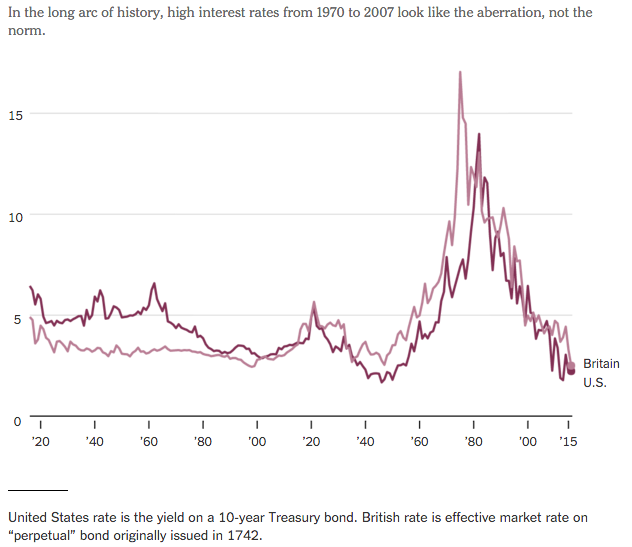
In the above scenario, the only price that will increase is the price of bonds, which is the same as a falling rate of interest (the rate of interest is inversely proportional to the price of the bond). And this is exactly what has been happening for the past 35 years or so[2].

[1] https://markets.businessinsider.com/news/stocks/costco-plans...

[2] https://awealthofcommonsense.com/wp-content/uploads/2015/12/...

Post reply on HN