I'm fishing quite a lot, few years ago if I reeled cloth, old sock, or plastic bag from river bottom it was full of tiny shrimps and other tiny insects. When I reel it now it's just empty. Also I see significantly less chubs.
Study shows massive insect loss
91–100 of 213 posts
Re: Study shows massive insect loss
#92Earlier quoted context omitted.
It is literally what I love about the English language. You can easily generate new words that are easily understood. In the same thought, it's completely unnecessary.
Hmm what do you mean by English language? I cannot think of a language that wouldn't let this (maybe a very analytic language, like Mandarin?). This is probably a universal property of human languages.
I have to say, Mandarin is the absolute best at this. One of my favorites is the fact that the word for precedent is simply the character for "first" followed by the character for "example." So simple and straightforward. Even as a non-native speaker, once you get the hang of it you can just glue words together and often hit on the right compound word for some vocabulary you haven't ever studied. And also make mistakes... of course.
Re: Study shows massive insect loss
#93I'd be more inclined to blame neonicotinoid pesticides than change in temperature, but seems plausible I guess.
Why would you be more inclined to blame neonicotinoid pesticides?
Not the poster, and I have no idea what was in their mind, but if you don't mind speculation, the timing is interesting. These particular pesticides arrived on the market in roughly the late 1980s / early 1990s according to Wikipedia, which according to my fuzzy recollection corresponds to when we started hearing reports of bee populations crashing.
Re: Study shows massive insect loss
#94Earlier quoted context omitted.
It's such a minor thing when it comes to our day to day but becomes truly terrifying when you put it all together and look at the big picture. I've noticed the same thing about wild-life in general whenever I visit my favorite places from childhood - whether it's the reefs around Australia, the tide pools in Baja, or the inland empire desert I grew up in. Looking at actual research just makes it worse: a third of mic…
> And so, slowly, we boil. Climate changing power, without the wisdom to wield it, is as plausible a Great Filter as anything. Hard to develop a space program when you're spending all your production fighting over scarce resources, plugging leaks, and attempting to feed a planet with decreasing yields. https://en.m.wikipedia.org/wiki/Great_Filter
I had two daughters before I came to the conclusion that this is the most likely path for humanity at this point. There is a possibility of a global awakening that might prevent this tragic loss of megafauna. But I'm already a vegan and don't drive much; can't think of more to do, and while I'm not too bad at dealing with this, it can be quite depressing.
Re: Study shows massive insect loss
#95> The authors of a 2017 study of vanished flying insects in Germany suggested other possible culprits, including pesticides and habitat loss. Arthropods around the globe also have to contend with pathogens and invasive species. “It’s bewildering, and I’m scared to death that it’s actually death by a thousand cuts,” Wagner said. “One of the scariest parts about it is that we don’t have an obvious smoking gun here.” I…
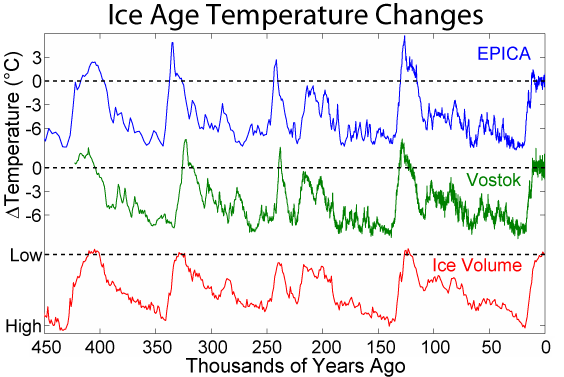
I think views such as this take a premise of peace in nature -- that without external influence, Earth would be relatively static. But we know this is false. For instance (as per the topic of this article) these [1] are the temperature readings we have from various sources, just over the past 400k years (things get really wacky going back a bit further). Literally before humanity existed we see extreme global climatic swings happening on very short time scales, with upwards of 9 degree (celsius) temperature changes. We are likely exasperating both the acceleration and magnitude of the most recent swing, but even if humanity did not exist or even if we managed to achieve 0 carbon output, we'd see a warming event happening some time right about now.
And it's easy to forget that throughout the history of our planet that have been numerous mass extinction events where nearly everything on this planet went extinct, all without any help from any species whatsoever, let alone humans. For instance during during the Permian-Triassic extinction period, about 250 million years ago, some 96% of species ended up going extinct. All of the incredible diversity we know as life today emerged from those 4% that survived.
The point of this is that Earth and nature are not inherently peaceful or stable. We live on a brutal planet that has a habit of killing just about everything that manages to evolve on it with a pretty good degree of regularity. The one and only reason we might not end up going extinct, in the longrun, is because of our intelligence. Be one with nature and it will, sooner or later, kill you. Overcome it, and you might just survive.
[1] - https://upload.wikimedia.org/wikipedia/commons/f/f8/Ice_Age_...
Re: Study shows massive insect loss
#96Earlier quoted context omitted.
> And so, slowly, we boil. Climate changing power, without the wisdom to wield it, is as plausible a Great Filter as anything. Hard to develop a space program when you're spending all your production fighting over scarce resources, plugging leaks, and attempting to feed a planet with decreasing yields. https://en.m.wikipedia.org/wiki/Great_Filter
I had two daughters before I came to the conclusion that this is the most likely path for humanity at this point. There is a possibility of a global awakening that might prevent this tragic loss of megafauna. But I'm already a vegan and don't drive much; can't think of more to do, and while I'm not too bad at dealing with this, it can be quite depressing.
I think we can do it... you can email me at my username at gmail if you want to chat but we can talk it out a bit here too.
Is there any aspect to culture that you’re personally drawn to? Food? Walkable communities? Forests? Wildlife? Durable goods?
I really respect that you grasp the magnitude of the problem and you empathize with those who will live with the consequences. That says a lot of you. But you can't stay in a framework where you are feeling depressed about it. That's probably not a good framework to work from.
Re: Study shows massive insect loss
#97Interesting. The insects must be migrating to Australia. I have lived in the same location now for 20 years. In that time, I have seen cycles in the populations of both insects and birds. This years has been one of the peaks for birds.
So many different species, and some of them are much larger than I have seen in a number of years - some of them are up to twice the normal size. Flies again have increased, but mosquitoes are down. Bees have been out and about as the amount of flowers being pollinated and fruit starting to appear is large this year. It seems to be an increase over last year. Plenty of spiders and earwigs, though down on snails (as yet).
The chooks are chasing lots of insects about for a feed. There are plenty of aphids on the roses - too many in fact - may not get any roses this year.
Mind you this is Spring and we may see a different change later as we get to summer. We are expecting a bad fire season, though doesn't appear to be like it was when we had the Black Saturday bushfires a decade ago.
I have only just stopped running the fire at night because it has still been too cold to not do so.
Re: Study shows massive insect loss
#98At what point does the cost of continuing the status quo outweigh changing it? How do you even measure something like that, when the people in charge of making changes won't live to see them?
I think a major problem humanity has, among many others, is the way we assign leadership roles. Leadership of major institutions should be balanced not just among gender, but also among age. Every government should include decision makers under 40.
When we don't have rules for this, we wind up with the current situation: the average Representative is 57, the average Senator is 61. [1]
This might seem trite or pointless to many, but I really think we need decision-makers who will have to live with the longer-term consequences of their decisions.
Mitch McConnell, the current majority leader in the Senate and one of the most powerful people in Congress, is 76. When the UN says we have 12 years to change our ways or suffer possibly world-ending consequences, how much does that matter to a 76-year old?
I think it's pretty well established at this point that we can't rely on our leaders to think or act empathetically, or make decisions that matter beyond their party and the next re-election. We need to figure out a way to build future-focused thinking into our governance.
Unfortunately, I have no idea how to do it.
[1]" https://www.quorum.us/data-driven-insights/the-115th-congres...
Re: Study shows massive insect loss
#99Years ago, my family used to drive to our grandparents' village in hot, summer Friday nights. The windshield ended so pestered with dead bugs that the first task on Saturday morning was to drive the car to the river to clean it. I remember it vividly because it was so fun to wash the car with the cold river water. Last August I went stargazing with my wife. We chose a secluded area because it was far away from light…
I recently went camping in mountains that I hadn't camped in for 15-20 years or so, and I remember constantly dealing with yellowjackets and bees all sorts of other fauna. I think I saw one yellowjacket the entire trip, and we had food out like crazy.
Plus, whereas I was used to waking up to the sounds of birds and animals, our campsite was completely silent. There was one hawk in the distance all morning.
It was strange.
Re: Study shows massive insect loss
#100Living in Vietnam, there is a massive population of swallows. They are prized for the nests they make [1] and people build whole multi-story windowless buildings just to house them [2]. I've seen these buildings all over. At dusk you see them flying around clearly eating up all the mosquitos and bugs in the air. No absolute proof, but I'm pretty sure this is why there are so few mosquitos and flying bugs here.
[1] https://en.wikipedia.org/wiki/Edible_bird%27s_nest
[2] https://en.wikipedia.org/wiki/Edible_bird%27s_nest#/media/Fi...
