Live data from Hacker News

Coders Automating Their Own Job

theatlantic.com

191–200 of 499 posts

Re: Coders Automating Their Own Job

#191

You know how sometimes you love an article so much that you are annoyed you didn't write it? This does a better job than I could have of tieing together a dozen threads of conversation that I've had with various friends for years. I actually believe that there's a culture war implied in this debate; the question of who deserves to reap the gains of automation is more than just philosophy or ethics. The question "is t…

> I actually believe that there's a culture war implied in this debate; the question of who deserves to reap the gains of automation is more than just philosophy or ethics. The question "is there inherent nobility in work itself?" seems to be just as much a political divide as any of the current popular hot-button issues.

Agreed, there's a lot of meaty ethics and philosophy tied up in this issue.

For most of my life I've tended to believe in the nobility of work, that it gives my life meaning and purpose.

But as rates of automation increase my children (or more likely their children) may well seek different ways of defining themselves.

Before that can happen though there'll have to be some fraught and difficult changes to our societies.

Re: Coders Automating Their Own Job

#192

Earlier quoted context omitted.

> there exists a large contingent of people who believe with all of their heart that God wanted them to find it, that the person who lost it should have been more careful, that they are just having a lucky day. A large part of how America sees work, poverty and wealth was historically influenced by the Protestant Work Ethic, and I think that lingers quite a bit today. I think it's why a lot of people view the poor as…

It cuts both ways at least, those with inherited wealth are just as unworthy as those who never accumulated any. > The so-called Protestant Ethic then prevalent held that man was a sturdy and responsible individual, responsible to himself, his society, and his God. Anybody who could not measure up to that standard could not qualify for public office or even popular respect. One who was born "with a silver spoon in hi…

> It cuts both ways at least, those with inherited wealth are just as unworthy as those who never accumulated any.

Not really. Because the idea is "To become successful you must be hard working". And if we take that as "iff hardworking -> successful" then the reverse is true "if successful -> hardworking". That's why so many people think the rich are hardworking, even if they inherited their wealth (or a sizable portion).

Re: Coders Automating Their Own Job

#193
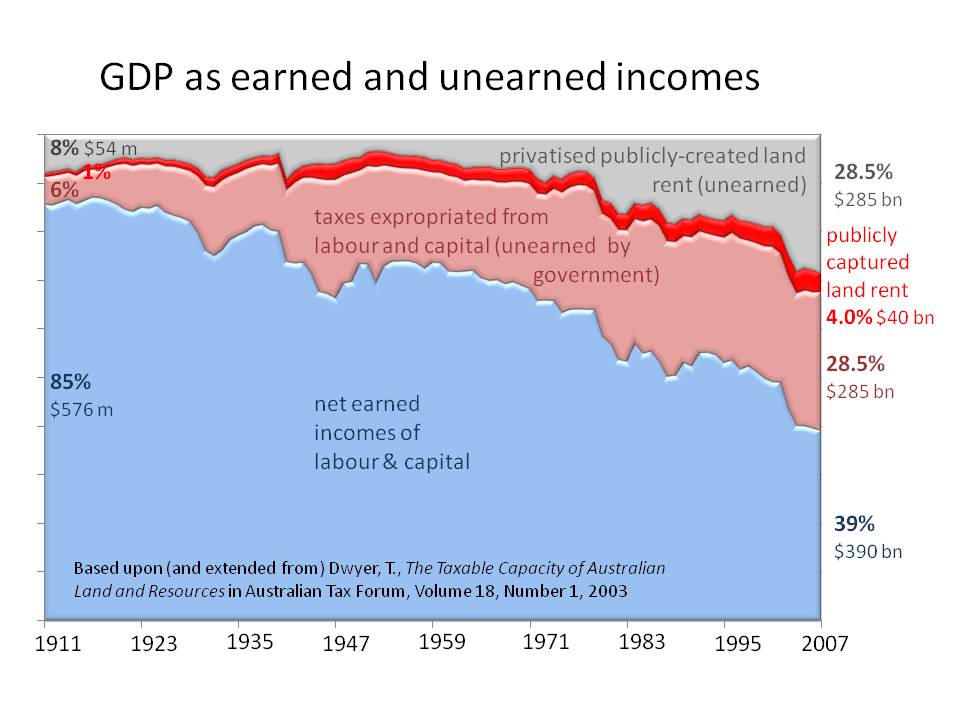
>The gains from automation have generally been enjoyed not by those who operate the machines, but those who own them. According to the Organisation for Economic Cooperation and Development, the share of income going to wages in OECD nations has been decreasing since the 1970s, while the share being funneled into capital—into things like cash reserves and machinery—has been increasing.

In Australia these benefits have largely gone to land owners, as opposed to capital. See this chart:

http://www.prosper.org.au/wp-content/uploads/2009/01/unearne...

Even a scheme such as universal basic income would not help much as the benefits would end up being captured by land owners, via inflation of rents and land prices; unless this was addressed another way, for example with a land value tax.

Re: Coders Automating Their Own Job

#194
post #183

Many programmers who automate portions of their workload will use the extra time they gain to place bugs in the systems. When those systems fail, they quickly fix them and look like a savior. If they are on after-hours standby, they make extra money from the callouts. They thus reduce the stress in their own jobs, but increase the stress in other peoples jobs.

I can't tell if this is satirical or not.

When I have "free time" at work, I put that time towards refactoring, improving/expanding test coverage, and scouting out potential performance boosts through our logs, load records, etc.

Do devs in actual programming positions do this?

Re: Coders Automating Their Own Job

#195
It seems to me that we are coming on a different paradigm of work. It makes sense in the industrial revolution to have assembly line like working. Where workers are "cogs in a wheel". But now we have tons of tools to do those strict tasks. After all, every programmer says you should program repetitive tasks.

So what do we shift to? A wider job duty and more creativity? Creativity is the thing that machines still fail at the most and (as far as I know) currently impossible to automate.

Re: Coders Automating Their Own Job

#196
> “They took what I had developed, replaced me with an idiot that they showed how to work it, and promptly fired me for ‘insubordination.’ I had taken a business asset that was making them $30 grand a year profit and turned it into a million dollar a year program for the company, and they fired me for it to save ~30 grand a year on my salary. Job creators my ass.”

There's an inherent conflict of interest and power struggles in many organizations. The business people rarely do create value by themselves; they create the opportunities where value can be created -- and not all businessmen. So when they see something that changes the game, they utilize the convenient clauses in the contract and seize that new power which they can utilize and try and gain the upper hand on others like them. Cynical I know, but it's what I observed first-hand and what many others have told me.

> Ideally, automation decisions would happen collectively, with colleagues’ and peers’ input, so, the gains could be evenly distributed.

Cute, but I don't see this happening anytime soon. Let's face it: most of us fight for scraps from the tables of others, much more rich, people, for most of our lives. Look at a lot of politicians.They start off so idealistic and some of them even strongly believe everything that got them elected. What happens next? We don't know what happens but the end result is that they get more and more disconnected from the problems of the people who elected them. Why do you think that is?

I believe it's because they got their hands on money and connections. Additionally, they worked a LOT to get where they ended up eventually. Tell me, would you like to start over in a brand new area and not get your hands on poorly documented money and just work for a meager official salary? All of that when you are 50+? We the people burn out and we need our efforts to lead to a better future where we work less. IMO it's inevitable.

What I am saying is that I don't feel the need to share a piece of $500,000 a year consultancy with fellow programmers if I do NOT have several beach houses and apartments in downtown areas of several capitals. And have a healthy reserve of money to last me a economical crysis akin to the 2008.

...Basically, I don't see myself being very generous up until I hit 8 figures of income. I am greedy and I am real about it. I don't feel many others are very benevolent and will STAY benevolent when faced with the choice to live peacefully and leisurely with all the financial security they desire vs. taking risks to finance people who might just be looking for a secure paycheck and don't care about the cause you want to invest your wealth into. This is a very real risk and is the reason for the failure of a lot of startups.

But if you have different view I am interested to hear it.

> “The system shouldn't be more important than the individuals who helped make that system relevant.”

That is unequivocally true. And IMO it will never change anyway. :(

The people who collect and get to redistribute wealth are greedy and aren't that stupid that they will invite competition out of a good heart.
Re: Coders Automating Their Own Job

#198

Earlier quoted context omitted.

Nope. Operations is a pure cost center. Cost centers only exist for the express purpose of being compressed twice as much this month as they were last month, so that you can make them half as expensive. Developers are valuable. They create value. When all the good Operations staff has left because they're tired of being treated like mushrooms, all the Operations stuff gets thrown over the wall and then the Developers…

Truth. Left ops for infosec and wouldn’t ever look back.

Not trying to diminish it's role or value, but wouldn't security be kinda looked as a cost center as well?

Re: Coders Automating Their Own Job

#199
post #57

Earlier quoted context omitted.

Which by definition is impossible... Once two different traders discover how to 'perfectly' trade, the game changes and as they say 'here we go again'

I disagree, the solution to remove stock market traders is to figure out a way to examine financial data and projections to such a fine degree that stock trading is no longer a sensible thing. Imagine a currency trader focused on USD & CAD, what would happen to their job if Canada decided to permanently pin their currency on the USD with a guaranteed exchange of .5 USD for 1 CAD, the markets surrounding arbitraging t…

To name just a tiny fraction of things that'd be required for a perfect stalemate between automated stock trading platforms (due to them all being able to predict the market with perfect accuracy):

* actions of any given platform doesn't meaningfully influence the market

* all have ability to forecast weather with 100% accuracy

* all have ability to perfectly predict human behavior

* all acquire the exact same news at the exact same rate

* all connect to the same exchanges with the same latency

* all have the same amount of capital to leverage trades

Simply put, there are incalculable ways for a trading platform to gain advantage over another, so I don't think this will be an issue in many lifetimes.

Re: Coders Automating Their Own Job

#200
post #190

Earlier quoted context omitted.

That is a larger societal question, though - how long should you be able to live off work you do? Is it fair for a worker to work for a few weeks, automating a job that used to be paid year after year, and then earn that money forever? Obviously there is a balance - a company shouldn't get ALL that savings (although in the long run, that savings would need to be passed on to customers, since competitors will also be…

Take the complexities of society out of the picture for a moment and reduce the scenario to a family unit living on subsistence farming with nobody else around: if the family is somehow able to automate their food, water, shelter and energy needs, are they entitled to live forever on that work?

It's a great question a but obviously the catch is in "nobody else around" - morality only really comes into play when humans interact with one another.

In perhaps the simplest possible example, they live on land that belongs to a country that defends and otherwise manages it. In that case, paying a basic land tax should be enough. If there are other interactions between the family unit and its society, then other arrangements might need to come into play to allow them to maintain the entitlement for that lifestyle.

Post reply on HN