Live data from Hacker News

Questions

patrickcollison.com

201–210 of 493 posts

Re: Questions

#201

Earlier quoted context omitted.

I travel to Hong Kong every few years to visit family. Each time, there are more MTR stations--and on some occasions, entirely new lines. The MTR is just as complex as BART, if not moreso. I think it's worth considering why some places can build things like a metro fast, but others can't.

before they build a new station.... do they do environmental impact studies? was enough time given for the study to complete and people to challenge the results? possibly with another study? are there community meetings to discuss the impact? does everyone in the area have a chance to voice their opposition at an open hearing? do all workers on the construction team have strict safety regulations? require certified t…

Western Europe has no shortage of worker safety, environmentalism, or democracy, and they don’t have this problem.

Re: Questions

#202
post #35

> Why are there so many successful startups in Stockholm? Several reasons. First, you need to recognize that any Sweden-based startup will, when it gets to be known internationally, have a Stockholm-based office. So it's not about a city of 1 million inhabitants, it's a country of 10 million that's the true number here. As an example, I believe Spotify opened their original offices in both Stockholm and Göteborg more…

I think Stockholm does have more startups than the rest of Sweden, though, so there is probably more to it. The article understates the size of Stockholm a bit though. As measured by urban area it’s a city of 2.5 million.

Not only that, but within a one hour drive are Västerås and Uppsala, big cities in Sweden's scale.

The former hosts ABB and has tons of robotics related research, the latter has one of the major universities. The startup scene is smaller in Västerås than in Uppsala though.

Uppsala produced Klarna and Skype, Västerås produced Pingdom, to name some.

Re: Questions

#203
post #147

"Why are certain things getting so much more expensive?" Because we are lying about inflation. It's not a conspiracy, just a mutually agreed-to delusion. By pretending inflation is lower than it is, the poor feel like they are standing still instead of sinking ...though instinctively they know. And the people just keeping up get to feel richer. Since technology and efficiency improve, the people staying in the same p…

There is a a better and a lot more consistent explanation. Government involvement. Wherever government puts its dirty fingers, efficiency sinks and prices skyrocket.

Re: Questions

#204

Earlier quoted context omitted.

I agree regarding the symptoms, but am less convinced that run-time efficiency is the sole (or perhaps even major) cause. If it were, I'd argue that we'd see less usage of, e.g. , Python. I don't know the true cause -- I wish I did. But I do do see a trend towards an ever more "hands-off" style of software development: large volumes of automated (especially unit) tests in preference to interactive approaches (or hybr…

Sometimes I do work this way in the repl - usually when I have little confidence I even understand how to fit together a new library or API call. But if you spend more time in the repl building a data structure and interactively iteratively testing your function, when it is all finished all you have checked into source control is a function, not the tests. You have to then write the tests. In a lot of cases its faste…

Perhaps if great interactive development and debugging tools were more pervasive, there would be less demand for lots of tests written at the same time as the actual function.

(The fine-grained "unit" stuff, anyway. System/integration tests come with different trade-offs).

Re: Questions

#205
post #130

>> Why do there seem to be more examples of rapidly-completed major projects in the past than the present? A large contributing factor is that major projects today are much more complicated than they were in the past. The tools we have built are always advancing, but the size of the human brain is not. As projects become more and more complicated, they require a larger number of people to collaborate, and that comes…

I would add the question, do we always need the level of complexity or advanced technology for a given problem?

When would it be good enough to have a simpler or less complex solution and why are we sometimes biased against that?

There’s also a weird sliding window that follows technological advancement and generations - what was complex for one often becomes more simple to the next. With such a rate of technological change and high levels of complexity, this is partly why some get left behind or can’t keep up. But it seems like sometimes we also ignore the simple solution in hand in deference to constant futurism.

Re: Questions

#206
post #9

> Why is US GDP growth so weirdly constant? This is something I noticed too. And it can't be just blamed to "inflation" of the US GDP. Almost any other country I checked does have fluctuations. Goes through booms and bust. China has gone through an exponential rise but slowed down and seems like it broke the pattern recently. The US is the only country so far that has been going decades through a constant rate of cha…

Not sure what you mean by "constant rate of change"? https://tradingeconomics.com/united-states/gdp-growth looks to me to a noisy overlay of https://tradingeconomics.com/united-states/inflation-cpi.

Re: Questions

#207

Regarding the question of education/college costs rising drastically, I thought a key answer was that govt started to fund education a whole ton less. In Canada (where this has not happened as badly), an undergrad in CS used to cost 3K annually a decade and a half ago, and costs 10K now. Other disciplines cost 6K I think .. CS degrees cost more since colleges decided that students earn a lot more and there is huge de…

To some extent I think people just underestimate what education costs. Sweden pays ~€40k to educate an engineer (5 year, B.Sc + M.Sc). On top of that there is another ~€20k in student benefits to the student and ~€40k in a government backed student loan (for books and living costs).

Re: Questions

#208
> Why is US GDP growth so weirdly constant?

i'm not sure about this but i get the impression that semilog plots of exponentially growing things often look deceptively linear, and hence that the best-fit exponential curve often looks like a better fit than it is.

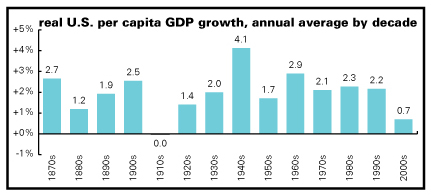
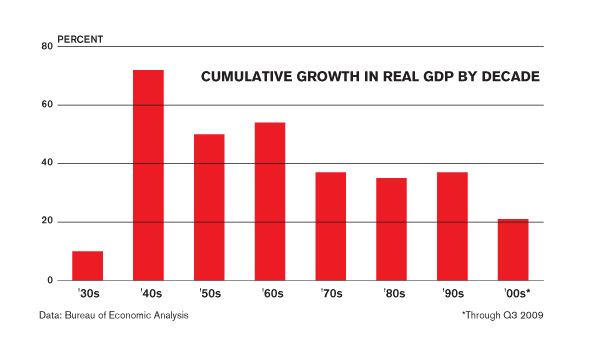
The claim here is that the actual rate-of-growth has been constant over time. What is shown is a graph of GDP growth with an exponential curve overlayed whose rate-of-growth parameter has been fit to the data. But perhaps if you had stopped the analysis at different times in the past, you would have gotten similarly linear-looking graphs, but with very different best-fit rate-of-growth parameters. What i might like to see instead is a graph showing, for each year in the past, the value of the best-fit rate-of-growth parameter if you looked only at a fixed-sized moving window of data ending at that year. If the size of the moving window is '1 year', it is no surprise that GDP is all over the map. But even when the window is 10 years, charts of GDP growth per decade (from a google image search) show more substantial variation:

http://www.leftbusinessobserver.com/GDP-per-cap-by-dec.jpg http://www.massline.org/Dictionary/Photos/G/GDP-US-Cumulativ...

I expect that the variation would be even more pronounced if you made a chart that showed, for each year, the growth over the preceding 10-year window, instead of those bar charts which only have one bar every 10 years. Also, even 10 years is too short; what i'd really like to see is charts of average GDP growth over 30 years, but i don't have time to compute that.

In addition, there is some evidence that very high rates of GDP growth are only possible when a country is less wealthy/developed (see eg figure 4.4 from https://www.econ.nyu.edu/user/debraj/Courses/GrDev17Warwick/... ; note that it appears to be possible for less wealthy/developed countries to have either low or high GDP growth, whereas wealthy/developed countries appear to only be capable of low GDP growth; this could be explained by a 'diminishing returns' argument). If true, this would imply that over very long timescales, the rate of growth would decrease.

My "analysis" here is rather hacky -- what is the proper statistical way to analyze this? What is the proper statistical test to see if long-term growth rates are constant?
Re: Questions

#209
post #35

> Why are there so many successful startups in Stockholm? Several reasons. First, you need to recognize that any Sweden-based startup will, when it gets to be known internationally, have a Stockholm-based office. So it's not about a city of 1 million inhabitants, it's a country of 10 million that's the true number here. As an example, I believe Spotify opened their original offices in both Stockholm and Göteborg more…

Most of the things you mention also apply to The Netherlands, except for possibly the tax-free computer scheme (not sure about that one). As far as I can tell we're not really all that note-worthy startup-wise. Assuming that's true, any ideas what might be the differentiating factor?

From what I understand, both Holland and Sweden are culturally similar enough that I can't immediately think of other factors that make 'us' more hostile to startups.

Re: Questions

#210
post #130

>> Why do there seem to be more examples of rapidly-completed major projects in the past than the present? A large contributing factor is that major projects today are much more complicated than they were in the past. The tools we have built are always advancing, but the size of the human brain is not. As projects become more and more complicated, they require a larger number of people to collaborate, and that comes…

I travel to Hong Kong every few years to visit family. Each time, there are more MTR stations--and on some occasions, entirely new lines. The MTR is just as complex as BART, if not moreso. I think it's worth considering why some places can build things like a metro fast, but others can't.

There was a very interesting article a few years ago (I've tried to find it several times but cannot) that tried to explain at least some of this. The one factor they circled in on is that the US government stopped enjoying their own experts. Instead even publishing project requirements for different construction companies to bid on have to be outsourced. This causes mainly to problems: if you get the contract for writing the spec you cannot bid on the project. So many big and competent players will avoid writing the spec. The other issue is that the project is lacking holistic oversight by someone who understands what's going on and had incentive to keep cost down. Because nobody has a actual career as a construction expert with the government we see the government putting people in charge of these projects who worked at the contracting company the previous day. They had a few examples of the same construction company finishing projects pretty much on time and budget in other countries but going over a lot in similar projects in the US.
Post reply on HN