Live data from Hacker News

Life in the Spanish city that banned cars

theguardian.com

121–130 of 699 posts

Re: Life in the Spanish city that banned cars

#121

What about people who live inside city limits but work elsewhere? For example, I currently reside in Washington, DC but work about 30 min away. There is no public transportation to my work. At night, I park in a garage but there are others who park on the street and commute out of the city every morning.

This would solve itself if cars were banned. Either you would have to find a more practical place to live, the city add public transportation to the work, you find a new place to work, the work moving offices etc.

It's only a problem because you decide things has to be exactly like they are. But with other constraints the society would have landed on an other configuration.
Re: Life in the Spanish city that banned cars

#122

Earlier quoted context omitted.

On top of other issues, most of Europe also enjoys a 4-season year - meaning that a bike or scooter is safely and comfortably usable around half of a year, definitely not more.

That really depends on the level of comfort you want to have when riding a bike. A lot of people do still use a bike in winter (through I can't recommend it), through even if you don't do so, using it for 5/8 of a year is quite doable.

I ride all year round in edmonton, I don't understand what the superstitions are against riding in winter. It's like walking, just a bit windier and you can't put your hands in your pockets. I'll take -20c over rain any day. The only thing I don't like doing in cold weather is being still. So long as I'm moving I'm fine.

Re: Life in the Spanish city that banned cars

#123
post #19

Earlier quoted context omitted.

On top of other issues, most of Europe also enjoys a 4-season year - meaning that a bike or scooter is safely and comfortably usable around half of a year, definitely not more.

That's very subjective, quite a lot of people do that year round in a lot of European cities. Certainly it's viable in southern Europe where it rarely snows.

Riding on the rare occasions there's snow on the ground in London is great. Assuming you can avoid snow in your chain (which causes it to skip the sprockets), the roads are empty - no cars, no busses, it's lovely.

Re: Life in the Spanish city that banned cars

#124
post #27
post #8

Earlier quoted context omitted.

How can it be that private property - my own body - occupies the public space?

I wouldn't think of my body as private property. Leaving that aside, the answer to your question is that everybody has a body, so we're not talking about the same kind of privilege that car owners have. Nor do bodies occupy the same amount of space. Last but not least, they don't easily kill other people as they cross their way.

>I wouldn't think of my body as private property.

Which it is fine.

But unless you are totally naked, your body (not your private property) is covered by your private property and/or carries it.

It is clear that a car occupies a lot more space than your clothes and carry-on belongings, but as said earlier that is only quantitative and not qualitative.

And cars don't kill people (yet), their drivers may.

Re: Life in the Spanish city that banned cars

#125

This may be shocking to people with an American upbringing, but cars (especially privately owned ones) just do not make sense going forward. Cities get bigger and denser, and wasting a big % of land on parking spaces, roads, intersections and accepting a horrible air quality (that reduces citizen life spans and health quality) and noise pollution just does not make any sense anymore. Carse are effective in less dense…

I also think there's a cultural relativism (pardon the anecdotal neologism~) factor. 100 years ago, moving people with a loaded trunk 100miles an hour was heaven. It became an obvious axiom of modern life that "further faster" was always good. To an extent I even think high speed internet is related to that (you can be everywhere without even moving). But I realized that going fast you forget what's near, and you for…

Until the 1950s most heavy things were moved by water.

I still can't believe how much I can pack into a canoe, probably as much as I can into a pick-up truck. Running down a lake or river, with a canoe, is even a smoother ride than a car on a regular road.

The first passenger trains were actually designed to move people from the city to the countryside. Once they achieved regular service people figured they can commute into the city, and started to live in the country.

Re: Life in the Spanish city that banned cars

#126
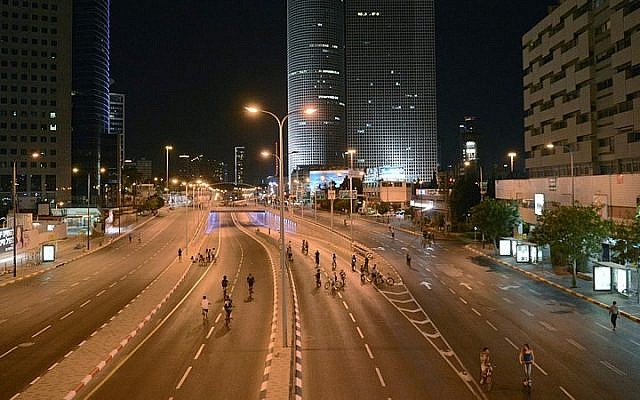
One of the most interesting experiences in my life was visiting Tel Aviv on Yom Kippur. On that day all car traffic is prohibited (also TV stations are offline etc). It was absolutely amazing. Tel Aviv is a city with large roads and usually extremely busy. On that day, cyclists ride over the highway, kids play on the streets. I never felt that directly before how invasive the normal car situation is.

Here's a photo https://static.timesofisrael.com/www/uploads/2015/09/F141003...

Re: Life in the Spanish city that banned cars

#127
post #29

This may be shocking to people with an American upbringing, but cars (especially privately owned ones) just do not make sense going forward. Cities get bigger and denser, and wasting a big % of land on parking spaces, roads, intersections and accepting a horrible air quality (that reduces citizen life spans and health quality) and noise pollution just does not make any sense anymore. Carse are effective in less dense…

I lived for a while in Berlin. Coming back to the U.S. the first thing I noticed were too many billboards and ugly parking lots. Each store has its own parking lot. Largely underused. No nice paths to traverse the bleak endless parking lot landscape. It’s ugly and wasteful. It’s hostile to pedestrians and discourages people from going outside to just wander. Even in relatively walkable communities like the one I live…

Just a side question: Did you also happen to found that you're more likely to going into a store when walk by it compare to drive by? (assuming you can park your car right at the spot and no charge)

Re: Life in the Spanish city that banned cars

#128

This may be shocking to people with an American upbringing, but cars (especially privately owned ones) just do not make sense going forward. Cities get bigger and denser, and wasting a big % of land on parking spaces, roads, intersections and accepting a horrible air quality (that reduces citizen life spans and health quality) and noise pollution just does not make any sense anymore. Carse are effective in less dense…

> cars (especially privately owned ones) just do not make sense going forward

Inside cities that is. One must remember that a lot of the people that move around in a city every day don't live in the city. And for many of them a car is a requirement anyway. For me the car is a sunk cost - I have it for the rare times I need it (I don't need it to go into the city), but buying/maintaining/insuring it is mostly a fixed cost, meaning that the marginal cost of each mile driven is very very small. I wouldn't mind if my city was made car free tomorrow - but I still wouldn't drive any less.

Re: Life in the Spanish city that banned cars

#129

First thing I noticed when moved to SF Bay Area from Europe was “God, Los Gatos would be so beautiful if the main street was a pedestrian area.” Then went actively searching for one and found a little stretch at Santana Row in San Jose, if you can call 30 meters of blocked off street pedestrian area. But even dense populated cities like SF dont have a pedestrian zone. It is one of the rare things I miss quality of li…

I agree. I think that there is a transition point where slow moving cars and people can intermingle. A third option, a hybrid.

Re: Life in the Spanish city that banned cars

#130
post #69

This may be shocking to people with an American upbringing, but cars (especially privately owned ones) just do not make sense going forward. Cities get bigger and denser, and wasting a big % of land on parking spaces, roads, intersections and accepting a horrible air quality (that reduces citizen life spans and health quality) and noise pollution just does not make any sense anymore. Carse are effective in less dense…

privately owned gasoline-guzzlers are an archaic solution to the transportation problem, and they are not effective in today's society For people with a very limited lifestyle restricted to a few city blocks perhaps this is true. But the majority of people do not live that way and have use cases for cars that you have not considered in your analysis. change always requires some sacrifice, By other people, funnily eno…

Most use cases are solvable with bikes, strollers, buses, and perhaps car rentals outside the city limits.
Post reply on HN