Live data from Hacker News

Serverless: Cold Start War

mikhail.io

21–30 of 110 posts

Re: Serverless: Cold Start War

#21
post #10

The whole point of serverless functions is to do work that isn’t necessarily real-time, but of which this is a lot and each unit of work can be completed relatively quickly (say, periodic sync tasks and the like). I really think if the nitty-gritty of cold start behavior is foremost in your mind you’re likely Doing it Wrong(tm).

I like that we're seeing more nuanced evaluations of serverless than the previous hype, but totally agree that there's certain use-cases where serverless shines and cold-start seems negligible in practice.

For example, on the real-time side, busy APIs with functions than execute quickly. If the caller has either a decent timeout + retry configured (or doesn't care), cold start really isn't an issue. User facing web technologies? Serverless has never been that compelling for that given auto-scaling webservers is a pretty solid technique.

But truth be told, not having to deal with servers at all is magical. And if your team is used to it, it does cut down on a lot of worry such as patching stuff. Spectre or Meltdown patches? Ha, zero effort for us.

Re: Serverless: Cold Start War

#22
Two things.

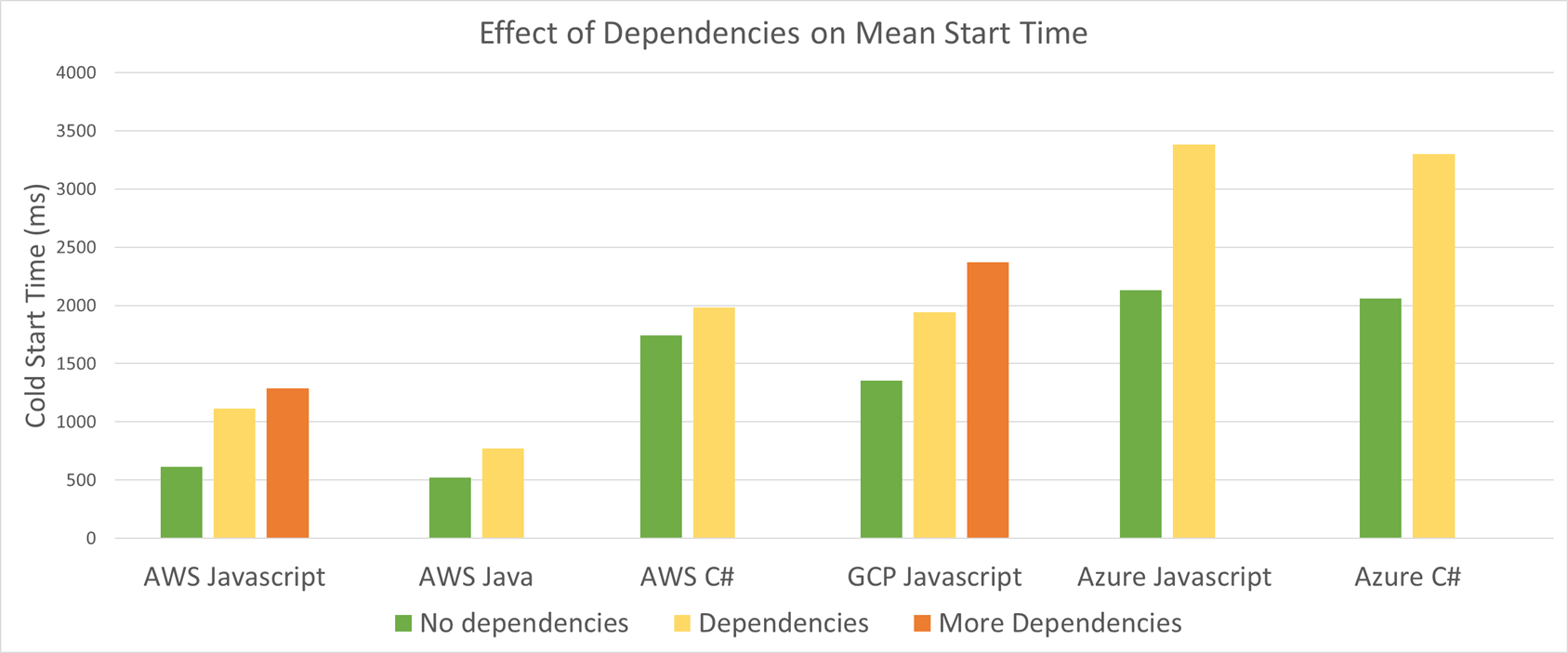
1- It's amazing that Java has the fastest cold start time! Faster than Nodejs.[1] That's exactly the opposite of what I've heard before.

2- I am so tired of hearing about cold start times for dormant apps as if that is the only cold start scenario. It is arguably a worse problem to have cold starts when scaling!

What do I mean by cold starts when scaling? You adopt serverless. Things go great. Your app is never dormant. You're not serverless because you want to shave costs for infrequently unused apps. You're serverless so you have infinite scale and pay by the millisecond and minimal devops and so on. But whenever you have a burst of scale and Lambda needs to spin up more instances... some of your unlucky users are going to hit that cold start. And this hack of keeping an instance warm would do nothing to solve that.

I mean, do they? Do we know? It's possible that AWS warms up instances before throwing traffic at them but.. has anyone looked at this?

[1] https://mikhail.io/2018/08/serverless-cold-start-war//coldst...

Re: Serverless: Cold Start War

#23
post #5

I'm still really puzzled why AWS lambda has golang and Azure functions has Java and python but GCF doesn't have anything but JavaScript. That's a big hole that must be leaving a lot of developers feeling frustrated.

GCP is just very slow at releasing and behind in both features and services as compared to AWS and Azure. The trade-off is that the GA services are usually more consistent, cheaper, faster and easier to use and integrate. GCF is still in beta so it's the worst case, but they recently announced Serverless Containers which will let you run anything insider a docker container on-demand. That'll get around the language b…

GCF is now Generally Available.

And to sign up for serverless containers: https://g.co/serverlesscontainers

(I am a PM on GCP)

Re: Serverless: Cold Start War

#24
I feel as if the whole "warm up the lamba as a pre-step"-thing takes away from the whole benefit of serverless. I wonder if AWS Lambda could be smart enough to anticipate requests based on some historical or daily pattern. Also, I'd be curious to know if it is still cost effective to use lambda with this technique (pre-warming) or to straight up go for a EC2 instance.

Re: Serverless: Cold Start War

#25
post #17
post #10

The whole point of serverless functions is to do work that isn’t necessarily real-time, but of which this is a lot and each unit of work can be completed relatively quickly (say, periodic sync tasks and the like). I really think if the nitty-gritty of cold start behavior is foremost in your mind you’re likely Doing it Wrong(tm).

I`m making a multiplayer game that includes dices using firebase + cloud functions. I must use cloud functions for the game because I can not let the client roll the dices on it`s own and just let it write to firebase, that could be easily cheated. When starting the game, cold starts are very noticeable, but after a few moves, everything feels fine.

Dice. The plural of die is dice. :)

Re: Serverless: Cold Start War

#26
I'm still a bit puzzled by the hype around FaaS. It seems like a useful tool for things where you don't want major queuing under pressure, but you can tolerate human perceptible delays. But it also seems easy to build a big ball of mud deeply tied to the nuances of the chosen FaaS provider. It just seems like most use cases are probably going to be just fine with more conventional horizontal scaling techniques.

But I think I missing something, so I'd love to hear from someone who can paint this picture for me.

Re: Serverless: Cold Start War

#27
Lambda is not useful. It solves a few problems but creates even more new problems.

Some problems include:

- It makes managing multiple environments (e.g. development, staging, production) almost impossible.

- It makes debugging difficult because you can't run the code on your own machine and step through the code. Most projects cannot be tested end-to-end due to environment incompatibilities between different services and front-ends running locally... It's a fact that multiple developers can't share a single development environment because each developer needs to work with their own test data but Lambda doesn't allow this.

- Lambda adds all sorts of unexpected limits on your code; e.g. cold starts, maximum function execution duration and others.

- The lock-in factor is significant; once you're hooked into Lambda and all the surrounding services that it encourages, you cannot leave and you have no bargaining power in terms of hosting costs and your future is entirely dependent on Amazon.

- Other AWS services that you can integrate with Lambda also exacerbate problems related to handling multiple environments and debugging. Services like Elastic Transcoder and S3 are blackboxes and are very hard to debug. If something goes wrong, sometimes the only way to resolve the problem is to contact Amazon support and spend weeks sending messages back and forth to figure out the issue.

- You're contributing to centralization of wealth and power instead of helping small companies and small open source projects. You're helping to turn Amazon into yet another too big to fail company with infinite leverage on the rest of the economy.

- It takes the fun out of coding. As a developer, you no longer feel any ownership or responsibility over the code that you produce, you're just handing over all that code to Amazon. In fact, it might as well belong to Amazon because that's the only company that is able to execute that code. It doesn't help with employee turnover.

The main reasons why Lambda is popular are because Amazon spent a fortune on marketing it and there are a lot of vested interests in the industry who want it to succeed (to drive up Amazon share price).
Re: Serverless: Cold Start War

#29
post #23

Earlier quoted context omitted.

GCP is just very slow at releasing and behind in both features and services as compared to AWS and Azure. The trade-off is that the GA services are usually more consistent, cheaper, faster and easier to use and integrate. GCF is still in beta so it's the worst case, but they recently announced Serverless Containers which will let you run anything insider a docker container on-demand. That'll get around the language b…

GCF is now Generally Available. And to sign up for serverless containers: https://g.co/serverlesscontainers (I am a PM on GCP)

I'm assuming there is a blog post detailing this somewhere, can you share it here?

Re: Serverless: Cold Start War

#30

Lambda is not useful. It solves a few problems but creates even more new problems. Some problems include: - It makes managing multiple environments (e.g. development, staging, production) almost impossible. - It makes debugging difficult because you can't run the code on your own machine and step through the code. Most projects cannot be tested end-to-end due to environment incompatibilities between different service…

Doesn't that mostly apply to all serverless platforms? Serverless is cheap and allows cloud providers to use excess capacity to allow small pieces of software to run, scaling almost infinitely[0]. But it is always vendor lock-in, whether you choose Azure or Amazon. It is a propietary platform but that applies for most of the cloud if you use services that don't exist elsewhere (Azure blobs, Azure Cosmos DB, etc)

[0]: https://www.troyhunt.com/serverless-to-the-max-doing-big-thi...

Post reply on HN