Live data from Hacker News

Can We Survive the Next Financial Crisis?

bloomberg.com

151–160 of 304 posts

Re: Can We Survive the Next Financial Crisis?

#151
post #100

Earlier quoted context omitted.

Most wealthy people borrow significantly even if they have high net worth (think mortgage on multi-million dollar home or investment property). Inflation helps them while they put their assets to work elsewhere. And it helps them far more than it helps some poor person with a few thousand in credit card debt.

But the wealthy have more assets than debt , so they have more losses than gains from inflation. Sure, they may gain $100,000 on their house, but they lose $1 million on their bond portfolio.

It would take a pretty unusual asset allocation to result in the numbers you just threw out there.

Re: Can We Survive the Next Financial Crisis?

#152
post #137

Earlier quoted context omitted.

the idea that you can get sick one time and be financially ruined is still astonishing to me. FWIW I'm not aware of many people who come down with a cold and are financially ruined. The people I know who are in crippling medical debt have, for example, had both kidneys replaced. While I'm not happy they are in those circumstances, it's not hard to picture two replacement kidneys and all the other treatments involved…

Still though (and correct me if I'm wrong), but if you get sick tomorrow with some ailment for which treatment is complex (and therefore expensive) AND you don't have insurance - your options are to find the money or go bankrupt? That's nuts in 2018 in a wealthy democracy.

> Still though (and correct me if I'm wrong), but if you get sick tomorrow with some ailment for which treatment is complex (and therefore expensive) AND you don't have insurance - your options are to find the money or go bankrupt? That's nuts in 2018 in a wealthy democracy.

Treating complex conditions (like cancer) is exactly where the US excels, compared to other countries. Yes, it's expensive, but the alternative is, well, dying.

Since the grandparent mentioned the UK specifically, I'll point out that the US has dramatically higher survival rates for treatable forms of cancer than the UK does. For prostate cancer - generally one of the most treatable forms of cancer, if treated properly - people in the US have over a 90% chance of survival[0]. The UK, on the other hand, has absolutely abysmal surival rates - second-worst of all OECD countries, and a mortality-to-incidence ratio that's almost twice what you see in the US.

Yes, the US could do a better job at making that top-of-the-line care accessible to more people, but even then, the baseline care for complex treatments specifically is actually much higher than what the UK provides.

[0] That's over the entire population, so it's including people who are uninsured and can't afford the most expensive treatments.
Re: Can We Survive the Next Financial Crisis?

#153

Earlier quoted context omitted.

The data doesn't support your conclusion. Almost nobody keeps all their assets in a savings account. What you should be looking at is net worth. https://dqydj.com/net-worth-by-age-calculator-united-states/

I disagree. Net worth is an unstable data point and I always view it as a status symbol more than a realistic means of acquiring cash. For example in a market where nobody is willing (or able) to buy your home, your net worth can be ... well, worthless. In a financial crisis it's even worse. Your "on-demand" cash is what's in your checking or savings account. There's no guarantee you'll be able to tap into your home,…

> For example in a market where nobody is willing (or able) to buy your home, your net worth can be ... well, worthless

No, because if it's true that nobody is willing to buy your home, your home isn't worth the $300,000 you're claiming it is.

There's no single metric that works for all situations, but net worth is the best way to compare financial health between people and across a population in a meaningful way.

Re: Can We Survive the Next Financial Crisis?

#154

Earlier quoted context omitted.

If you have an extreme health care incident, why pay the bill? Sure it would hurt your credit score not to, but if it's between that and tens/hundreds of thousands, I think it is worth it to take the hit for 7 years. I know health care workers who give this 'unofficial' advice to their patients and I've had friends and family members do the same thing - people who had no health insurance but still got health care and…

Would this, for example, for cancer? Refusing to pay your first treatment might make access to subsequent treatments harder.

Is it legal for a doctor to refuse treatments that may cost you your life? I understand that an insurance company may refuse to insure you due to preexisting conditions (or at least they were able to at some point), but I think insurance is different from showing up at a hospital in the midst of a life or death situation.

Re: Can We Survive the Next Financial Crisis?

#155

The definition of "we" and "survive" needs to be established clearly first and I don't think all those fancy graphs and market trends will define them. There's a lot of people that ended up bankrupt, in a bottomless depression, turned to drug abuse or committed suicide because of the last crisis. Wages are still relatively low while prices continue to climb. Many people are working 2-3 jobs and having trouble affordi…

The distance between the average and the median is staggering. This should be why you always should be suspicious when someone uses an average as a good statistic for wealth or income in the US.

I assume you intend "mean" instead of "average".

Mean, median, and mode are all averages and a lot of statistics actually refer to median when they say "average".

Re: Can We Survive the Next Financial Crisis?

#156

Earlier quoted context omitted.

That's true, but also a non-sequitur, since nobody "stole" home equity from anyone. The value of homes went down across the board because of oversupply, and that is a phenomenon that required potential homeowners, financiers, builders, and other entities to tango. It's not something the banks caused to happen on their own, nor something they bear sole and unmitigated responsibility for.

I'd argue you're into red herring land a little yourself with the systemic goings-on. From Joe Sixpack's perspective, he paid his mortgage every month for 20 years, was all set to retire on his home equity, and then poof, the rug got pulled out from under him. It's a bit of a tall ask to say he should've seen that his home was overvalued and planned accordingly when all of Wall St couldn't see it either.

But he can retire. He owns a house. Nothing poofed away. He owns it, and is not getting evicted. He can continue to live in that same house that he has lived in for 20 years.

Re: Can We Survive the Next Financial Crisis?

#157
Yes we will survive the next crisis but we will have to switch to a green crypto based currency. The Zero interest rate policy has made for ownership accounting errors. We will also need to consume less and make use of more recycled goods.

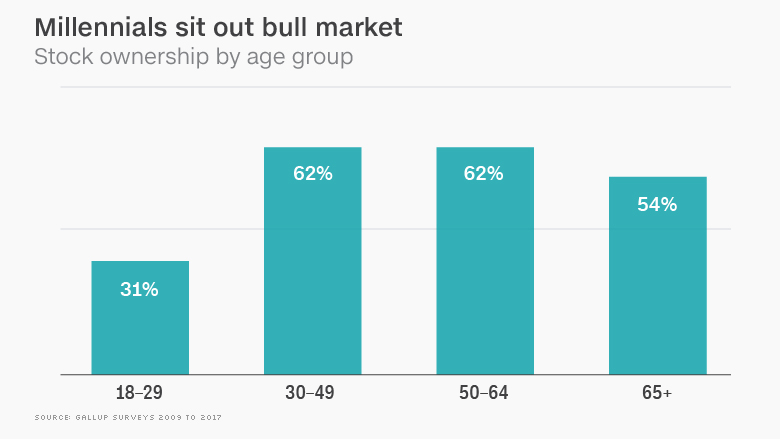
There is a leverage issue where young people are in debt, has less house ownership compared to older people who own lots of the assets houses, stocks and derivatives. https://researchbriefings.parliament.uk/ResearchBriefing/Sum... https://i2.cdn.turner.com/money/dam/assets/170808150752-char...

There is an accounting error in the current market system of tragedy of the commons where pollutions of common assets the polluter does not pay.

Re: Can We Survive the Next Financial Crisis?

#158

Earlier quoted context omitted.

But the wealthy have more assets than debt , so they have more losses than gains from inflation. Sure, they may gain $100,000 on their house, but they lose $1 million on their bond portfolio.

But inflation also implies economic growth which generally raises the value of equity holdings. The impact of inflation is dependent upon asset allocation.

> But inflation also implies economic growth

Inflation does not imply growth in real GDP, no.

> which generally raises the value of equity holdings. The impact of inflation is dependent upon asset allocation.

Ceteris paribus, inflation hurts debtholders (who, incidentally, tend to be wealthy), and it helps debtors (who, incidentally, tend to be poorer).

Re: Can We Survive the Next Financial Crisis?

#159

Earlier quoted context omitted.

Yes that would explain them being rich. But I'm sure you have heard the phrase "Past performance is no guarantee of future results." What I am talking about here is debt. Owe money on your house? Inflation makes you owe less. Lend money to someone buying a house? Inflation means you get paid back less.

It's only "less" if your wages also inflate. But your food and housing prices increase on the leading edge of inflation, and wages lag. And often they never catch up.

> It's only "less" if your wages also inflate. But your food and housing prices increase on the leading edge of inflation, and wages lag. And often they never catch up.

Except that's not true. If you're a debtor, the effects of inflation decreasing your debt in real dollars is orders of magnitude more consequential than the increase in your expenses, and that's even assuming your wages don't increase (which is generally not true either).

Re: Can We Survive the Next Financial Crisis?

#160
post #36

Earlier quoted context omitted.

This is a real misunderstanding of how markets work. An index fund invests in everything, market-cap weighted (usually). This means that your investment merely reinforces the prices already determined by the other participants in the market . There are still huge numbers of active managers, not to mention quants and others. They, collectively, determine the prices of assets. When you invest in an index fund, you're j…

> basically. It doesn't cause amazon to rise in price. Yes, it does - you cannot add capital to a market without raising the market cap. It doesn't cause it to raise higher or faster than it's index peers, but it absolutely does cause it to rise.

It doesn't cause it to rise in price relative to others in the same index.
Post reply on HN