Live data from Hacker News

Generative Art Finds Its Prodigy

artnome.com

41–50 of 112 posts

Re: Generative Art Finds Its Prodigy

#41
I think Naon is very distinctive for his embracement of the importance of human touch & influence in generative art. His choice of color, his adjustment of the shape and form in the work (either intentional or accidental) all produce works that have a human element to them even as they are generated by a Processing script. Automation is a tool and a big element of the work, but the vision of the artist and his creation plays a big part in what the end result looks like.

I've often wondered - and maybe this is an actively explored area of art - what it would look like to attempt to remove all human impact from the process of generative art. A human will write the code, so maybe that's impossible, but how far divorced from the influence of the coder can the resulting work be? Do we just end up at random noise, or is it still possible to make something pleasing without a conscious guiding hand? Distribution-mimicking methods like GANs are very "hands-off" like this in principle, but of course are influenced by the training data. Interested to see how generative art continues to play out in the future.
Re: Generative Art Finds Its Prodigy

#42

I like Manolo Naon's art, and I am quite fond of creative coding, but something that strikes me when seeing this article comparing his works to Kandinsky, Ernst et. al is that his works are always harmonious, a single idea in action, whereas all these classic artists have conflicts and discord in their works. They deliberately avoided doing things that were simply decorative or pleasant. (Probably they were avoiding…

I've experienced what you're talking about as maybe the fundamental challenge in making computer-based art. Computers love to follow rules. Come up with some interesting rules, and they will spit out interesting pictures/music. It's much much harder to figure out how to tell the computer "okay, but break the rule just a little bit, at the appropriate time". Codifying breaking the rules as its own rule is...well, so f…

Maybe there's an opportunity to combine computers and hand-made choices.

Art using a mixture of several generative tools and manual tweaks by the artist on the final result could achieve that goal of "breaking the rules just a little bit", especially if the generative tools are parametrical and easy to customize, maybe with direct manipulation on the generated canvas.

Re: Generative Art Finds Its Prodigy

#43

I like Manolo Naon's art, and I am quite fond of creative coding, but something that strikes me when seeing this article comparing his works to Kandinsky, Ernst et. al is that his works are always harmonious, a single idea in action, whereas all these classic artists have conflicts and discord in their works. They deliberately avoided doing things that were simply decorative or pleasant. (Probably they were avoiding…

I've experienced what you're talking about as maybe the fundamental challenge in making computer-based art. Computers love to follow rules. Come up with some interesting rules, and they will spit out interesting pictures/music. It's much much harder to figure out how to tell the computer "okay, but break the rule just a little bit, at the appropriate time". Codifying breaking the rules as its own rule is...well, so f…

Definitely check this artist out: https://twitter.com/quasimondo/status/1035626920090718209

"If I let the machine decide which images to keep, I must admit that I am probably not ready yet for its sense of aesthetics and originality and my heart bleeds seeing which ones it discarded."

Re: Generative Art Finds Its Prodigy

#44

I like Manolo Naon's art, and I am quite fond of creative coding, but something that strikes me when seeing this article comparing his works to Kandinsky, Ernst et. al is that his works are always harmonious, a single idea in action, whereas all these classic artists have conflicts and discord in their works. They deliberately avoided doing things that were simply decorative or pleasant. (Probably they were avoiding…

I've experienced what you're talking about as maybe the fundamental challenge in making computer-based art. Computers love to follow rules. Come up with some interesting rules, and they will spit out interesting pictures/music. It's much much harder to figure out how to tell the computer "okay, but break the rule just a little bit, at the appropriate time". Codifying breaking the rules as its own rule is...well, so f…

I feel like that's an interesting balance in generative art: I want to make something that is aesthetically pleasing or at least interesting to look at, but I also want to be surprised. If the process is really heavily stochastic, then you'll have to do a lot of manual curation to produce the final work. If it's heavily rules-based, then you might not find anything novel after the first few images.

Re: Generative Art Finds Its Prodigy

#46

I like Manolo Naon's art, and I am quite fond of creative coding, but something that strikes me when seeing this article comparing his works to Kandinsky, Ernst et. al is that his works are always harmonious, a single idea in action, whereas all these classic artists have conflicts and discord in their works. They deliberately avoided doing things that were simply decorative or pleasant. (Probably they were avoiding…

"If works of art were judged democratically--that is, according to how many people like them--kitsch would easily defeat all its competitors" -Thomas Kulka

http://csmt.uchicago.edu/glossary2004/kitsch.htm

Re: Generative Art Finds Its Prodigy

#47
post #29
post #27

Earlier quoted context omitted.

Demoscene demos are nice, but to me they feel more like expressions of technical prowess rather than aesthetic art. I don't think I've ever seen a demo where the result transcends the algorithm, and I don't think that's the goal of the demoscene in any case. They want to showcase how much technical brilliance they can fit in a couple of KB's. That's different from this example, where the goal is more like how much ex…

You're right that many demos simply exist to showcase technical brilliance, but many in the demoscene are starting to trend further towards expressing artistic ability. Some examples off the top of my head: - Number One/Another One by CNCD/FLT: http://www.pouet.net/prod.php?which=77399 - When Silence Dims the Stars Above by Conspiracy: http://www.pouet.net/prod.php?which=75713 - Aurora by Excess: http://www.pouet.net…

Also any ASD demo. They tend to stray away from the general "demo-esthetic" even when it come to the music.

"Lifeforce" was fantastic and really stand out from any other demo, event to this day.

"For your love" use the same kind of particles extravaganza that Fairlight popularized, but really has it's own esthetic.

Re: Generative Art Finds Its Prodigy

#48

This gives me an idea. What it game textures for 3D models were entirely made up of shaders/generative algorithms. The entire game could be rendered with an equation and never have to load assets.

That's how a lot of the demoscene stuff works I'm sure!

https://www.youtube.com/watch?v=jY5Vrc5G0lk

> The secret behind all this is procedural content generation. in a nutshell, instead of storing a movie as-is we're storing a certain number of mathematical formulas for image and audio manipulation as well as the "recipe" how to apply those small bits of code in a way that what you see comes out.

Re: Generative Art Finds Its Prodigy

#49

I like Manolo Naon's art, and I am quite fond of creative coding, but something that strikes me when seeing this article comparing his works to Kandinsky, Ernst et. al is that his works are always harmonious, a single idea in action, whereas all these classic artists have conflicts and discord in their works. They deliberately avoided doing things that were simply decorative or pleasant. (Probably they were avoiding…

I've experienced what you're talking about as maybe the fundamental challenge in making computer-based art. Computers love to follow rules. Come up with some interesting rules, and they will spit out interesting pictures/music. It's much much harder to figure out how to tell the computer "okay, but break the rule just a little bit, at the appropriate time". Codifying breaking the rules as its own rule is...well, so f…

I don't think it's really about computers. These 20th Century artists were deeply involved with systems, rationality, the rise of machines, futurism, the jarring new perceptions that technology was hurling everybody into.

The quaint criticisms people are voicing today about generative art (as if this was new) are the exact same ones everybody was having in the early part of the 20th century.

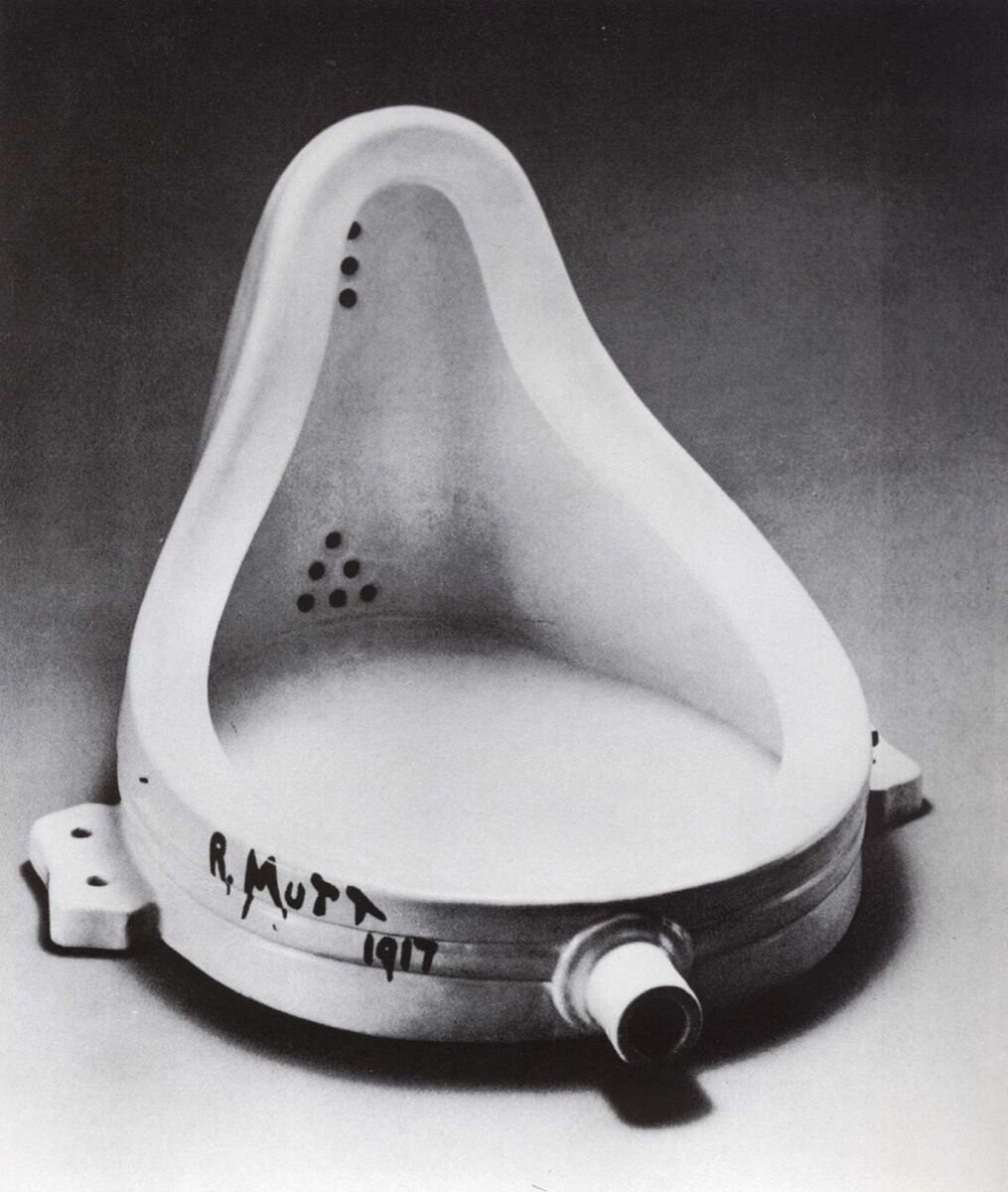
Authorship lol: https://d7hftxdivxxvm.cloudfront.net/?resize_to=width&src=ht...

Post reply on HN