Live data from Hacker News

Where Vim Came From

twobithistory.org

121–130 of 265 posts

Re: Where Vim Came From

#121
post #76

I wouldn't be surprised if a large part of Vim's current popularity stems from EDITOR=vim by default on many distros, despite often having emacs and always including nano. Even over a decade ago when I was in my early teens this seemed pretty common.

To be honest I've seen very few linux machines with emacs preinstalled, nano seems to be part of the ubuntu default install (maybe debian too?) but isn't on any fedora box I have immediate access too (it is available in the repos). This might be because I mainly deal in servers with smaller installs than most desktops.

I would entirely agree that a lot of vims popularity lies in it being part of the default install on pretty much every unix box ever though. That and it actually being a decent editor once you get over that initial insert mode/command mode learning curve.
Re: Where Vim Came From

#123

Though e-lisp is great and I appreciate the power and regularity of Emacs, Vi(m)'s mode-full, default cmd-mode editing that doesn't require ctrl + meta + esc left_foot_pedal + wink-wink-nudge-nudge... seems so much nicer to me than insert-by-default editing - thank goodness there are vim plugins everywhere. The TRS-80 Level II line editor was very much in the spirit of "em", along with other BASICs of the day. And pe…

I'm always kind of curious about comments like this -- it seems everybody knows you have to play games of Twister and hit twelve control keys simultaneously to do even the most basic things in Emacs. But... I use Emacs. I've been using it for almost twenty years. And I'm struggling to think of anything I use regularly the involves hitting more than two total keys simultaneously (keys pressed in sequence obviously don…

I think this is just one of those memes, like Vim being difficult to exit. It's OK for banter but not to be taken seriously.

Vim itself has many corded commands which I find are especially useful in Insert and Ex mode.

As a long time Vim user I know I'll probably never move to another editor like Emacs. That's because of familiarity with Vim and not because of any failing with Emacs shortcuts.

Re: Where Vim Came From

#124
post #79

Earlier quoted context omitted.

Very difficult to do with free software and completely irrelevant really. At some point in your life it's OK to accept that you're the weird one. We're the weird ones. Donald Knuth, Richard Stallman, Guido van Rossum, Rich Hickey et al are the weird ones. I don't know why emacs is such a barrier to everyone else or why vim is so attractive. But I don't understand most other humans about most things.

Vim is attractive to many because it launches in a fraction of a second. This is especially important to sysadmins, who don't "live in a text editor." It's also quite popular to use vim without customization. I understand that some people have simple needs. I don't. The editor wars are over for me and Emacs has won.

Startup time is a non-issue for both Vim and GNU Emacs on modern hardware. (It was not ever so: I remember first meeting Emacs under DOS on a 20MHz 386. It was not speedy.)

Perhaps another underrated issue affecting relative uptake is keyboard layout.

As the OP explained, Berkeley vi was originally developed on an ADM-3A tty, with no arrow keys and the "Esc" key where a modern keyboard would position the "Tab" key.

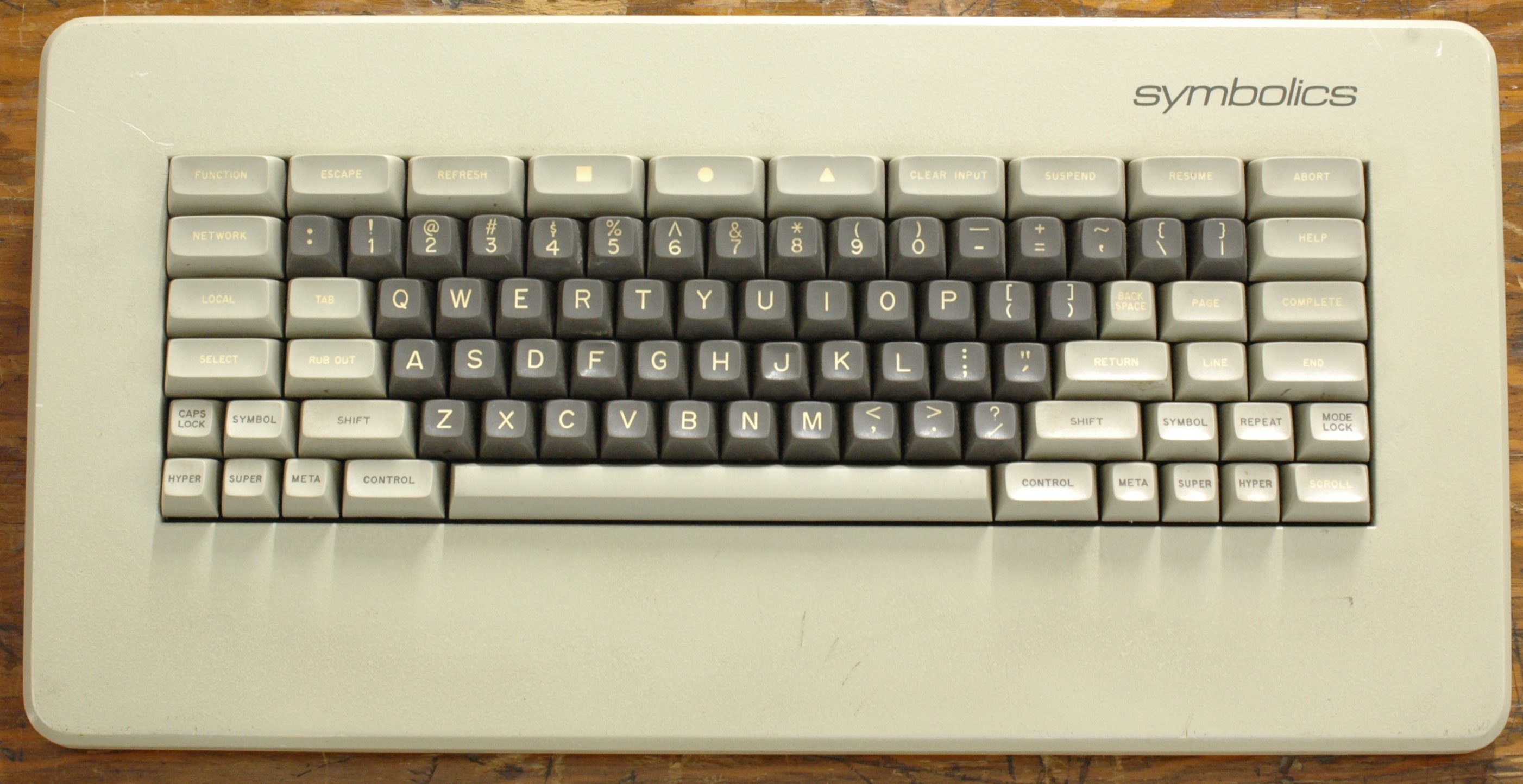
In contrast, Emacs first appeared in anything like its modern form on LISP machines, which had a radically different keyboard layout from a modern PC or Mac — much less austere, lots of modifier keys (not just Ctrl and Alt, but Meta, Super, and Hyper as well!), and an Esc key tucked out of the way at the top left, as is standard today. Here's s photo: https://upload.wikimedia.org/wikipedia/commons/9/9a/Symbolic...

If you consider the ergonomics of typing lots of Ctrl- and Meta- keystrokes on the Symbolics keyboard above, it's fairly clear that it requires a lot less hand stretching to play those chords in the key of Emacs. So it was a cheap design choice for the original Emacs folks to take that route — but every time I've tried to spend serious time in Emacs over the past 30 years on a PC or Mac keyboard, I've ended up with stabbing pains in my wrists within a week (and I will note that back in the 1990s FSF programmers were notorious for always wearing wrist splints).

The basic vi commands can all be executed from the main QWERTY keyboard area, plus the Enter, Ctrl, and Esc keys. If the position of Esc really bugs you, you can rebind it to the Caps Lock key on your keyboard (depending on hardware support, of course). The point is, there's far less chording involved.

So my working hypothesis is that vim is gaining leverage due to selection bias for an editor that hurts the hands less when you use it intensively on an IBM PC-descended keyboard layout rather than a Symbolics keyboard. But "less pain in wrists" is not something we spot easily, so a whole load of post-hoc justifications get invoked to explain the preference.

Re: Where Vim Came From

#125
post #38

> While Emacs certainly still has a following, some people think that the Editor Wars are over and that Vim won.16 The 2018 Stack Overflow Developer Survey suggests that this is true; only 4.1% of respondents used Emacs. I'm an Emacs user for years now and love the editor. But I'm curious about this claim of its poor popularity. The article refers to a piece from http://www.linux-magazine.com/Online/Blogs/Off-the-Bea…

Very difficult to do with free software and completely irrelevant really. At some point in your life it's OK to accept that you're the weird one. We're the weird ones. Donald Knuth, Richard Stallman, Guido van Rossum, Rich Hickey et al are the weird ones. I don't know why emacs is such a barrier to everyone else or why vim is so attractive. But I don't understand most other humans about most things.

Ok let me be very honest here, let's look at both editors learning curves

- vi/vim

You need to learn to open a file, edit it, move around and exit and the edit/view mode. Everybody learns how to do it. At first it sucks but you can learn this in 5 min.

Nothing too hard, and yes, do use the direction keys, it's not the 70s anymore.

From there you can learn other things

- Emacs

You try reading anything about it, there's something about Meta key (and apparently nobody can say what the actual meta key is without some wrangling from them because who knows if you're not coding on a Sun Sparc from the 90s so they don't want to compromise).

Then something about a "prefix command" C-x (what is C? Control? Which other program uses C as an abbreviation for that?) Buffers. What's a buffer?

I tried opening the help of both programs, VIM shows exactly what I mentioned there. Move around, close this window, etc

Emacs? I'll copy-paste here (key bindings help)

> C-x Prefix Command

> \200 .. ÿ encoded-kbd-self-insert-ccl

> C-x 8 iso-transl-ctl-x-8-map

Why the F is this relevant or useful?

Then I try to quit and it's a bit of a wrangle until it gets Ctrl-C Ctrl-X right (or the other way)

Everything seems like it's actively fighting the user, and making it more difficult or convoluted than it should.

Usability problems are never the fault of the user.

Re: Where Vim Came From

#126
post #90

This is a great historical trace / origin story. And now it all makes sense. But I'm a little disappointed. As someone who came to vim from the world of Notepad / Wordpad / WordPerfect / Word, vim, when I finally learned how to be productive in it, seemed so revolutionary and amazing. I sort of was hoping for a story that justified this feeling, like "Bram had a dream one night where alien greys appeared to him and t…

This is, in fact, the story behind Lisp Machines. Unfortunately, humans quickly forgot the lessons from the aliens, and made computing the mess it is today. The history is documented here: http://landoflisp.com/ (scroll down and follow the arrows).

This is really hilarious. I am so glad you showed me that.

The endless scroll section with the arrows. Great! :D and the music video...hypnotic.

Re: Where Vim Came From

#127

Earlier quoted context omitted.

Very difficult to do with free software and completely irrelevant really. At some point in your life it's OK to accept that you're the weird one. We're the weird ones. Donald Knuth, Richard Stallman, Guido van Rossum, Rich Hickey et al are the weird ones. I don't know why emacs is such a barrier to everyone else or why vim is so attractive. But I don't understand most other humans about most things.

Ok let me be very honest here, let's look at both editors learning curves - vi/vim You need to learn to open a file, edit it, move around and exit and the edit/view mode. Everybody learns how to do it. At first it sucks but you can learn this in 5 min. Nothing too hard, and yes, do use the direction keys, it's not the 70s anymore. From there you can learn other things - Emacs You try reading anything about it, there'…

Have you tried exiting vim? :D

Re: Where Vim Came From

#128

> How did Vim become so successful? I recall the early days of RoR crowd were pushing for Vim too. It was hipster in term of adopting new and awesome things and RoR crowd really push some new things. This was when the editors war was still a thing.

In the early days of Ruby on Rails Textmate was the recommended editor. DHH used it in the original blog screen-cast showing off features such as snippets and fuzzy file finding that weren't commonly supported in Vim in 2005/2006

Tim Pope's plugins came later.

Re: Where Vim Came From

#130

Earlier quoted context omitted.

Ok let me be very honest here, let's look at both editors learning curves - vi/vim You need to learn to open a file, edit it, move around and exit and the edit/view mode. Everybody learns how to do it. At first it sucks but you can learn this in 5 min. Nothing too hard, and yes, do use the direction keys, it's not the 70s anymore. From there you can learn other things - Emacs You try reading anything about it, there'…

Have you tried exiting vim? :D

Yes, I press F1 (help) it shows me this:

> Get out of Vim: Use ":qa!" (careful, all changes are lost!)

The joke is not relevant anymore

Post reply on HN