Live data from Hacker News

Ten years left to redesign lithium-ion batteries?

nature.com

71–80 of 261 posts

Re: Ten years left to redesign lithium-ion batteries?

#71
post #42

The problem with Rare Earth is that the West collectively acts like 3 year old who are to dumb to solve incredibly simple problems. Rare earth contained lots of Thorium and that has to be handled as nuclear waste and that means you have 1000s of tons of nuclear waste on your hands. This is of course completely idiotic because Thorium not really a big problem as it is not radioactive. The few Rare Earth mines that do…

Thorium is not much radioactive indeed, but radon it emits is. That's why f.ex. building houses on a granit (that is generally thorium rich) without proper ventilation underneath can result in serious health issues.
Re: Ten years left to redesign lithium-ion batteries?

#72
post #51
post #42

The problem with Rare Earth is that the West collectively acts like 3 year old who are to dumb to solve incredibly simple problems. Rare earth contained lots of Thorium and that has to be handled as nuclear waste and that means you have 1000s of tons of nuclear waste on your hands. This is of course completely idiotic because Thorium not really a big problem as it is not radioactive. The few Rare Earth mines that do…

Thorium is radioactive, just not very much. It's toxic in the way a lot of heavy metals are. https://www.atsdr.cdc.gov/toxprofiles/tp147.pdf

Yeah is radioactive but you can build a bed out of it and sleep on it so its not radioactive in any practical sense.

And of course Toxic is not a problem because most of the metals a rare earth mine would deal with would be toxic.

You can actually find heavily concentrated earth in the US that would basically count as nuclear waste because nuclear policy is so insane.

Re: Ten years left to redesign lithium-ion batteries?

#73
post #42

The problem with Rare Earth is that the West collectively acts like 3 year old who are to dumb to solve incredibly simple problems. Rare earth contained lots of Thorium and that has to be handled as nuclear waste and that means you have 1000s of tons of nuclear waste on your hands. This is of course completely idiotic because Thorium not really a big problem as it is not radioactive. The few Rare Earth mines that do…

Seems possible to me the US may want to deplete others’ mines while saving their mines to become the last ones remaining.

Yeah that is impossible, rare earths are all over the place if you are willing to go to slightly less optimal places you can never run out.

That would be like saying in 1800 that Britain will not use domestic coal because they want to save it.

Re: Ten years left to redesign lithium-ion batteries?

#74
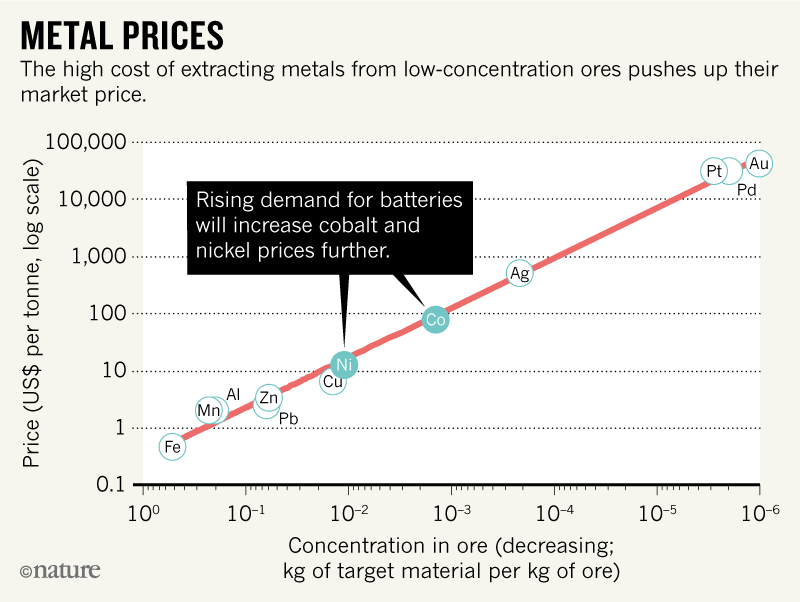
The inclusion of the metal price graph[1] is very strange. What are they trying to tell with that? To me it demonstrates that nickel and cobalt prices are currently right where they should be in the market (considering the concentration), compared to the other metals. So if cobalt prices quadrupled from 22$ to 81$ recently, doesn't it mean that cobalt was highly undervalued before and is now correctly priced?

[1] https://media.nature.com/w800/magazine-assets/d41586-018-057...

Re: Ten years left to redesign lithium-ion batteries?

#75
post #42

The problem with Rare Earth is that the West collectively acts like 3 year old who are to dumb to solve incredibly simple problems. Rare earth contained lots of Thorium and that has to be handled as nuclear waste and that means you have 1000s of tons of nuclear waste on your hands. This is of course completely idiotic because Thorium not really a big problem as it is not radioactive. The few Rare Earth mines that do…

The article is about the availability of cobalt and nickel, which are not rare earth metals.

Same exact thing applies to many of these metals and worrying about cobalt and nickel is really not close to as important as rare earth mines.

You need rare earth for batteries as well, also for many other things in the new electric transport infrastructure.

Re: Ten years left to redesign lithium-ion batteries?

#76
post #12
post #7

Earlier quoted context omitted.

> High prices isn't a signal that we have run out, it is a signal that more mines are needed. It is likely the market will heed the signal. It is a signal that there is a high demand, and not enough supply (whether naturally or artificially -- e.g. diamonds) to meet that demand. That's it. Building more mines can only happen if the resources exist to mine. This idea that "the market" is a magic wand to wave at proble…

>> Building more mines can only happen if the resources exist to mine. The resources do exist to mine. Only a tiny fraction of rare earth minerals are actually being mined, because it's not economical in most places.

The article is not about rare earth metals.

Re: Ten years left to redesign lithium-ion batteries?

#77
post #8

Oh god, another Erlich/Simons bet is needed: what's low is the level of rare earth exploration and exploitation not absolute supply. Is there a supply chain problem? Yes. Are we approaching a mad-max hell war for the last vestiges of humanities wonder mineral? Alas.. no. The ten years meme is based in a false premise. The article even says Australian known sources are only utilised at 14% and yet predicts a long term…

Australia is not utilising only 14% of their resources, they have only 14% of the known world resources. More than 50% is based on Congo were the work is performed in miserable conditions. We are all happy that we still don’t reach peak oil, but if we don’t change the way we think about progress and economic growth, in a world with finite resources will have severe consequences.

Is your comment to say that cobalt should simply be more expensive to compensate for the negative externalities of obtaining it?

Re: Ten years left to redesign lithium-ion batteries?

#78
post #53

Earlier quoted context omitted.

> the environment is not something the market will automatically solve Not quite true. The market can easily solve for it. You just have to internalize the external costs. Usually done through taxes (ie carbon tax).

That's the political employing the market to solve the actual. The market is the policy maker's tool. Take carbon taxes, if implemented incorrectly they may change incentives so harshly on CO2 that industries start creating more methane (a much worse GHG). This isn't "the market solving it" it's policy makers solving it because the tax base is used to fund the studies used to create the regulations necessary to harne…

By that definition the market can never solve anything because there is some overlying system of property rights, government or not.

But any economist worth their salt would never discussed these issues in the simple marketgovernment paradigm because it simply breaks down.

There is lots of research on property rights and institutions, whole sub-fields of economics are devoted to it you are vastly oversimplifying and projecting a idealistic view of government and their intensives.

Re: Ten years left to redesign lithium-ion batteries?

#79

One of the more interesting aspects of modern global warfare is the fact that, should the world decide to stage another world war, pretty much everyone is going to run out of a lot of these strategic resources within a few months to years. This, plus the fact that nuclear warfare is going to be extremely limited due to lack of available weapons, and the virtual impossibility of invading a country you don't share a la…

In reality nuclear warfare is always extremely limited and that is a good thing. Either they can dictate terms or they have a cold war. Look at India and Pakistan- they have long hated and fought with each other but are relatively cordial for two nations with borders disputes because they are both nuclear powers. Even sociopaths and meglomaniacs know nuclear warfare is like having a polonium tipped knife fight in untreated sewage- even if you win you lose.

The lack of supplies is also a good thing to irrelevant - most wars are too quick to involve significant production during combat and the superior equipment takes a lot of to build but are often one vehicle armies compared to the old fast to produce ones given the lopsided casualty ratios. And even if things somehow lasted that long without peace breaking out and it was worth doing resources are still subsitutable even if they are strictly worse otherwise. We can run cars on coal but don't for many reasons. That applies to many of the best options that so overshadow alternatives that almost nobody does it.

Re: Ten years left to redesign lithium-ion batteries?

#80
post #43
post #8

Oh god, another Erlich/Simons bet is needed: what's low is the level of rare earth exploration and exploitation not absolute supply. Is there a supply chain problem? Yes. Are we approaching a mad-max hell war for the last vestiges of humanities wonder mineral? Alas.. no. The ten years meme is based in a false premise. The article even says Australian known sources are only utilised at 14% and yet predicts a long term…

Another point the article missed: although batteries have a lifetime of 15-20 years (which they claim makes recycling infeasible), most people currently replace their cars far more frequently than that. Which means that either the cars will be scrapped and the battery materials recycled (if they really are all that valuable), or the global production of cars per capita will slow as people keep their cars for the life…

Most people replace their new cars within 10 years, but those cars are sold to second owners rather than being scrapped.
Post reply on HN