Live data from Hacker News

Looking Glass – A new type of holographic interface

feld.com

11–20 of 89 posts

Re: Looking Glass – A new type of holographic interface

#11
post #6

"The Looking Glass generates 45 distinct views of a three-dimensional scene" Now that GPUs can reliably generate 60 FPS, this is the next step to push that technology. Because you'll need 45x60FPS for the same quality. And then you'll push the 45 number higher. (yes, I know the 60 isn't visible and has to do with control input).

I'm not sure I get your comment.

In my mind you can render $x pixels at 60fps. So the number of pixels for each distinct view is: $x / 45.
Re: Looking Glass – A new type of holographic interface

#12
post #9
post #7

I wonder if it's a 4k screen generating 45 different views in alternating locations on the screen. Thus your new resolution is like 720x256. From the videos they look higher res than that.

If you were smart you could encode multiple views into a single pixel to get a higher resolution, but then I figure that would limit your colour depth availability.

How would encoding multiple view into a single pixel work with a lenticular display? There needs to be a physical distance between each of the views.

Re: Looking Glass – A new type of holographic interface

#13
post #6

"The Looking Glass generates 45 distinct views of a three-dimensional scene" Now that GPUs can reliably generate 60 FPS, this is the next step to push that technology. Because you'll need 45x60FPS for the same quality. And then you'll push the 45 number higher. (yes, I know the 60 isn't visible and has to do with control input).

Aren't the 45 views bound by the physical lenticular screen?

Re: Looking Glass – A new type of holographic interface

#14
post #11
post #6

"The Looking Glass generates 45 distinct views of a three-dimensional scene" Now that GPUs can reliably generate 60 FPS, this is the next step to push that technology. Because you'll need 45x60FPS for the same quality. And then you'll push the 45 number higher. (yes, I know the 60 isn't visible and has to do with control input).

I'm not sure I get your comment. In my mind you can render $x pixels at 60fps. So the number of pixels for each distinct view is: $x / 45.

I think it's a little more complex than that. In addition to rasterizing a large number of pixels, the entire vertex pipeline has to run 45 times to generate 45 projections of the scene's geometry. You're correct though in that the rest of what happens in a frame (physics, animations & other state updates) do not have to run 45x.

Re: Looking Glass – A new type of holographic interface

#16
post #6

"The Looking Glass generates 45 distinct views of a three-dimensional scene" Now that GPUs can reliably generate 60 FPS, this is the next step to push that technology. Because you'll need 45x60FPS for the same quality. And then you'll push the 45 number higher. (yes, I know the 60 isn't visible and has to do with control input).

45 render angles, but of the same geometry, and at much lower resolution.

Re: Looking Glass – A new type of holographic interface

#17
post #10
post #8

Earlier quoted context omitted.

It's like 2560x1600 interlaced

That leaves even less resolution, in what orientation are they using the lenticular lens then? It must be less than 45 unique views and they smear between them.

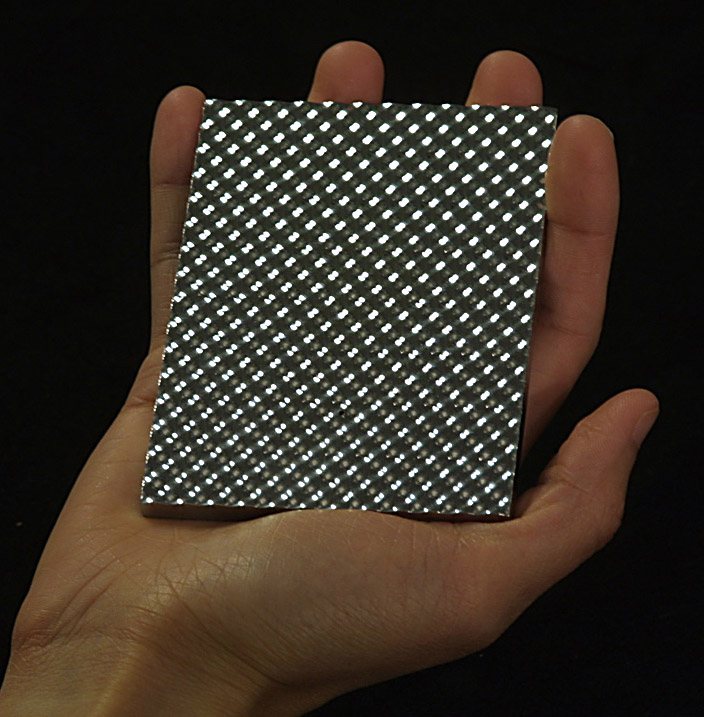
It's a lightfield display, not a lenticular display. Lightfield lens bumps go in two spacial directions:

http://graphics.stanford.edu/projects/lightfield/leslie-hold...

http://real-eyes.eu/wp-content/uploads/2015/05/Technologie_0...

I guess in their case the microlenses aren't even round, since 45 is 5*9. I guess they have 9 horizontal X 5 vertical pixels per microlens.

Re: Looking Glass – A new type of holographic interface

#18
I've wanted to watch a Broadway play in my living room that was indistinguishable from being in the theater for close to thirty years. I'm excited because this is the closest technology that I've seen that could make this possible.

But I'm saddened if this is really the Apple II version of this technology because if it takes another forty years I probably won't live to see it. Always imagined that there would be sensors on the floor and ceiling, not watching it in a glass box but if that's how it has to be I'm OK with it.

Re: Looking Glass – A new type of holographic interface

#19
These lenticular autostereoscopic displays have been around for a long time and never quite took off. There have been even 3D TVs (Philips) using this idea. I am not quite sure what is "new" apart of yet again abusing the "holographic" term (hint, it has zero to do with holograms or holography).

The major issues with these are the limited viewing angles and the enormous bandwidth needed to both render the individual points of view and to actually transfer them to the screen. Heck, a lot of computer games have problems to generate stereoscopic (i.e. 2 images) content at 60 or 90fps required by the VR helmets such as Rift or Vive these days. And these guys want to push 45 distinct images at 60fps?

Good luck with that, especially for that ridiculous price for a tiny screen.

These guys offer a 4k, 50" screen: http://www.ultra-d.com/

Re: Looking Glass – A new type of holographic interface

#20
post #6

"The Looking Glass generates 45 distinct views of a three-dimensional scene" Now that GPUs can reliably generate 60 FPS, this is the next step to push that technology. Because you'll need 45x60FPS for the same quality. And then you'll push the 45 number higher. (yes, I know the 60 isn't visible and has to do with control input).

You’d only render angles from which anyone was looking though? So with a single observer it’s only 2 angles (one per eye) just like VR. This of course assumes perfect tracking of the eyes of any observer
Post reply on HN