Live data from Hacker News

People Aren’t Dumb, the World Is Hard

freakonomics.com

431–440 of 453 posts

Re: People Aren’t Dumb, the World Is Hard

#431

Earlier quoted context omitted.

This is, by the way, a problem I see with a lot of public policy - in a market system, what's good for companies is not necessarily what's good for the system . Steve Eisman puts this well in [1] when talking about why he's investing in bank stocks even though he thinks prospective rollbacks in Dodd-Frank reforms are a bad idea: "There's two issues. There's what I think about the financial system and what I think abo…

I liked the Steve Eisman character from The Big Short, but I was disappointed his prediction bank stocks would do well didn't play out. KBE: 44.49 Jan 30, 2017, 47.82 July 11, 2018 = 7.48% price growth (I couldn't find numbers for total return and too lazy to compute from distribution history) VFAIX: 20123 Jan 30, 2017, 23569 July 11, 2018 = 17.1% total return VFIAX: 22291 Jan 30, 2017, 27729 July 11, 2018 = 24.4% to…

I find that super interesting - especially since they seem to have underperformed the 500 even after the deregulation bill passed in March.
Re: People Aren’t Dumb, the World Is Hard

#432

Earlier quoted context omitted.

I really wish this notion of "society by survival of the fittest" would die its long-overdue death. What actually happens, in the real world, in situations like this, is that people suffer and die. They don't become Ayn Rand's ideal man; there's just lots of needless suffering. And because people are capable of violence, and because people don't like suffering very much, they commit violence against each other to imp…

> What actually happens, in the real world, in situations like this, is that people suffer and die. They don't become Ayn Rand's ideal man; there's just lots of needless suffering. There are many many counterexamples to this. See [Seeing Like a State - Wikiwand]( https://www.wikiwand.com/en/Seeing_Like_a_State ) for many good ones. There's a lot of good evidence that people are in fact capable of taking care of thems…

[deleted]

Re: People Aren’t Dumb, the World Is Hard

#434
post #420

Earlier quoted context omitted.

> Anyway, humans, compared to other animals we compete with for survival, food, and territory, are doing really well. I don't see any cows on the moon yet. Would all this be possible without other mammals? Or is the ecosystem (including mammals) the enabler for us?

Probably yes, but on a longer timeline. Humans don't need other mammals to survive.

Maybe not survival, but would we be anywhere near where we are now without the help of say, cows and horses? Possibly, but maybe not.

Re: People Aren’t Dumb, the World Is Hard

#435
post #358

I think people are dumb, and I'm not being derogatory about 'the 'masses' or any such crap. I'm unbelievably dumb. It often takes me a ridiculously long time to come to a solution to a problem, where the answer seems like it should be obvious. Instead my slow, feeble mammal brain takes forever to grope blindly around the issue before getting any traction. Lets say there is a scale of sentience that goes from 1, which…

I'd say your scale is heavily mis-calibrated and demonstrates nothing more than your personal pessimism. As an alternative:

  A scale of 1-10:
  - 1 is the minimum threshold for civilisation
  - 10 is the most advanced civilisation the universe has ever known
We are a 10.

Unless you know of any other civilisations out there we can measure ourselves against?

Re: People Aren’t Dumb, the World Is Hard

#436
post #153

An interesting bit from the article was that he talks about 'sunk cost' with the defining example of ordering a dessert when you're nearly full and feeling compelled to finish it. > There was an economist once early in my career who said to me, “You know, if you’re right, what am I supposed to do? What I know how to do is solve optimization problems.” A career economist not wanting to change their ways because they h…

My understanding with Kodak is that they invented digital tech far earlier than expected (pre 80s) and hushed it to avoid cannibalizing their existing film business. I suspect Blockbuster behaved similarly. It's hard to kill the golden goose. Still examples of the sunk cost fallacy, for sure, but it feels like "lack of realization" is perhaps the wrong attribution.

I don't think Kodak did hush it, they had some pretty advanced digital cameras early on, they were pioneers. The problem was they were a film company not a camera company, those businesses are so distinct they were never likely to cross from one to the other.

They would have been better ignoring the whole digital camera thing and looking for other opportunities where they could leverage their skills and assets. Or just wound down gracefully.

Re: People Aren’t Dumb, the World Is Hard

#437

Earlier quoted context omitted.

In Finland, as a male, refusal to perform military or civil service is a crime punishable by approximately 6 months of imprisonment. I understand that very recently that has been put on hold as a result of a legal challenge on the grounds that a certain religious minority is exempted from such service, the claim being that this constitutes inequal treatment.

I thought that in Finland you could do other public works (something along the lines of Americorps in the USA) instead of serve in the army if you were a conscientious objector.

Yes, that's the civil service. I was using "conscientous objector" to describe what are called "total objectors" here, men who refuse to serve in any capacity for a variety of reasons.

Re: People Aren’t Dumb, the World Is Hard

#438
post #153

Earlier quoted context omitted.

My understanding with Kodak is that they invented digital tech far earlier than expected (pre 80s) and hushed it to avoid cannibalizing their existing film business. I suspect Blockbuster behaved similarly. It's hard to kill the golden goose. Still examples of the sunk cost fallacy, for sure, but it feels like "lack of realization" is perhaps the wrong attribution.

I don't think Kodak did hush it, they had some pretty advanced digital cameras early on, they were pioneers. The problem was they were a film company not a camera company, those businesses are so distinct they were never likely to cross from one to the other. They would have been better ignoring the whole digital camera thing and looking for other opportunities where they could leverage their skills and assets. Or ju…

Kodak saw what was coming ahead of everyone else (they owned the digital camera field from the mid 1970 onwards), but it did them no good. The problem was there just is not as much money in digital photography compared to chemical photography.

Kodak is a classic example that no amount of foresight will save you when the entire industry changes underneath you.

Re: People Aren’t Dumb, the World Is Hard

#439
post #358

I think people are dumb, and I'm not being derogatory about 'the 'masses' or any such crap. I'm unbelievably dumb. It often takes me a ridiculously long time to come to a solution to a problem, where the answer seems like it should be obvious. Instead my slow, feeble mammal brain takes forever to grope blindly around the issue before getting any traction. Lets say there is a scale of sentience that goes from 1, which…

I'd say your scale is heavily mis-calibrated and demonstrates nothing more than your personal pessimism. As an alternative: A scale of 1-10: - 1 is the minimum threshold for civilisation - 10 is the most advanced civilisation the universe has ever known We are a 10. Unless you know of any other civilisations out there we can measure ourselves against?

Eh, your scale is off. Let's surmise, only in this case, that the universe is sentient, and knows all civilizations. This universe could then judge where we are on the scale of have made.

The issue here is you have conflated humanity with the universe. Simply, we can't know, and it may be unknowable to any civilization where they are on the scale in an absolute measure, only a relative one.

On a relative scale, we are a 10. On an absolute one, we are no where close.

Re: People Aren’t Dumb, the World Is Hard

#440
post #388

Earlier quoted context omitted.

I wish more math teachers would actually understand this. The amount of crap I got for using the "wrong way" to calculate something in math class, was probably one of the major reason I never really got into it. I remember math classes in the beginning actually being fun, I loved figuring out more convenient/to me more logical ways to calculate something, only to be constantly shut down by the teachers for using them…

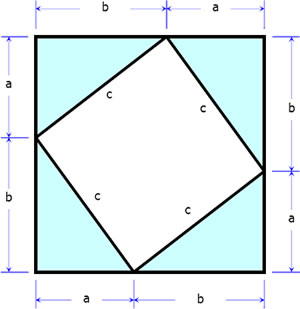
Easiest way of visualising the pythagorean theorem is to think about it the way it was initially written: think about areas formed by tree squares. This image[0] from wikipedia shows it all: the area of square a plus the area of square b equals the area of square c. It's just really convenient that we can use that to calculate triangle sides without resorting to trigonometry. [0] https://upload.wikimedia.org/wikipedi…

I find that that's a terrible way of visualising the theorum, as it offers no indication of why the theorem is true. I much prefer the below picture: https://www.mathalino.com/sites/default/files/images/01-pyth...

It could be improved by putting -(ab/2) inside the triangles, but I'm on mobile, so making something is out of the question.

Post reply on HN